Death the Leveller – Sadhna goes to eternal sleep !

“You’ll stay with me?’
Until the very end,’ said James.” – J.K. Rowling, Harry Potter and the Deathly Hallows

And those who have seen the twin magnum opus ‘Mere Mehboob’ an ‘Arzoo’ would have dreamed that about Sadhna Shivadasni Nayyar – the iconic actress on Hindi Cinema.

May be I’m poorly informed or may be I’ve missed the vision and imagination of a Ghazal Poet but I can’t remember any other Indian Film actress whose hair style was celebrated like Sadhna’s. She was one of the most popular heroines of yesteryear Bolywood, an actress who had reigned for many years, She passed away in Mumbai today, on December 25 after a brief illness. The actress was detected with a tumor and had been battling cancer for a very long time. In December 2014, the lady underwent an emergency surgery for a bleeding oral lesion. Sadhana breathed her last at a Mumbai hospital. She was 74.

sadhana

The beautiful damsel had enthralled masses with her graceful performances in Hindi films in the 60s and 70s. Initially her father had helped her enter films. Her family had migrated from Karachi in 1947. In 1955, at the age of 15, she had played a chorus girl in the song “Mur mur ke na dekh mur mur ke” in Raj Kapoor’s ‘Shree 420’. She was cast her in India’s first Sindhi film titled Abaana (1958), where she played the role of Sheila Ramani’s ‘s younger sister and she was paid a token amount of 1 rupee. She had joined Mukherjee’s acting school along with her debutante co-star Joy Mukherjee.

Her trademark look, called Sadhana cut is said to be inspired from Hollywood actress Audrey Hepburn. However, in one of her interview she revealed that she had a broad forehead and that was a bid odd in the eye of cameras. To hide that minor flaw, her hairdresser had advised her to cover it in order to appear it narrower with a tumbled cascade of trimmed tress – better known as Sadhna Cut or Style. Some say that it was R.K.Nayyar who had suggested the idea. That fringe style was originally sported by the Hollywood actress Audrey Hepburn. The fringe soon became popular and a fashion fad in the 1960s. The style was copied by many girls in India. The Filmalaya Production banner had introduced Joy, Sadhana and her iconic hairstyle in their 1960 romantic film ‘Love in Simla.’ Sadhana had played the role of a simple, bespectacled girl who is transformed by her grandmother into a beautiful woman and encouraged to pursue the hero. During this period she again worked under the same banner opposite Joy in ‘Ek Musafir Ek Haseena.’ In 1961 she played against Dev Anand in ‘Hum Dono.’ It was a super hit.

A famous film journalist describe her beauty in these words: “Her eyes, expressive and captivating, do most of the work, while she balances out her submissiveness with a firm tongue.” In 1963, Sadhna acted in the technicolour film ‘Mere Mehboob’ directed by H.S.Rawail. It was a classical film and still known for the famous scene where Rajendra Kumar encounters her for the first time and sees her eyes through her Burqa at an auditorium of Aligarh Muslim University.

She got her second Filmfare nomination as Best Actress for the role of Meena in Yash Chopra’s directorial saga ‘Waqt’ (1965). She stood out in Bollywood’s first ever ensemble cast by bringing along the fashion of tight chudidar-kurtas.

Sadhana married her ‘Love in Simla’ director Ram Krishna Nayyar on 7 March 1966. Their love had blossomed on the film sets. Her parents opposed it as the difference of age was telling. They were married for nearly thirty years, until his husband’s death in 1995 from asthma. The couple had no children.

Naim Naqvi

Naim Naqvi

Did his graduation in Science discipline from AMU in 1972-73. He was Secretary of University Ali Society in 1970 and M.M. Hall Literary Society in early 70 's and member of Tayyabji Literary Society. Did his Diploma in Bakery Administration from HTT College Oxford Street London in 1987. Worked with National Herald - Delhi, Blitz - Bombay as Trainee Journalist and in Production Department with 'Naya Sansar Pictures' of Khwaja Ahmed Abbas at Bombay in early 70's. Traveled for study and training purposes to Germany, U.K., Switzerland, France, Dubai, Oman, AbuDhabi, Bahrain and Philepines.

More Posts

The unwarranted, brutal and mindless massacre in Nigeria

Moulana Mohammed Ali Johar had once said: “Qatl-e-ay Hussain (AS) asal men marg-e-Yezid haid, Islam zindah hota hai har Karbala ke baad.” Even if I refrain from delving into the past 1400 years and confine myself to recent past only, there are numerous barbaric incidences when the minority Muslim minority Shias, have been systematically massacred with unprecedented brutality in various parts of Muslims world. From the mindless and horrific killing of innocent school boys in Pakistan to latest pogroms of Shia Muslims in Nigeria, we witness the resurrection of the old story of ‘Martyrdom of Karbala.’ The masks and tricks of perpetrators change but the Yezid appears again and again in different form – each time more macabre than before.

boko

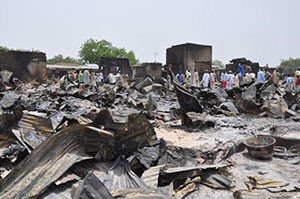
On last Saturday the bloodshed took place in the ancient mud-walled city of Zaria in northern Nigeria in which hundreds of Shias were killed by Nigerian army. The army put up an excuse that followers of Shia scholar Ayatullah Zakzaky allegedly hurled stones at a military convoy carrying the country’s new top general, Tukur Buratai.

Way back in May 2013, I had written an article in the portal ‘Merinews’ about the game of blood- shed played by militant Talibani organization ‘Boko Haram’ of Nigeria and I’m reproducing here a part of it to link it with the present crisis:

“Fedreal Republic of Nigerian is located in West Africa the Nigeria was taken from the Niger river which runs through the country. In the late nineteenth century it was colonized by Britishers. The new rulers followed the old feudal system of traditional chiefs and fiefdoms. It got independence in 1960. Sir Abubakar Tafawa Balewa was the first Prime Minister who was respected widely. Unfortunately, for the country and for the African continent that ebullient politician could not hold the rein of power for long and Nigeria fell to military junta. A civil war followed as the region of Biafra tried to establish independence. Military governments in times of crisis have alternated with democratically elected governments. Nigeria is also known as “the Giant of Africa.” Half of the population of country follows Islam and Muslims are mostly concentrated in north while rest are Christians and Yoruba religion. They mostly live in the South and central parts of the country. Nigerian has large oil reserves and good wealth of minerals. It is fertile and beautiful country with tall and healthy people.”…end of the quote.

Nigeria is a heavily Muslim country, and the overwhelming majority of Nigerian Muslims are Sunni. There were insignificant small pockets of Shia Muslims and by most accounts Shia Islam had little presence in Nigeria until the Islamic Revolution in 1979. The Iranian revolution of 1979 inspired many northern Nigerian Muslims. A Shia priest, Ibrahim Zakzaky who had been trained in Shia theology in Iran aggressively preached the Shia doctrine of Islam in Nigeria and found many followers. The movement that was led by Ayatullah Ibrahim Zakzaky became popular in northern Nigeria since the early ’80s. Its stated mission was to establish an Iran type of Islamic state in Nigeria and the ideology caused consternation in the top echelons of Nigerian government and led to several intermittent skirmishes with government security forces in past.

Ayatullah Zakzaki’s own Zaria-based sect, which is known as the Shia Islamic movement, is believed to account for the majority of Shia Muslims in Nigeria. It is claimed by army that Ayatullah Zakzaky brought “millions” of followers onto the streets and he does command a hardcore of disciples who have allegedly received paramilitary training. He had been thrown in jail in the past also on charges of stirring up violence between Muslims and Christians.

According to Mr. Michael Olufemi Sodipo, the founder of Nigeria’s Peace Initiative Network, the puritanical tendency among [Muslims and Christians] in northern Nigeria gave rise to increasingly zealous political actors. It was alleged that the followers of Ayatullah Zakzaki acquired weapons also but the group had never taken up arms against Nigeria’s secular government.

The non-official observers reported that the latest conflagration developed as a large Shia demonstration, led by the Zakzaky’s Islamic Movement, took place on the Sokoto road, near Zaria, where the Islamic Movement has a large presence. Around this time, Buratai’s convoy was driving through. The military demanded that the demonstrators disperse, and they refused. Some sort of projectile then struck Buratai’s car (reports conflict as to what it was), and the soldiers fired into the air as a warning. When that didn’t work, according to SBM, “the military opened fire to cover their principal, after which they left the location.” The military’s crackdown on the Islamic Movement began shortly afterward. According to SBM, the military saw the incident as an excuse to finally crush the Islamic Movement, which it had long seen as a threat.

Amnesty International said in a statement on Tuesday evening that the shooting of members of the Shia group in Zaria “must be urgently investigated … and anyone found responsible for unlawful killings must be brought to justice”.

“While the final death toll is unclear, there is no doubt of that there has been a substantial loss of life at the hands of the military,” said MK Ibrahim, director of Amnesty International, Nigeria.

“Armed policemen ambushed the procession unprovoked and threw tear gas into the crowd before opening fire, killing four people and injuring 25,” said Ibrahim Musa, a spokesman for the Shia Islamic Movement. “Despite the unwarranted attack, the march forged ahead.” Musa said soldiers on Monday carried away about 200 bodies from around Zakzaky’s home in Zaria, and hundreds more corpses are in the mortuary. The cleric himself also suffered four bullet wounds and is now understood to be in Nigerian military custody.

Human rights activists said hundreds, perhaps as many as 1,000, have been killed. Iran has also complained to Nigeria over an army raid on the headquarters of a militant pro-Iranian cleric in which hundreds of people are now feared to have died. The Iranian President, Hassan Rouhani, has demanded an explanation by the Nigerian government for its crackdown on the Shia Muslim sect led by Ibrahim Zakzaky.

Those concerns appeared to be shared by the US ambassador to Nigeria, James Entwhistle, who also called for an investigation into misconduct by all parties.

The confrontation is yet another security headache for Nigeria’s new president, Muhammadu Buhari, who took power in May promising to improve security in northern Nigeria. Some 10,000 people have died in recent years there in attacks by the Boko Haram Islamist group. But with his security forces already facing stiff challenges in northern Nigeria, Mr Buhari appears to have little time for any group who threatens the rule of law. Nigeria’s military also has a long reputation for human rights abuses, which is often said to have fuelled local support for Boko Haram.

Naim Naqvi

Naim Naqvi

Did his graduation in Science discipline from AMU in 1972-73. He was Secretary of University Ali Society in 1970 and M.M. Hall Literary Society in early 70 's and member of Tayyabji Literary Society. Did his Diploma in Bakery Administration from HTT College Oxford Street London in 1987. Worked with National Herald - Delhi, Blitz - Bombay as Trainee Journalist and in Production Department with 'Naya Sansar Pictures' of Khwaja Ahmed Abbas at Bombay in early 70's. Traveled for study and training purposes to Germany, U.K., Switzerland, France, Dubai, Oman, AbuDhabi, Bahrain and Philepines.

More Posts

ISIS is a creation of Arab Monarchies, West and Israel

And the Bigots strike again. The tenets of religion they follow, according to their understanding, allow them to use violence to communicate their message. So, the committed gunmen and bombers attack restaurants, a concert hall and a sports stadium at locations across Paris. Around 130 innocents are killed and more than double of these numbers are injured.
A few days back, twin suicide attacked in a Shia suburb and killed at least 43 people and injured more than 240. Both were the gory artwork of ISIL Suicide Brigade. The explosions occurred in Ain el Sikkeh, next to the Burj el-Barajneh Palestinian refugee camp which is a well-known commercial and residential area in the capital’s southern suburbs. It is the deadliest such attack to hit Lebanon in over a year. According to a Lebanese security official, the first suicide attacker detonated his explosives outside a Shia mosque, while the second blew himself up inside a nearby bakery. Al-Mayadeen TV reported that there was a third would-be suicide attacker who wore an explosives’ belt. The report said he was killed before he was able to detonate the explosives.
And today, in a Paris city hall four gunmen repeat the same macabre deed and systematically slaughter at least 87 young people at a rock concert at the Bataclan concert hall. Anti-terrorist commandos eventually launched an assault on the building. The gunmen detonated explosive belts. More than 40 more people are killed in five other attacks in the Paris region including an apparent double suicide bombing outside the ‘Stade de France national stadium’, where President of France, Hollande and the German foreign minister were watching a friendly soccer international. Some 200 people were injured. France has declared a national state of emergency and tightened borders.
We listen the same cliché – A terrorist has no religion. Is it not the ripe for all the top priests of all religions to sit together and ask themselves why the unwavering fanatical attachment to religion inspires or commit the terroristic acts? We do we have the burgeoning armies of Hindu terrorists, Islamic terrorists, Christian terrorists, Buddhist terrorists etc??
Religions and terrorism often travel together. Terrorism knows no boundaries. Yesterday it was Lebanon, today it is France. There was hardly any ripple of sorrow or condemnation in the world eyes when the Lebanese mourned the death of their innocents. Today, the deaths in France will be mourned more because France is a world power and the racist Eurocentric media dominate the news and opinions. The cruelty was not different in both places. Thoughts of Islamophobia aside, while the happening in France is intensely tragic, we must remember that ISIS is a creation of combined efforts of several Islamic nations and their Western Masters backed by the strategists of Israel who wanted to get rid of Bashar Asad of Syria. They really want to subdue and square up with Iran. Only a few months passed by, these killers of ISIS were termed as Jihadists by West.
The West was doing little to tame ISIS till the President Putin of Russia entered the crisis with determination and decision. The Russian bombing in Syria transformed the civil war there. It had compelled the West to show the concrete efforts to tame the specter of ISIS. Today, Russia is but at the centre stage. It ensures that the Syrian war will be brought to an earlier end. Russian military support for the Syrian government forces means that Asad is not likely to lose militarily and ISIS is not likely to win.

Naim Naqvi

Naim Naqvi

Did his graduation in Science discipline from AMU in 1972-73. He was Secretary of University Ali Society in 1970 and M.M. Hall Literary Society in early 70 's and member of Tayyabji Literary Society. Did his Diploma in Bakery Administration from HTT College Oxford Street London in 1987. Worked with National Herald - Delhi, Blitz - Bombay as Trainee Journalist and in Production Department with 'Naya Sansar Pictures' of Khwaja Ahmed Abbas at Bombay in early 70's. Traveled for study and training purposes to Germany, U.K., Switzerland, France, Dubai, Oman, AbuDhabi, Bahrain and Philepines.

More Posts

Muharram in Amroha (INTRO)

The city of Amroha has 52 Imambaras, excluding the one exclusive for the female folks. On commencement of Dhū al-Ḥijjah month, the preparations for Muharram start ―the painting of the Imambaras.

On the sight of the Muharram moon, whole city echoes with the sound of Naubat (triangular shaped drums), playing the tunes of the famous Marsiyas (lament), or Nauha (litany). By the evening of the Chand Raat (night when the new moon sighted) all the Imambaras are decorated with expensive chandlers, the Taboot (symbol of the Death body), Alams (flags), etc.

This all starts the series of Majaalis (religious congregation) which becomes the daily routine of the inhabitants and the visitors from outside for the next 12 days, but it is only the Imambara of Chand Suraj where the Majaalis are conducted for Two months and Eight day, daily.

1st and 2nd Muharram are the days when the people are busy in the Majaalis. It is the 3rd Muharram when the processions start and follow the route of 16.5 Km.

3rd Muharram: The procession starts from the Imambara of Walia. This procession is 155 years old. The procession consists of the Camels in the beginning, then the Araaish (tableau) after which is the Hussaini Band, the Alams, Taboot, Zuljina (Horse depicting the Horse of Imam Hussain) and following this are the people reciting the Duara (Hussain! Hussain!).

4th Muharram: Procession of the day commences from the Imambara Hurmat Shah. The system and the route of the procession are same. The age of this procession is around 148 years.

5th Muharram: This is the procession known as the Saqqo Ka Juloos. This procession is 159 years old.

6th Muharram: This procession started by Musammaat Nuran about 201 years ago.

7th Muharram: This procession starts from the Imambara Katra Ghulam Ali. The Araaish of this procession is different from the other processions.

8th Muharram: This is the last procession of Muharram covering the route of 16.5 Km, and starts from the Imambara Chand Suraj. This is the oldest procession of Amroha, aging about 478 years. This procession was started by Shah Miskeen, who came from Iran. The permission for the first procession was given to Shah Miskeen against decapitation. This procession also consists of Zanjeer Ka Matam (self-flagellation).

9th Muharram: From Mohalla of Darbar-E-Kalan a procession of Nishan similar to Alams (but colourful) is started in the second half of the day unlike the procession from 3 to 8 Muharram which starts in the morning at 9:00 am and ends in the evening covering the route of 16.5 Km. This procession of Nishan has a route of 2 Km, which ends in the Imambara Dost Ali Sahib in mohalla Katkoi. The people recite Munajaats (solemn supplication) and do Matam (lamentation with breast-beating). In the night of this day, the people visit every Imambara to pay homage to the Imam (Imam Hussain A.S.) as in the morning the Taboot and the Alams are to be removed as the 10 days of Muharram are over.

10th Muharram: The morning of this day is with the farewell Majaalis and then the Turbatay (depicting the death bodies of the worriers of Karbala) are taken to the Karbala and buried. After midday, the Tazia procession is started and the people from the mohallas, which do not have processions, carry Tazia. When the night falls, and it is dark the last farewell Majaalis–Sham-E-Ghariban–commenced, which is congregated in dark Imambara.

From Karbala – A road to Damascus

Before you travel to Karbala of near 1400 years, let us have a glimpse of present state of Arabian peninsula.
Everyone knows what kind of destruction the House of Al Sauds had wreaked at the cemeteries of Jannat-ul-Baqi and Jannat-ul Maala in the Holy Land where most of the descendents and family members of Prophet of Islam (PBUH) are buried. And now read what has happened in Syria and Iraq:

A blogger, Zain Gardezi, describes about Syria.

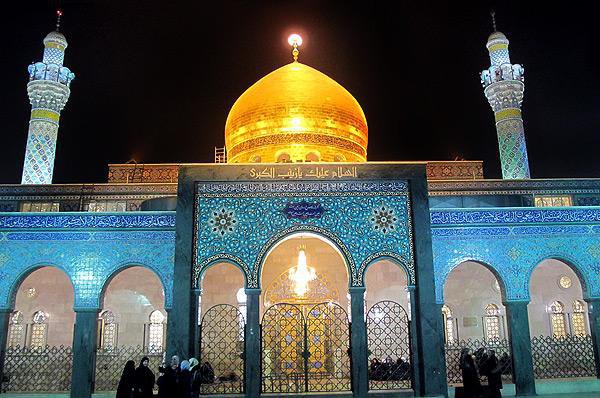
Shrine of Hazrat Bibi Zainab (s.a.) in Dimashq Syria.

Shrine of Hazrat Bibi Zainab (s.a.) in Dimashq Syria.

“That was back in 2008, when I had first visited Syria and fell in love with the country. I loved everything about it; the people, the cultural diversity and above all the sacred shrines that invoked the deepest spiritual awareness of God inside one’s soul. Of course, my view of Syria was limited to the areas I had lived in and visited; those mainly being Damascus and the small city near the outskirts of Damascus where the shrine of Bibi Zainab (AS) is located.

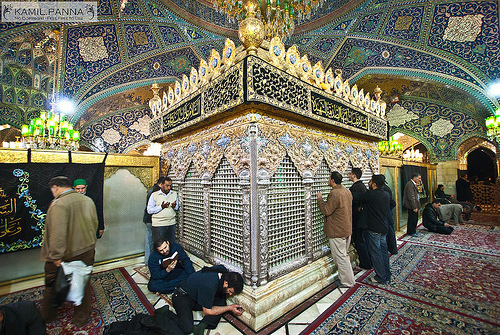
Shrine of Hazrat Bibi Sakeena (s.a.) in Dimashq Syria.

Shrine of Hazrat Bibi Sakeena (s.a.) in Dimashq Syria.

In old Damascus, I visited the historic route leading from old souk, or market, to the Umayyad Mosque, close to which the court of Yazid was originally located. Half a kilometre away was the shrine of Ruqayya Bint al Hussain (AS), commonly known as Bibi Sakina (AS), the four-year-old daughter of Hazrat Imam Hussain, who had died in imprisonment and buried therein.

If anyone had told me back then that in three years time a violent struggle against the regime would start and sacred places would be attacked, I would have laughed at their utter naiveté and told them that it was impossible. But it happened nonetheless and not only was Bibi Zainab’s (AS) shrine attacked, the shrine of one of Hujr Bin Adi(RA), a close companion of the Holy Prophet (pbuh) was also attacked by rebels. They took complete control of Hujr Bin Adi’s (RA) shrine, destroyed the mausoleum including the grave within and allegedly exhumed the body”…..End of quote from the blog of Zain Gardezi.
The hate that began against the Family of Prophet (PBUH) still continues unabated. By the night of Aashoor “Our beloved Imam (AS) put out a singular candle of light but lo, in the aftermath, seventy two lamps got flared up, the ‘blackout’ was caught off its guard – wondering what’s inflamed and what’s silenced.”

“Bujhaya ek ‘diya’ Sheh ne, bahattar ho gaye roshan,
‘Andhera’ khud pareshan hai, jalaa kiya tha, bujha kiya hai !”

That is the story in nutshell of ‘Karb-o-Bala’ that we narrate it to our audiences every year. It is a greatest story of sacrifice in the history of mankind. It is the legacy of forbearance, fortitude and endurance – the height of grit and determination. It is the best example of patience, perseverance, dedication and devotion; it is the worst of story of brutality, savagery, cruelty, ferocity, barbarity, cold-bloodedness and inhumanity. It is the tragedy of Islam; it is the misfortune of Humanity.

The story of the Martyrdom of Imam Hussain (AS), his family and friends could be traced back to the moment when the Prophet Mohammad (PBUH) took his last breath and the issue of succession flared up. But it is not the subject of this tribute.
Islam entered its crucial phase when the Governor of Damascus rebelled against the Khilafat-e- Rasheda and refused to accept Imam Ali (AS) as the Khalifa of all Muslims. The Governor of Damascus declared the areas of his influence as independent and not under the sovereign rule of 4 th Khalif of Islam. Many wars were fought and finally Imam Ali (AS) was martyred in the Kufa mosque. After his martyrdom, the Muslims unanimously elected Imam Hasan (AS) as the 5 th Khalifa (Ruler of Muslims). A conspiracy was hatched and Imam Hasan (AS) was poisoned to death. Yazid-bin-Muaviah – the son of Hakim-e-Sham (Governor of Syria) was nominated as his successor. Yezid was declared the next king and that cataclysmic event brought the paradigm shift in the object and conduct of the Islamic Constitution that was followed during the first three Caliphates. It was this change and the catastrophe to which the Islamic State was reshaped from Caliphate to Mulukiyat – the Monarchy. Unfortunately many of the ‘Companions’ who were still alive and ‘Companions and Companions of the Prophet of Islam (PBUH) witnessed this transformation but kept the stiff upper lip out of fear or conviction. Imam-e-Mazloom foresaw the dangers looming ahead and resolved to stake his life to prevent the imminent doom.

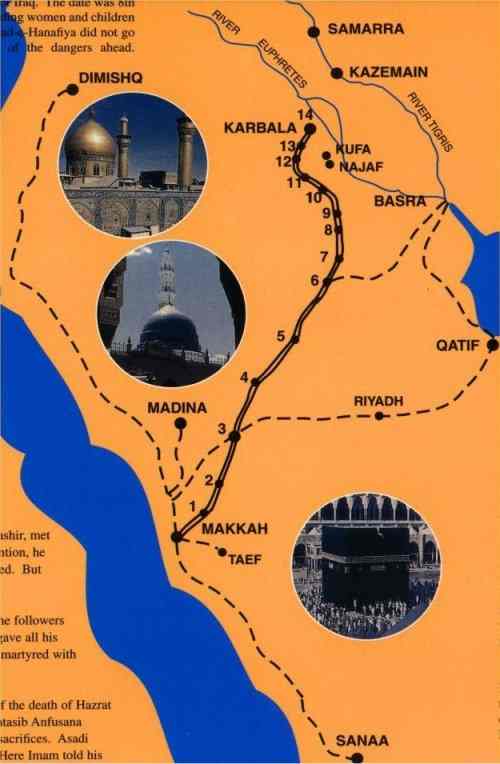
After ascending the throne Yezid demanded allegiance from Imam Hussain (AS), the grandson of the Prophet Muhammad (PBUH) which he flatly refused. The people of Kufa (the capitol of Iraq) invited Imam Hussain to come to Kufa to seek his guidance. Imam set out to Kufa at their invitation. It was a mission of peace. No one maptakes his family, relatives, small children and friends in a pursuit of war. It was much easier for Imam to have rebelled in Medina itself and declare himself as the caliph irrespective of consequences. A war was forced upon him, when the army of Yazid stopped him at Karbala. Imam never asked for trouble. He made an offer of peace to the Commander of Yezid and asked to be allowed to return to Medina or taken to Yezid for a direct one to one talk or be sent to a Muslim land (preferably to India).

The commander of Yezid army, under the instructions of Abdullah bin Ziyad, the Governor of Iraq did not accept any of those proposals but finally his conscience forced him to realize his mistake and Hur, the commander, defected to the side of Imam Hussain (AS) just before the starting of war.

For ten days Imam Hussain and his caravan camped at Karbala. The army of Yezid encircled the camp. The hostile forces of Yezid deprived food and water to them. On the tenth day, Shamir, a trustee of Yezid, ordered to seek the allegiance of Imam Hussain by force. No alternate was given to Imam except to kill him.

A brief battle ensued and all male members of Imam Hussain’s family and close associates were martyred. He was last to be killed and beheaded. Their bodies were run over by horses or desecrated and then left to decompose. Seventy-two heads were taken of Kufa at the tip of spears and presented to the court of Ibn Ziyad, then across the desert to Damascus to face Yazid. The prisoners of war were mostly women and children and one man in his twenties Hazrat Imam Zainul Abedin, the 4 rth Imam who was very sick and couldn’t take part in battle was spared.

Every year, in the month of Muharram, the Muslims all over the world, in their own traditional way observe the mourning of Imam Hussain’s martyrdom. Now, the pertinent question is – what is so unique about the tragedy of Karbala that even though more than1300 years have elapsed the grief is afresh? What value would this mere personal love and devotion hold in the service of Islam? The answer is simple and straight – sacrifices of Karbala bear witness that Imam had held the objective of Islam dearer than his own self.
As one Islamic scholar had pointed out – “The best lesson that we learn from the tragedy of Karbala is that Islam is not a religion of compromises. Living with peace with forces of oppression is wrong. If Imam Hussain had pledged allegiance to a tyrant ruler, he could have saved his neck, and would have most likely given a high post by the Yezid who would have allowed him to do his prayer, fasting, and other ritual acts of worship. But he was the grandson of a Prophet who said, “One of the greatest jihad is to stand up to a tyrant ruler, and say a word of truth. ” Imam Hussain, in one of his speeches on the way to Karbala said,” To live with an oppressor is a crime in itself.”

The second lesson is the concept that our body and life belong to our Creator, and should be spent on His cause. “And if you are slain or die in the cause of Allah, Forgiveness and Mercy from Allah are far better than they could amass, and it you die or are slain, lo it is unto Allah that you are brought together”. (3:157-158). There is a great reward for martyrdom. A martyr is next to Prophets in heaven.

“Those who leave their homes in the cause of Allah and are then slain or die, on them Allah will bestow good provision. Truly Allah is He who bestows the best provision.” (2:58-59)

The Holy Book Quran tells us that Martyrs are not dead.

“And do not call those who die in the way of Allah as “Dead”, no they are living, only you do not see them. (2:154)

The Sacrifices Karbala proved forever the illegitimacy of transformation of benign and just rule of Islam into Kingdom and Monarchy. As Moulana Mohammed Ali Johar has said:

“Qatl-e-Hussain asal men marg-e-Yezid hai; Islam zinda hota hai har Karbala ke baad.”

In the Murder of Hussain, In deed is the death of Yazid.Each Karbala revives Islam. Martyrdom of karbala is the death of Yazid’s and his followers ideology.

What was the objective of Imam Hussain (AS)? Did the Imam stake his life to vindicate his hereditary claim as a ruler? Can anyone who knows the high moral standard of Imam Hussain’s household harbor the vile notion that they would cause bloodshed among the Muslims to gain political power? The fact is that the Imam’s keen eye was discerning the symptoms of decay and corruption in the system of Muslim society and the Islamic state as a materialistic person like Yezid had captured the throne and became in-charge of Islamic affairs. Imam felt impelled to resist these forces – even if it required treading a path of war which he not only considered to be legitimate but obligatory as well.

The character of Yezid presented the worst picture of Islam to the world. The acquiescence of Muslims in general and the acceptance thereof of his authority were going to destroy the mission of the Prophet of Islam (PBUH). Yazid’s nomination as successor marked the second phase of the reign in which the concept of God’s sovereignty was reduced to mere deception. In the new kingdom of Islam, the sovereignty was vested in the monarch and his family, and he was the undisputed master of the life, property, honor and every tangible and intangible entity of his subjects. The Divine Law was not applied to the King, his family, the nobles and the officials. They were all exempted from it. The objective of the state was only indulging in the possession of lands, self-aggrandizement, the collection of tribute and the gratification of sensual desires. The monarch, their nobles and their officials were instrumental in propagating vice than virtue. The policy of the rulers, officers and their subordinates had continuously led the Muslim society to moral degradation. The path of monarchy was embellished with the pomp and pageantry of Caesar. Oppression and injustice overruled justice. Instead of righteousness, profligacy and luxury had come into vogue. The failure to distinguish between the lawfulness and unlawfulness of affairs, rendered in a lack of character and actions of the ruler. Politics was no longer cogent with morality. The rulers kept their subjects under fear instead of instilling the fear of God.

With the beginning of monarchy in Islam, the voice of conscience was stifled and freedom of expression of opinion was denied.
These were the changes that appeared in the wake of converting the Caliphate into a Monarchy. This is the reason why Imam Hussain decided to stem the tide of the evil forces. He took the risk of confrontation by rising in revolt against an established government. The consequences are known to everyone.
The legacy of Karabala is, once again that a believer should not hesitate to sacrifice all that he possesses to safeguard the principles of Islam – laid down by Prophet of Islam (PBUH). Imam Hussain (AS) preferred the crown of martyrdom over the crown of this materialistic world.

Naim Naqvi

Naim Naqvi

Did his graduation in Science discipline from AMU in 1972-73. He was Secretary of University Ali Society in 1970 and M.M. Hall Literary Society in early 70 's and member of Tayyabji Literary Society. Did his Diploma in Bakery Administration from HTT College Oxford Street London in 1987. Worked with National Herald - Delhi, Blitz - Bombay as Trainee Journalist and in Production Department with 'Naya Sansar Pictures' of Khwaja Ahmed Abbas at Bombay in early 70's. Traveled for study and training purposes to Germany, U.K., Switzerland, France, Dubai, Oman, AbuDhabi, Bahrain and Philepines.

More Posts

Are we not wearing thin the most respectable TITLES of clergy ?

Of late years an abundant shower of reputed Islamic titles is falling over the Indian subcontinent where several priests have begun to add them with their names without any solid background to qualify for these honorific designations.

Especially, the two of them that have been offensively consumed by shia clergy are Ayatullah and Hujjatul Islam and the author feels it necessary to share his thoughts about the subtle misuse of these prestigious holy subriquites.

Ayatullah means “Sign of Allah”. It is a high-ranking title given to Ithna Aasharee Twelver Shiah clerics. Those who carry the title are experts in Islamic Studies such as Islamic Jurisprudence, ethics, and philosophy.
The name “ayatollah” originates from a passage in the Quran which the Shia interpret to mean human beings can be regarded as ‘signs’ or ‘evidence’ of God. Passage 51:20–21 of the Quran states: On the earth are signs (Ayat) for those of assured Faith.

The Sunni Muslims do not give credence to this interpretation.

For the readers of this article, it might sound strange that there are a few women who are equal in ranking to the ayatollahs, and are known as Lady Mujtahideh. The most outstanding in recent history was Nosrat Amin, also known as Banu Isfahani. Current examples of the Lady Mujtahidehs are Zohreh Sefati and Lady Ayatollah Aatieh Hassani also known as Imam’ah Al-Hassani daughter of Grand Ayatollah Gholamreza Hassani.

Grand Ayatollah and Marja – Only a few of the most important ayatollahs are accorded the rank of Grand Ayatollah (Ayatollah Uzma, “Great Sign of God”). This usually happens when the followers of one of the ayatollahs refer to him in many situations and ask him to publish his Juristic book in which he answers the vast majority of daily Muslim affairs. The book is called “Resalah” which is usually a reinvention of the book Al-Urwatu l-Wuthqah, according to their knowledge of the most authentic Islamic sources and their application to current life.

It requires decades of serious learning and hardships to reach to the position of Ayatollah. There are seminaries in Iraq, Iran and Syria where the Shia Knowledge Seekers and students are taught, patronised and polished.

RITUALS, RHETORIC and dramatisations are the salient characteristics of the mighty rulers.

The ‘Ayatollahs’ employ none of them. They don’t visit world capitals; they welcome no salutations and no ‘guards of honour’ and sit on the ordinary tattered mat that you can find in the poorest house holds. However, when Ayatollah Khomeni gives a clarion call of rebellion, the crown and scepter of mighty Arya Meher Shanshah Raza Pehelvi go to dust. When Ayatollah Sheestani speaks from his hovel in Iraq, his every word is analysed with utmost care in the most powerful capitals of the world. What makes these Ayatollahs so powerful?

We can’t understand this enigma without an understanding of the theological principles of SHIA religion. According to Ithna Ashri (believers in 12 Imams) Shia belief, whoever dies without following an Imam (Religious Jurist) dies in ignorance. Living Imam is not visible and God has put him beyond the visual reach of ordinary human being. He guides through his ‘spiritual agents’ and ‘Ayatollahs’ are those revered agents or representatives. It requires decades of serious learning and hardships to reach to the position of Ayatollah. There are seminaries in Iraq, Iran and recently in Syria also where the Shia Knowledge Seekers and students are attracted, taught, patronised and polished to begin their upward journey towards religious perfection as guides. These seminaries are known as ‘Hawazat Ilmiyyah’ where Islamic Jurisprudence, Quranic Explications, Philosophy, Sufism, History, Mathematics and Islamic Sciences are taught. These seminaries are headed by Ayatollahs. No formal degrees, certificates or licenses are awarded to students. Emphasis is laid in developing the student’s research skills and mental capacities on increasing the cultural, juridical and philosophical information. An attitude in inculcated for scientific and political approach. These seminaries are located in Najaf, Samaraa, Baghdad and Karbala in Iraq, and in Qum and Mashad in Iran.
After few years of learning if the Ayatollah feels a student fit as beginner he is called the Molvi, Moulana or Mulla.

Maturing after the first rank, he goes the higher stage of learning and it is known as ‘Ijtihad’ and he become as ‘Mujtahid’. Next position is ‘Hujjat Al-Islam’. Then he climbs to the pedestal of ‘Hujjat Al-Islam wa Muslimeen’. As the learning proceeds he becomes an ‘Authoritative Source’ or ‘Ayatollah’. There after he is last authority of Shias – The Grand Ayatollah or ‘Ayatollah al Uzma’.

The financial support for these seminaries comes from every Shia household who can afford and from every country where he resides. It is the most powerful institution of Shia Jurisprudence. The nominated sources or ‘Nayabs’ of these Ayatollahs are present in every country where there is a reasonable population of Shias exists. They collect Zakah, the obligatory charity and ‘Khums’ which is a fifth of total saving of the year. They do distribute that money in their own country also for the welfare of their people. According to Shia doctrine ‘Khums’ is mentioned in Quran and allocated to Prophet during his life time and to his kith and kin after him.
According to Sunni Doctrine, the right of a fifth of saving was only related to spoils of war and lost effect by the Prophet’s death.

The money collected as KHUMS had always been the prominent source of strength of Shia Clergy. It makes Shia priest richer by degrees and independent of any ruler who could interfere in religious affairs. In all matters to religion the decree of Ayatollah al Uzma runs supreme. It is the base of the ‘Theory of Clerical Rule’ or ‘Guardianship of the Jurist’. This Guardianship implies that every public act of Islamic government require a pre-permission or approval of Ayatollah before being done. State derives its legitimacy from being under the ‘Supervision’ of Jurist Guardian – the Ayatollah al Uzma.

Note: It is not a judgmental article and should be considered for its informative value only.

Naim Naqvi

Naim Naqvi

Did his graduation in Science discipline from AMU in 1972-73. He was Secretary of University Ali Society in 1970 and M.M. Hall Literary Society in early 70 's and member of Tayyabji Literary Society. Did his Diploma in Bakery Administration from HTT College Oxford Street London in 1987. Worked with National Herald - Delhi, Blitz - Bombay as Trainee Journalist and in Production Department with 'Naya Sansar Pictures' of Khwaja Ahmed Abbas at Bombay in early 70's. Traveled for study and training purposes to Germany, U.K., Switzerland, France, Dubai, Oman, AbuDhabi, Bahrain and Philepines.

More Posts

Dr APJ Abdul Kalam – A Jewel in the Crown of ‘Mother India”

“Hazaron saal Nargis apni be noori pa roti hai, badi mushkil se hota hai chaman men deeda war paida”
Avul Pakir Jainulabdeen “A. P. J.” Abdul Kalam , the 11th President of India from 2002 to 2007, a career scientist turned reluctant politician, one of India’s most eminent scientist and a people’s President passed away yesterday after collapsing during a lecture at the Indian Institute of Management in Shillong. The late President was born and raised in Rameswaram, Tamil Nadu and studied physics and aerospace engineering. He had the unique honor of receiving honorary doctorates from 30 universities and institutions.
He has also been awarded the civilian awards – Padma Bhushan (1981) and Padma Vibhushan (1990) and the highest civilian award Bharat Ratna (1997). Dr. Kalam had lead the ISRO’s ( Indian Space Research Organization) satellite launch program and headed the country’s guided missile program for many years. He was the scientific advisor to the Defence Minister from July 1992 to December 1999. DR. APJ Abdul Kalam was the guiding spirit behind the “weaponisation of strategic missile systems and the Pokhran-II nuclear tests in collaboration with Department of Atomic Energy”. He was the brain behind India’s missile program – Agni and Prithvi. One of his pet themes was PURA – or the Provision of Urban Amenities in Rural Areas – a theme he referred to often in his travels abroad.
It won’t be an exaggeration to say that a great tree has fallen, and the crash has for the moment silenced all the sounds of the forest. Talks of Wars and controversies at home are hushed for the moment. All men, of all schools of opinion, creeds, and parties, see now, in the calm face of the dead, ‘the likeness Hindustan -the great of old.’ Kalam’s name has become part of history today but the elevation and comprehensiveness of the ideals that he set forth would live long after him. APJ Abdul Kalam has become a grand ideal, a great name, a hero who had guided the destinies of this land.
His journey as a space scientist began in early 1960s at Thumba, a coastal village near here, which housed India’s first rocket launcher, Thumba Equatorial Rocket Launcher. Kalam was one of the few young scientists sent by Dr Vikram Sarabhai for training of ‘sounding rockets’ at the National Aeronautics Space Agency in the US. When he reached Thumba in 1964, Kalam had no great infra structure to support. There he had converted a cattle shed at this coast into a laboratory to work on sounding rockets. In those days, even rocket parts and payloads were transported by bicycle. Kalam, who was not a cyclist and he used to hitchhikee with strangers.
After Vikram Sarabhai’d death in 1971, Kalam played a key role in transforming the equatorial rocket launcher station into a hub of space technology. It was renamed Vikram Sarabhai Space Centre (VSSC). In that complex his team designed, developed and built a satellite launch vehicle called SLV3 that was put India’s first satellite, Rohini, into the earth orbit. That achievement brought India into an exclusive member of the Space Club. He worked at VSSC until 1982. Later he moved to the DRDO (Distinctive Profile of a Developed India)

It was a dream ‘India Vision 2020’ as to how India to look like by 2020:

1. A nation where the rural-urban divide has been reduced to a thin line.

2. A nation where there is an equitable distribution of, and adequate access to, energy and quality water.

3. A nation where agriculture, industry and the service sector work together in symphony.

4. A nation where education with a good value system is not denied to any meritorious candidates because of societal or economic discrimination.

5. A nation which is the best destination for the most talented scholars, scientists, and investors from around the world.

6. A nation where the best of healthcare is available to all.

7. A nation where governance is responsive, transparent and corruption-free.

8. A nation where poverty has been totally eradicated, illiteracy removed, crime against women and children is absent, and no one in the society feels alienated.

9. A nation that is prosperous, healthy, secure, devoid of terrorism, peaceful and happy, and continues on a sustainable growth path.

10. A nation that is one of the best places to live in and is proud of its leadership.

The India Vision 2020 document was prepared at the time of Prime Minister P.V. Narasimha Rao. It was given to his successor, Atal Bihari Vajpayee, who announced in Parliament as well as in one of his Independence Day addresses that India will become an economically developed nation by 2020. At a governors’ conference during my presidency, Manmohan Singh announced that his government, too, will carry forward the task of economically developing the nation.
Today, when he is no more among us, it is the ripe time to assess where we stand 2015 in terms of what we aspired to be in the 1990s, and discover the gap.
The real tribute to Dr. Abdul Kalam would be to develop an inclusive political system that gives the required full support to farmers, scientists, engineers, doctors, teachers, advocates and other professionals alike to enable this nation to achieve success in the green revolution, white revolution, the space mission, defence mission, science and technology mission, and infrastructure development mission.
There is no dearth of honest, hard working, committed and ignited minds in the country. Let the system inspire to ‘do it, we’re with you.’ And the youth with bubbling spirit are ever ready to respond – ‘Yes, We’ll do it.’ We would truly do justice to the soul of the Great Departed Leader APJ Abdul Kalam if we could make India a developed nation.
May his soul live rest in peace ! Amen !

Naim Naqvi

Naim Naqvi

Did his graduation in Science discipline from AMU in 1972-73. He was Secretary of University Ali Society in 1970 and M.M. Hall Literary Society in early 70 's and member of Tayyabji Literary Society. Did his Diploma in Bakery Administration from HTT College Oxford Street London in 1987. Worked with National Herald - Delhi, Blitz - Bombay as Trainee Journalist and in Production Department with 'Naya Sansar Pictures' of Khwaja Ahmed Abbas at Bombay in early 70's. Traveled for study and training purposes to Germany, U.K., Switzerland, France, Dubai, Oman, AbuDhabi, Bahrain and Philepines.

More Posts

Overt Show of Rituals,Traditions and Absence of Essence Is Failing Us

I’m not a religious scholar and I don’t want to be one. ‘Religion,’ to me, is a very personal matter.

RELIGIONES

RELIGIONES

It was not my choice to be born in a certain family and I’ve not studied enough to go through all contemporary religions to make a choice once again. What I am as in my birth certificate is the description of an accident of birth. Today if I’m to explore the deeper truths of creation and existence, one life or several lives won’t suffice to find the ultimate truth. So, I’m contended with the set of beliefs I’ve received from my parents, relatives, neighborhood and the society I lived in. Good luck to deeply religious, passionate and sincere souls and no argument with those who believe otherwise. Everyone has to bear his own cross. I’m what I’m.

I know the religion sometimes motivates people to do good things, but that is far outweighed by the misery, death, and divisiveness produced by religions since it arose thousands of years ago. It was religion that crucified (or seemingly) Jesus and it was also religion that caused the martyrdom of KARBALA. Whose faith was the ‘force of good’ and who was following SATAN is an argument that is pregnant with the side you stand, by choice or accident of birth. And certainly, the argument continues. It is the religion that is causing bombs to explode in mosques, imambargahs and hospitals and it is religion that is dividing one human being from others. So, could we simply say – Religion is the cause, reason and effect of the negative developments today or yesterday or yonder?

No sir!

The beneficial effects of religion far outweigh the negatives it has caused. Let me be honest – I’ve no airtight case for it. If you look around, you will find that religion does indeed motivate people to do good things. If you can get people to behave better by making them believe in things that inspire them you are on the right track. You may call it religion. Isn’t better to base your actions and philosophy on things you know? That defines your background. For if you participate in good deeds because your trust in a faith and you think that this is what God wants, you’re a happy and contended man and in hopes of having a nice afterlife.

But many are not gifted with that deep, unshakable resolution. They are the victim of Universal Sense of CURIOSITY. It is often the scientific penchant for wanting to know what’s true that makes one an atheist. It is what challenges the basics of life. Here are two diametrically opposite opinions:

Anon: “There can never be a conflict between true science and true religion, because they both describe reality.” Excerpt from a posting to a religious mailing list.

Peter Atkins: “Science is almost totally incompatible with religion.”

While, religious wars, barbarism, coercion, discrimination and nepotism, desire to subjugate fellow human beings and lord over others point towards the flip side of religion, the good side is that religion promotes charity, altruism, compassion, discipline and total surrender to Universal Power who is always RIGHT and that has been given different names.

With religions come the religious books and faith-soaked literature that wield their long term and short-term effects. One can’t dare to question the claims of Holy Literature. Religion is out domain of criticism. The society and religion are too powerful to crush the dissent in any form slowly and surely without much ado. Religion, as a system of dictatorship was seen when Popes had total control over the lives of their subjects and the Arab countries where even today they exploit religion and religious book to perpetuate their cruel dynastic rules. Egypt, once a cradle of Islam, the oldest seat of religion is the latest example of failed understanding or no understanding of religion. There is bloodshed and death on either side of river Nile.

But, on the other side, if one goes to an Utopian society where all the better rules could prevail without religion, you would end up in a desert where even the psychological palliation is not available when you are in doldrums. All new ISMS have flopped. The best examples were the worsening social, economic and political conditions of Communist, Scandinavia and Western European countries that had, by and large, rejected religion but were certainly no better or worse as societies than the highly religious states.

One can’t deny, if you’re not a religious zealot that secularist societies in the West have often shown, in 20 the century more “well being” than religious ones. This reflects a negative correlation between the religiosity of a country and its well being. The sub-Saharan Africa and the Middle East are places where many countries are both highly religious and deeply dysfunctional.

Let us go back to the fundamental question – What is religion and why do we need it?

“Religion is a divine law that enables people with intelligence to attain goodness and happiness in this world and the next with their own desire.”

Here I am quoting some lines of Albert Einstein. The following article by Albert Einstein was appeared in the New York Times Magazine on November 9, 1930 pp 1-4.

Everything that the human race has done and thought is concerned with the satisfaction of deeply felt needs and the assuagement of pain. One has to keep this constantly in mind if one wishes to understand spiritual movements and their development.

Albert Einstein

Albert Einstein

A little consideration will suffice to show us that the most varying emotions preside over the birth of religious thought and experience. With primitive man it is above all fear that evokes religious notions – fear of hunger, wild beasts, sickness, death. Since at this stage of existence understanding of causal connections is usually poorly developed, the human mind creates illusory beings more or less analogous to itself on whose wills and actions these fearful happenings depend. Thus one tries to secure the favor of these beings by carrying out actions and offering sacrifices which, according to the tradition handed down from generation to generation, propitiate them or make them well disposed toward a mortal. In this sense I am speaking of a religion of fear. This, though not created, is in an important degree stabilized by the formation of a special priestly caste which sets itself up as a mediator between the people and the beings they fear, and erects a hegemony on this basis. In many cases a leader or ruler or a privileged class whose position rests on other factors combines priestly functions with its secular authority in order to make the latter more secure; or the political rulers and the priestly caste make common cause in their own interests.

The social impulses are another source of the crystallization of religion. Fathers and mothers and the leaders of larger human communities are mortal and fallible. The desire for guidance, love, and support prompts men to form the social or moral conception of God. This is the God of Providence, who protects, disposes, rewards, and punishes; the God who, according to the limits of the believer’s outlook, loves and cherishes the life of the tribe or of the human race, or even or life itself; the comforter in sorrow and unsatisfied longing; he who preserves the souls of the dead. This is the social or moral conception of God.

The Jewish scriptures admirably illustrate the development from the religion of fear to moral religion, a development continued in the New Testament. The religions of all civilized peoples, especially the peoples of the Orient, are primarily moral religions. The development from a religion of fear to moral religion is a great step in peoples’ lives. And yet, that primitive religions are based entirely on fear and the religions of civilized peoples purely on morality is a prejudice against which we must be on our guard. The truth is that all religions are a varying blend of both types, with this differentiation: that on the higher levels of social life the religion of morality predominates.
Common to all these types is the anthropomorphic character of their conception of God. In general, only individuals of exceptional endowments, and exceptionally high-minded communities, rise to any considerable extent above this level. But there is a third stage of religious experience which belongs to all of them, even though it is rarely found in a pure form: I shall call it cosmic religious feeling. It is very difficult to elucidate this feeling to anyone who is entirely without it, especially as there is no anthropomorphic conception of God corresponding to it.

We thus arrive at a conception of the relation of science to religion very different from the usual one. When one views the matter historically, one is inclined to look upon science and religion as irreconcilable antagonists, and for a very obvious reason. The man who is thoroughly convinced of the universal operation of the law of causation cannot for a moment entertain the idea of a being who interferes in the course of events – provided, of course, that he takes the hypothesis of causality really seriously. He has no use for the religion of fear and equally little for social or moral religion. A God who rewards and punishes is inconceivable to him for the simple reason that a man’s actions are determined by necessity, external and internal, so that in God’s eyes he cannot be responsible, any more than an inanimate object is responsible for the motions it undergoes. Science has therefore been charged with undermining morality, but the charge is unjust. A man’s ethical behavior should be based effectually on sympathy, education, and social ties and needs; no religious basis is necessary. Man would indeed be in a poor way if he had to be restrained by fear of punishment and hopes of reward after death.

It is therefore easy to see why the churches have always fought science and persecuted its devotees. On the other hand, I maintain that the cosmic religious feeling is the strongest and noblest motive for scientific research.

Let us move to the works of another famous philosopher Bertrand Russell.

Bertrand Russell

Bertrand Russell

The Wikipedia article on Russell describes his view on religion as agnostic or atheist, concluding: “For most of his adult life, Russell maintained that religion is little more than superstition and, despite any positive effects that religion might have, it is largely harmful to people. He believed that religion and the religious outlook serve to impede knowledge and foster fear and dependency, and are responsible for much of our world’s wars, oppression, and misery.

He was often asked the question of whether he was agnostic or atheist. In his replies he typically said that he was an agnostic. I think the reason for that was that he had very high standards for knowledge. The atheist would be someone who claims to know there is no God. That for Russell would require a proof. He always said he denied that he could prove that God didn’t exist, but he thought that there was no evidence whatsoever to support the view that God did exist.

Russell did think that religion was responsible for a great deal of harm. He was acutely aware of historical religious wars, he was acutely aware of religious oppression, of the horrors of the inquisition and the ongoing horrors of religious oppression in everyday life. He was living in the 1920s and 30s when religion was in retreat but it still had a very substantial hold on people’s lives, especially on matters of sexual morality that he was concerned with.

From Bertrand Russell we switch over to our own backyard. According to the second Indian President, scholar and philosopher Dr Radha Krishnan, life of strenuous endeavor for human betterment is not possible, if we are not persuaded that life has a meaning. Many of our popular writers today seem to be possessed by the one desire to escape from the world of meaning and teach us the essential purposelessness of life. They make us believe, with a good deal of cleverness and sophistry, that life is infinitely complicated and totally inexplicable. Many of our students are taught to assume that free-will and personal responsibility are illusions, that human beings are conditioned almost wholly by their physical make-up and the society in which they live, and that the only sense that the religious statements make is emotional and subjective. This is a generation which knows how to doubt but not how to admire, much less to believe. This aimlessness, this indifference to basic issues, is to no small extent, responsible for the decline of standards, for the fading of ideals, for the defeat of human endeavor.

For Dr Radhakrishnan, religion was not about path to salvation.

Dr Radha Krishnan

Dr Radha Krishnan

He says, “For me the road to salvation is through incessant toil in the service of my country and humanity.” Religion is neither about set of concrete dogmas defining its identity, as he argues that “There are some things which are more important that our particularistic allegiances: truth and humanity and that universal religious consciousness which is the common possession of all human beings by virtue of their spiritual endowment. Only such recognition of universal values can secure the fate of civilization and humanity on this earth, for a ‘civilized society is possible only in an ordered community, where there is a rule of law before which the poor man and the rich, the weak nation and the strong are equal, which believes that the world belongs to all’

As a person who believed in evolution of religion according to changing times, Dr Radhakrishnan argued that there is nothing called “irreligion”. Atheism is a quest for higher religion compatible with the increased knowledge. Secularism itself is a spiritual construct. He explains: “There is no state religion. All the different forms are given equal place, provided they do not lead to corrupt practices. Each one is at liberty to approach the unseen as it suits his capacity and inclination. If this is the basis of our secular state, to be secular is not to be religiously illiterate. It is to be deeply spiritual and not narrowly religious”. Dr Radhakrishnan believed that religion and science can not only coexist but one is incomplete without the other. Acquiring knowledge involves devotion/discipline (Bhakti) and Faith (Shraddha). It must be complimented by other process like Hearing/Listening (Shravana), Reflection (Manana) and Contemplation (Nididdhyasana).

Today, many of the thinkers blame Islam’s indifference rather its supposed hostility towards science. Let us remember that between the eighth and the 13th centuries, while Europe stumbled through the dark ages while science thrived in Islamic states. Irrespective of their style and antecedents, the Abbasid caliphs showered money on learning. The 11th century “Canon of Medicine” by Avicenna (pictured, with modern equipment he would have relished) was a standard medical text in Europe for hundreds of years. In the ninth century Muhammad al-Khwarizmi laid down the principles of algebra, a word derived from the name of his book, “Kitab al-Jabr”. Al-Hasan Ibn al-Haytham transformed the study of light and optics. Abu Raihan al-Biruni, a Persian, calculated the earth’s circumference to within 1%. And Muslim scholars did much to preserve the intellectual heritage of ancient Greece; centuries later it helped spark Europe’s scientific revolution. Science and Islam were compatible.

In the last few centuries, while the other Christian states compromised between religion and science, the myopic rulers or Muslim world refused to change. While the science was taking the man to moon they were fighting about the sighting of moon. It was the political attitude and ignorance of Muslim rulers and not the set of belief that brought the down fall of once leading society of the world.

According to Rana Dajani, a Jordanian molecular biologist,

Rana Dajani

Rana Dajani

The Koran is not a science textbook. It provides people with guidelines as to how they should live their lives.” Interpretations of it, she argues, can evolve with new scientific discoveries. Koranic verses about the creation of man, for example, can now be read as providing support for evolution.

To me, the spirit of religion is to serve the mankind. Unfortunately, the new movements in Islamic world are closing the windows of fresh air of thoughts. The kind of freedom that science demands is not to be found in the fanatic fringes of Muslim world. With the rise of political Islam, including dogmatic Salafists who espouse a radical version of Islam, in such important countries as Egypt, some fear that it could be eroded further still. Let us pray God that the political storms shaking the Middle East could promote not only democracy, but revive scientific freethinking also. Amen

Naim Naqvi

Naim Naqvi

Did his graduation in Science discipline from AMU in 1972-73. He was Secretary of University Ali Society in 1970 and M.M. Hall Literary Society in early 70 's and member of Tayyabji Literary Society. Did his Diploma in Bakery Administration from HTT College Oxford Street London in 1987. Worked with National Herald - Delhi, Blitz - Bombay as Trainee Journalist and in Production Department with 'Naya Sansar Pictures' of Khwaja Ahmed Abbas at Bombay in early 70's. Traveled for study and training purposes to Germany, U.K., Switzerland, France, Dubai, Oman, AbuDhabi, Bahrain and Philepines.

More Posts
A Rainy Day

From the sixth standard to eight we were asked to memorize the essays about A Rainy Day, A Railway Coolie, A Washerman, A Postman and The Teacher. This essay has a tinge of the childhood, the bounce of youth and serenity of old age.
All seasons are pleasant if you’re well protected against the hardship and havoc that they generate. Summer is real cool, romantic and salubrious if the room is air-conditioned and the curtains are made up of Khus reeds; winter is beautiful if your wardrobe is full of the woolen garments for every occasion, if the rooms are warm with electric heaters; and the rainy season is wonderful when you just have to walk into your car parked at your portico. An official chauffeur is an added bonus. However, even a short summer spell is a hell if you are living in a tin-shack or a stuffed hovel under the scorching sun; winter is a nightmare, a torment and an ordeal if the cold winds are entering through the chinks of your cottage, your quilt is riddled with holes, your blanket is tattered. The life a curse if your salary fails to make the both ends meet in any season. You are in for a miserable perdition. Achche Din are not for you.
The bounties of nature are created for all living beings or so they say also. I do also believe in that. And sometime when I walk on the road, all of a sudden the sky turns grey dark with heavy clouds, a pleasant wind blows from across the open spaces, I watch with curiosity the unfolding scenario before me. Passing along side a park hedge or a field, you enjoy the music of nature free of cost. Then silently and slowly it begins with a drizzle. You feel the moist spike upon your face. It is the dear water, the great facilitator of life. You know that farmers need it to grow their crops, the wild life to survive and the streams to replenish; the dams to generate electricity. The tiny droplets of water bring a new hope, distant memories and a vibrant romance. You feel like crooning the famous lyric – “Tak dhina dhin, dina dhin, tak dhina dhin, Barsat me, tak dhina dhin Barsat me, humse mile tum sajan, tumse mile ham. Barsat men…..”

And abruptly the sweet dream is shattered with a loud horn and hard calling from a ‘Grameen Seva transport’ which has almost bumped into your posterior. You come back to real life. Till now it was raining slowly and cool breeze was washing your face. You look around and feel comfortable with several other set of people who are still walking composedly without umbrella. You think they are also the lovers of mist and gentle rain or may be, they are still not conscious or aware of changed weather. The world is full of frivolous introverts. You look at the unapologetic driver and before you could express your indignation he is gone.
Now the drizzle seems to be turning into a real rain. You’re still adamant. You do not want to move fast. For you, it brings a new hope and big relief in an unbearable hot summer. Being an eternal Indian optimist, you brood about plants, trees, birds, animals and parched soil that wait for the rains eagerly. You still want to walk slowly. In fact all the flora and fauna is patient as they were getting prepared to welcome the rainy season. Everyone is expecting a refreshing relief and comfort. Soon there will a Rain Bow when the sky clears up – the beautiful rainbow that you haven’t seen since you arrived in this cosmopolitan city. Nearby in the city forest, you picture the whole environment would present a very attractive and beautiful scene.
But your destination is still far off. On the road, the elders are also wading slowly in the rain and getting wet. They are now walking in knee deep water. Vehicles cycles and scooters were splashing water on the pedestrians. No one is caring about anyone. It has not been even an hour since it had started raining.

You are left with plenty of time to reach home. In the splashing intervals you also want to walk throug the memory lane. You try to recall the field trips of Lonavala, Matheran and Nanital when you had accompanied the college groups that had toured these hill stations. Once and again the mist had suddenly surrounded the lake and road side. The clouds had engulfed the bodies of all touring team like soft cotton. The unforgettable thrill was descending upon earth as the students of all genders were unwittingly albeit accidently losing spaces. There were dreams and new hopes of those days that inspire you when you’re young. Life in that phase is so full of attractions and promises. Every hurdle, every block seems surmountable.

But lo, now it starts thundering and lightings and heavy rain. The mind says – stop and take shelter under any canopy. The heart says – no. Move on, carry on as you used to stroll at Marine Drive when the rain was falling from the sky and the waves of Arabian Sea lashed the sea-wall. You were enjoying the geysers and fountains of nature at the most expansive landscape of the world. That was the real life though with little resources to support it. Surely, it was worth living that day as one of your most loyal and loving friends had accompanied you at ‘Purohits Thali’ that was the most reasonably priced and finest in the city.‘Purohits’ was a tasty joint at Church Gate of Bombay of those days. You had put aside the money from your meager salary to stand that treat. What had happened after that? You don’t want to blame or recollect who ditched whom. Things look beautiful when they are seen from a distance of time and space. Years later, still in Bombay, you would put a CHAWANNI (four anna coin) into the slot of majestic ‘Song’s Machine’ at Irani Raza Ali’s Hotel to listen the famous song – “Waqt ne kiya who haseen sitam, hum rahe na hum, tum rahe na tum.” It was sad memory but not the end of the life.

Let me switch over from ‘You’ to “I’. It is now raining cats and dogs. Opinions and mood often switch fast. It all depends upon where you are at the moment, where do you live and what your do for a living. I’m back on the real road. As I am watching the scene unfold, I hardly notice the people rushing and running around me. I’m staring fixed at the same flowing filth, the dirty stream of drain water that had submerged the hitherto tolerably clean street. Being an elder boy I’ve to think of fetid puddles, killing pot-holes and broken road. I have to move, to jump and skip and splash before the others would do. An old man and his wife are struggling to walk straight at the crossing. What can I do for them? Perhaps they need no help. They have had already traveled long enough at the road of life. No more is left for them but the casual strolling in the twilight. Further off in a concrete drain and a dog has been stuck in it. He can’t come out. I pass the buck. God would take care of its fate. To my left, a long black car swishes past with grace. Perhaps the people inside are discussing their affairs that must be very important.

Now the sky is clearing and the blue dome is visible in the chinks of cloud. There is some respite. The rain has fizzled off. The white, brown and dark black puffs of the clouds are still hovering in the sky. The sun is weakly cresting. The trees and plants got a wash of the week. The trees are now covered with new washed green leaves. The lawns and fields are covered with the great green velvet grass with a sheen. All the natural water resources such as pits, rivers, ponds, lakes, ditches must have been filled with water in the countryside. Roads and playgrounds are full of water. Children are having fun in the rain. They are splashing water on one another some were making paper boats others were chasing pieces of straw and paper that were flowing in the gutter.
I’m back home. Rain has actually added scenic beauty to the environment and in my life. All birds are happy. They were also tired of heat and dust. Frogs are croaking in the neighborhood graveyard. I put on my radio and again a Barsati song is played here. I’d recently purchased the radio set to listen ‘Man Ki Baat.’

Naim Naqvi

Naim Naqvi

Did his graduation in Science discipline from AMU in 1972-73. He was Secretary of University Ali Society in 1970 and M.M. Hall Literary Society in early 70 's and member of Tayyabji Literary Society. Did his Diploma in Bakery Administration from HTT College Oxford Street London in 1987. Worked with National Herald - Delhi, Blitz - Bombay as Trainee Journalist and in Production Department with 'Naya Sansar Pictures' of Khwaja Ahmed Abbas at Bombay in early 70's. Traveled for study and training purposes to Germany, U.K., Switzerland, France, Dubai, Oman, AbuDhabi, Bahrain and Philepines.

More Posts

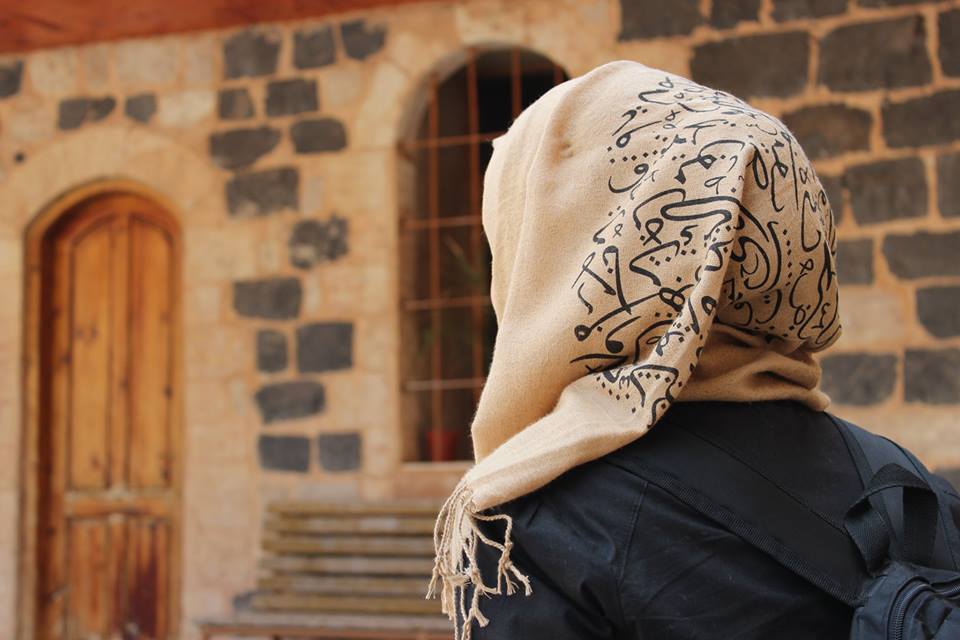
Hijab -A matter of discussion

Let us try to understand the word Hijab (veil) before going in to further details. Many people like to refer to Hijab as a “personal choice”. Yes. It is a personal choice. It is a personal choice to submit to God rather than the fashion of society. It is a choice to be beautiful to God, rather than to people.Hijab However, Hijab should not just be seen as a cloth one puts on the head. Rather Hijab is a symbol of our worship and servitude to God. It is a symbol of modesty, that is not just about our attire; it extends to our whole demeanor. Let us turn our attention to The Holy Qur’an.

Allah says (interpretation of the meaning): 

“And tell the believing women to lower their gaze (from looking at forbidden things), and protect their private parts (from illegal sexual acts) and not to show off their adornment except only that which is apparent (like both eyes for necessity to see the way, or outer palms of hands or dress like veil, gloves, head cover, apron), and to draw their veils all over Juyoobihinna (i.e. their bodies, faces, necks and bosoms) and not to reveal their adornment except to their husbands, or their fathers, or their husband’s fathers, or their sons, or their husband’s sons, or their brothers or their brother’s sons, or their sister’s sons, or their (Muslim) women (i.e. their sisters in Islam), or the (female) slaves whom their right hands possess, or old male servants who lack vigour, or small children who have no sense of feminine sex. And let them not stamp their feet so as to reveal what they hide of their adornment. And all of you beg Allah to forgive you all, O believers, that you may be successful”

[Al-Noor 24:31] 


My personal experience

I am a girl who born and bought up in Delhi, still putting my Hijab on wasn’t actually a hard decision for me.
For some Muslim women, it is a real jihad as they can’t imagine themselves wearing a Hijab and covering their hair. I met many Muslim women who were praying, fasting, going to religious meetings, seeking Islamic knowledge, yet they always found excuses why not to wear their Hijab.

Few couplets on Hijab by my father “Sikandar Amrohvi”:

Daur-e-hazir mein taraqqi kar rahi hain aurtein,
Dekho parde mein bhi rehkar har amal mein saath hain

Ye kaun keh raha hai rukawat Hijab hai,
Parde mein bhi jahaz udati hain aurtein

During my school days, I just felt it is impossible to walk in with Hijab in hot summer days, at that time I used to wear Hijab just in winters to protect myself from cold wind. I used to wear my Hijab only during our visit to my Hometown, Amroha but I was always thinking of wearing it outside as well.
After high school Allah responded to my supplications and helped me to finally accept the Hijab completely. When I joined Delhi University, apart from choosing so called happening life style of DU campus I choose to wear Hijab to retain my dignity and to protect myself from shaitan. Most of the friends accepted me with Hijab in fact some of them support and appreciate me while some of them demoralized me with some hurtful comments. I would like to tell my sisters that it’s not as hard to wear Hijab as it seems, it’s just to take a challenge, and accept the reality, try to live a life the way we have learnt from Qura’n.

I do wear trendy clothes and a scarf/Hijab. My clothing is modest. Allah makes Islam easy and tells us to do everything in moderation. Looking presentable and neat is also important especially if you are a Muslim because you are representing Islam.

When we are discussing Hijab, it might come to one’s mind that it’s a kind of marginalization of women, who have to preserve their beauty away from the eyes of all the people except the woman’s husband or some of her relatives. But is it really true that Hijab causes women to be suppressed or marginalized? To be able to answer this question we may look at the advantages of its wearing.

Benefits of Wearing Hijab

Wearing Hijab has being observing a modest Muslim style of dressing offers these benefits:

Represent Purity
Hijab is an indication of dignity and purity. It highlights women as chaste and pure women. I think, the Hijab acts like a shield between chaste Muslim women and the World’s evil.

Protect from male harassment
Research shows that one of Hijab’s most important advantages is the security of the society that clears it from crimes, rape, incest, harassment in daily life, etc. looking at this advantage affirms the idea that by taking off their Hijab social crimes are increasing. I personally feel that if Hijab is observed in true sense by all of us, half of the problems existing in our society related to women will be solved. Maybe we can create a better society for coming generations by opting for Hijab.

Scientific Benefits Of Wearing Hijab:
Protecting the head is very important from a health perspective. Results Of medical tests show that 40-60% of body heat is lost through the head during winters and in summer hijab protects our head from direct sunlight and heatwave, so persons wearing head coverings are protected from cold and heat about fifty-percent more than those who do not.

All these are my personal opinions and feelings about Hijab. Please leave your feedback/comments.

Nuzha Fatima

She was born and bought up in Delhi. Graduated from Jamia Millia Islamia Sr. Sec. School in 2011 and received an undergraduate degree in 2014 in Botany from Delhi University. She earned a degree Bachelor of Education in 2015 from Indraprastha University. She started writing diary at very early age.

More Posts