Education should be based on concrete facts.

Some days ago, Shri Ram Shankar Katheria, the junior minister in Smt Smriti Irani’s education ministry had stirred a controversy with his remarks that “if saffronisation of education is good for the country, it will happen”. He enlightened this vision at a function held to celebrate ‘Hindvi Swaraj Diwas Samaroh’ at the Lucknow University on Saturday.

His words : Reporters told us that some people are saying that our government is saffronising education in the country. Saffronisation will happen in both education and in the country. Whatever is good for the country will definitely happen, whether it is bhagwakaran (saffronisation) or sanghwad.He further said: “If our children do not read about Maharana Pratap or Maharaj Shivaji, then will they read about Genghis Khan?”

One wonders if it was the part of Development Agenda that BJP has recently pronounced.

That takes us to the basic dilemma – What is Saffronization?

However, as we fathom the impact of this new Indian coinage of ‘Saffronization,’ it would be refreshing to discuss about Saffron itself. It is one of the costliest spices that bears a shiny crimson color. This delicate fragrant herb or spice  is derived from the flowers of Saffron Corcus. The styles and stigmas of the flower are collected and dried. It used mainly as a flavoring, seasoning and coloring agent in food.

Recorded history of food additives inform that it was probably first cultivated in or near Greece. But now, almost 90–93% of saffron is produced by Iran. Rest of saffron comes from the belt from Spain in the west to India in the east. The saffron of Kashmir is also in demand around the globe especially in Middle East.

I have produced all these snippets about saffron so that readers must acknowledge that RSS or BJP have no ownership or nothing to do with Saffron as such. Saffron habits were introduced and popularized in this world by the Aryans of Iran.

Off late since RSS / BJP captured power, we are hearing a lot and often sensing a lot about the ISATION of Saffron. To the best of my knowledge, it only the color of saffron that matches of Bhagwa color that is responsible about this protracted dialogue. It is interesting that India media is giving equal emphasis to both ‘Saffronization’ or ‘Bhagwakaran.’

It was only a few days in power when BJP began to tinker with school textbooks to bring them in line with its Hindu-centred worldview. Smt Smriti Irani, the Human Resources Development Minister is doing a yewmen’s job to bring back the  the glories of the Hindu “golden age.’’ Undoubtely, those were the glorious chapters and recalling them is honorable deed. Though, as a poor student of school books, I have to confess that being Indian, I know more about Hindu India, present and past, than the Islamic history.

All that I’d learned from the books that were introduced by Congress oriented academics and politicians. On the face of it, there’s nothing wrong if RSS wants to give a new tinge to it. We are given to understand by RSS intellectuals that the Congress governments, all along were ignoring the contribution of Hindu culture and religion to nation-building. The RSS feels that current textbooks as Left-leaning.

Actually, the “Saffronisation’’ of education has been is a campaign to purge textbooks of “foreign’’ influences especially the Islamic period and to promote “patriotism’’ that suits to RSS’ Hindutva agenda. In the name of sentiments of majority, the RSS-affiliated Shiksha Sanskriti Utthan Nyas (SSUN)  has demanded a “total change’’ in school education. Its lead campaigner is RSS pracharak Dinanath Batra who also runs the controversial Shiksha Bachao Andolan,which has earned notoriety for seeking ban on any book it regards “anti-Hindu’’.

Dinanath Batra had earlier proclaimed that “NCERT textbooks will be rewritten according to the aim and objects of the nation so that it inculcates feeling of patriotism among children. Modernity is not westernisation. We want modernity with Indian base (marked by) patriotism and spiritualism.’’

For the nation, interested to learn the real, the writing on the wall is clear. It’s not going to end with a few bland chapters on ancient India.

However, intellectual like historian Ramchandra Guha had advised that the HRD ministry should focus on institutional reform, not communalisation of the curriculum.’’

But now the dagger is out of its sheath. No mincing of words. The waters are being tested. Member of Parliament from Agra and Minister of State for Human Resource Development Ram Shankar Katheria has boldly stated, “There will be saffronisation of education and the country” and termed the process as beneficial for the country. He was speaking at the Lucknow University on Saturday at celebrations of Hindavi Swaraj Diwas Samaroh marking the 342nd coronation year of Maratha warrior-king Shivaji. Sharing the dias with the Minister was Uttar Pradesh Governor Ram Naik who presided over the function.

The Agra MP said: “Some journalists ask if we are we are promoting saffronisation of education. I am saying, yes, there will be saffronisation of education and of the country. Jo acha hoga, woh hoga (Whatever is good for the country will certainly happen) be it saffronisation or sanghwaad (propagation of the RSS ideology).” Elaborating on the theme, Mr. Katheria said the need of the hour was to create a curriculum that would increase the nation’s samman (honour) and swabhimaan (self-respect) in the world. “We kept silent for such a long time and never accused anybody. But today the circumstances in the country are such.”

His remarks provoked criticism on social media and across political parties calling the remarks “highly objectionable and anti-national.” Mr Katheria is not new to controversy. Earlier this year, at a condolence meeting for a murdered VHP worker in Agram, he delivered “hate-speech” against Muslims, which led to uproar in Parliament.

Finding himself in troubled waters, on Monday, while speaking to ANI, Kateria took a u-turn and said “I just said whatever is good for the nation, we’ll accept that; whether its Bhagwakaran or green or red color.” The listeners are no fools Sir!It is worn out trick.

Let the nation be informed – It wants ‘Indianisation’ or ‘Saffronization’ or ‘Polarisation?”

Naim Naqvi

Naim Naqvi

Did his graduation in Science discipline from AMU in 1972-73. He was Secretary of University Ali Society in 1970 and M.M. Hall Literary Society in early 70 's and member of Tayyabji Literary Society. Did his Diploma in Bakery Administration from HTT College Oxford Street London in 1987. Worked with National Herald - Delhi, Blitz - Bombay as Trainee Journalist and in Production Department with 'Naya Sansar Pictures' of Khwaja Ahmed Abbas at Bombay in early 70's. Traveled for study and training purposes to Germany, U.K., Switzerland, France, Dubai, Oman, AbuDhabi, Bahrain and Philepines.

More Posts

The poor show of toppers of Bihar – Can we learn something ??

I do often come across the kids whose parents present them as the victors, the prodigal genius and high or highest in mark sheet. Having put them through paces in their own domain I found them as inflated balloons that satisfy the ego of their families. Nothing more.

It is pathetic that so many real genius and hard working kids lag behind in marks before these artificial achievers in a nascent stage.

The topper kids of Bihar are the worse example that Vanity Fair of Education in India produces.

In Bihar, it was a situation pregnant with curiosity, shame, fear and fall. In the video, the Bihar state arts topper Ruby Rai was seen mispronouncing ‘political science’ and calling it prodigal science. The 17-year-old managed an impressive 88.8% despite the fact that she described political science a subject which deals with food. Similarly, another video showed state science topper Saurabh Rai having no knowledge of the periodic table.

Rai, who had scored 485 out of 500 marks, failed to answer questions related to electron and proton. An embarrassed Bihar government has also asked the 10 top scorers among the nearly 15 lakh students in Bihar to take another exam within the next week. Education Minister Ashok Choudhary conceded that it appears that either proxies took the exam for the students or the answer sheets submitted by the students were replaced later. I admit there has been some lapses somewhere,” he said.

As per the earlier documents of the Annual Status of Education Report (ASER) report revealed the status of education in India, enrolment in elementary education is almost 100 percent. However, when it comes to education outcomes, abilities in reading, writing and other comprehensive skills have deteriorated among children between the ages of six and 14.

Even with the increasing primary enrolment rates, India has the largest number of out-of-school children in the world which is more than the out of school children in whole of sub-Saharan Africa. There is a huge disparity between the urban and rural education; rich and poor children have radically different schooling experience.

The reality is that most of the educational policies of States and Centre are half-baked. Each segment in the educational hierarchy is facing some kind of problems which governments have no solutions or failing to address. The teachers in primary schools in rural areas face an uphill task are dealing with an outdated curriculum combined with the disinterest of principals and boards or commercialization of education.

Poor teaching facilities result in poor quality of education and students with lower standards. There is the chronic shortage of teachers. To make the matters worse, the situation is further deteriorated by high level of teacher absenteeism. It has been found out that often teachers do not come to school which clearly states that there is no mechanism to punish or fine such absent teachers. Consequently, low learning and falling quality of education imparted to kids entail grave implications for the future of country and country’s economy.

Apart from some hi-fi convent schools and similar elite city schools, country has not been able to improve the learning skills of majority of its primary school children. Contrarily, it has fallen to alarming lows.

In the Primary schools, teachers often make students read the lessons without explaining the meaning of the text. The kids never get the basic feel of the subject, be it history, arts or Science A fifth grader cannot do basic multiplication and division and cannot properly read or explain the text. However, most of them are masters of ‘copy it down’ effortlessly. Only a modicum of physical work without any brain work takes them nowhere. There are no opportunities to use the faculties of critical thinking, analytical reasoning, problem-solving and collaborative working.

From a weak base and a shaky pad the rocket or the symbol of India’s Future – the ordinary kid, is launched to explore the mysterious and difficult world. He can’t write a proper application for a job. Parental pressures and expectations dump them in Coaching Centers where they often commit suicide as they reach a dead end. You can’t blame Smirithi Irani alone or her degree or absence of it for all ills which beset today’s education. It goes deeper and higher.

If we look back, after the solid and sound foundations laid by learned scholar and first Education Minister Moulana Abul Kalam Azad, this crucial sector of nation building had lost its importance. The Cheap politics, prejudices and corruption had seeped into the system and real problems were intentionally ignored.

A look at the trail the Vyapam scam that has left since 2007 would reveal the pathetic situation of education in India. The scam involves massive irregularities and corruption in the Madhya Pradesh Professional Examination Board (MPPEB) or MP Vyavsayik Pareeksha Mandal, abbreviated in Hindi as Vyapam. No count of deaths would speak the complete darkness that prevailed or still prevailing.

The height of tragedy unmasked whenthe Supreme Court had transferred all criminal and death cases linked to the Vyapam scam to the Central Bureau of Investigation for a “fair and impartial” probe. The Supreme Court has ordered a CBI probe into the multi-crore cash-for-jobs scam in the Madhya Pradesh Professional Examination Board that has resulted in unexplained deaths of key accused and witnesses.

We need a smart and updated education system with no bias against or for the religions, cultures, history and ethics. It should be free of corruption of every possible hue and shape. It should be purpose based on facts and realities and not jaundiced.

An education system is only as good as its teachers. However, when it comes to improvement of academic quality, teachers cannot do it alone. They will be able to give their best only when well-designed atmosphere, facilities, curriculum and assessment strategies are put in place, to improve teaching and learning.

I’ve yet to understand the TRP culture that compelled to quick judgment about these poor toppers of Bihar without full investigations. I pray that kids were lost their bearing in focus of media éclat and they are not as bad as appeared before camera. If the truth is as it appeared on TV, then the nation has to do some soul search and correction without delay.

Naim Naqvi

Naim Naqvi

Did his graduation in Science discipline from AMU in 1972-73. He was Secretary of University Ali Society in 1970 and M.M. Hall Literary Society in early 70 's and member of Tayyabji Literary Society. Did his Diploma in Bakery Administration from HTT College Oxford Street London in 1987. Worked with National Herald - Delhi, Blitz - Bombay as Trainee Journalist and in Production Department with 'Naya Sansar Pictures' of Khwaja Ahmed Abbas at Bombay in early 70's. Traveled for study and training purposes to Germany, U.K., Switzerland, France, Dubai, Oman, AbuDhabi, Bahrain and Philepines.

More Posts

God doesn’t play dice with the Universe

On 19th March, 2016 my wife met a road accident. She was coming down from a chemist shop with her friend. Both of them were hit in the rear by a juvenile driving the bike. Both of them fell down unconscious on the road for minutes. The driver escaped. My wife got compound fracture in her feet. Her friend got internal injuries in neck and back. Exactly one month later, near the same spot, I was hit by another juvenile driver and got identical fracture in my foot. It was real pain. According to the Orthopedic surgeon, mine is a bit more serious injury it would take longer to heal.

The saving grace was that boy who hit me didn’t run away. He behaved responsibly and was there with me till I came back home. He had also apologized sincerely and I refused to accept any financial assistance despite his insistence. Usually I don’t share the personal physical eventualities to bother others but as so many of my friends are inquiring about my relative absence from Facebook and other social media, I have to keep them abreast. I’m a strong believer of the cliché – ‘whatever happens, happens for the best.’ Allama Eqbal has said –

“Mout to zindagi ka waqfa hai, yani aage barhen ge dum dekar.”

Death is only a stop gap moment in the continuity of Life. It connotes that we have to move ahead after a pause. I believe also – if something is lotted in the scheme of God, I can’t blot it. Albert Einstein had famously said “God does not play dice with the universe.” Despite what we have been led to believe about coincidences and synchronicities (namely that they are little more than chance), is not quite the whole picture. The fact of the matter is that these serendipitous events hold much more meaning than we often give them credit for. We live in an intelligent, responsive, multidimensional universe.

A synchronicity is more than just a coincidence, it is divine providence and a little hint from the cosmos that there is more going on than meets the eye. At some time or another it’s happened to all of us. For most mainstream scientists, experiences like this, however strange and recurrent, are nothing but lawful expressions of chance, a creation — not of the divine or mystical — but of simply that which is possible. Ignorance of natural law, they argue, causes us to fall prey to superstitious thinking, inventing supernatural causes where none exist. Many see coincidences as embedded in a higher, transcendental force, a cosmic “glue,” as it were, which binds random events together in a meaningful and coherent pattern. Mathematician Warren Weaver, in his book, Lady Luck: The Theory of Probability, recounts a fascinating tale of coincidence that stretches our traditional notions of chance to their breaking point. The story originally appeared in Life magazine.

Weaver writes:
“All fifteen members of a church choir in Beatrice, Nebraska, due at practice at 7:20, were late on the evening of March 1, 1950. The minister and his wife and daughter had one reason (his wife delayed to iron the daughter’s dress) one girl waited to finish a geometry problem; one couldn’t start her car; two lingered to hear the end of an especially exciting radio program; one mother and daughter were late because the mother had to call the daughter twice to wake her from a nap; and so on.

The reasons seemed rather ordinary. But there were ten separate and quite unconnected reasons for the lateness of the fifteen persons. It was rather fortunate that none of the fifteen arrived on time at 7:20, for at 7:25 the church building was destroyed in an explosion. The members of the choir, Life reported, wondered if their delay was “an act of God.”

Naim Naqvi

Naim Naqvi

Did his graduation in Science discipline from AMU in 1972-73. He was Secretary of University Ali Society in 1970 and M.M. Hall Literary Society in early 70 's and member of Tayyabji Literary Society. Did his Diploma in Bakery Administration from HTT College Oxford Street London in 1987. Worked with National Herald - Delhi, Blitz - Bombay as Trainee Journalist and in Production Department with 'Naya Sansar Pictures' of Khwaja Ahmed Abbas at Bombay in early 70's. Traveled for study and training purposes to Germany, U.K., Switzerland, France, Dubai, Oman, AbuDhabi, Bahrain and Philepines.

More Posts

Why the ‘Facebook’ friendships are turning insipid??

social-media-banner

It was around fifteen years when I got to know about Facebook. Since then Facebook has been changing its profiles in several interesting patterns. Friends who had once appeared as the most sincere one have either disappeared or lost in the run of times. Fortunately, some old friends go back into real from the realm of memories and some new friends made their pleasant presence felt. But sad that with the passage of time, Facebook is becoming a medium of deception where we began to behave more formal than real. Often I thought of leaving this field but presence of few friends had proved to be the magnet that kept the relationships alive. However, I feel this friendship is losing the verve and sincerity. I may take a sabbatical from social media and for those of my friends who want to know what does this word means – “In recent times, “sabbatical” has come to mean any extended absence in the career of an individual in order to achieve something. In the modern sense, one takes sabbatical typically to fulfill some goal, e.g., writing a book, need time to look into retrospect or travel extensively for research. Some universities and other institutional employers of scientists, physicians, and academics offer the opportunity to qualify for paid sabbatical as an employee benefit, called sabbatical leave. The concept of sabbatical originates in the Holy Bible.

An article of my colleague Sneha Pathak is forcing to go in that direction. Here are some excerpts of her thought provoking column:

Gone are the days when people write elaborate letters and wait for replies, or spend evening in a park or a coffee house talking to friends.

People are becoming increasingly more reserved for fear of being judged by a society where appearing happy on social media is more important than actually being happy. So ironically, the more some people share, less they share their real selves. Sometimes one needs to listen to people, understand their situations without judgment.

What a world we live in where we would rather post messages to random strangers than communicate about what is bothering us with our close friends.

It is easy to mask your emotions behind the bunch of fake ones.

What is the point of observing on social media if we don’t know what is going on in their life.

For a change, let’s try to be social in our real lives instead of the virtual world.

Naim Naqvi

Naim Naqvi

Did his graduation in Science discipline from AMU in 1972-73. He was Secretary of University Ali Society in 1970 and M.M. Hall Literary Society in early 70 's and member of Tayyabji Literary Society. Did his Diploma in Bakery Administration from HTT College Oxford Street London in 1987. Worked with National Herald - Delhi, Blitz - Bombay as Trainee Journalist and in Production Department with 'Naya Sansar Pictures' of Khwaja Ahmed Abbas at Bombay in early 70's. Traveled for study and training purposes to Germany, U.K., Switzerland, France, Dubai, Oman, AbuDhabi, Bahrain and Philepines.

More Posts

The trill of the mountain brooks; the symphony of the ocean waves

There is an authentic tradition (Hadees) of Prophet Mohammed (PBUH) that says: “As shuf fe bahar ebadah.” It is a benediction even to look at sea.

Having lived the best part of my life near the sea shores in Bombay and Middle East I am familiar with the sweet sounds of waves as they wash and splash the beaches and shores. It reminds the immense beauty and strengths of mother-nature. Just close your eyes and think of a river or a sea. The scenery that emerges at the mind screen removes half of your worries, puts you at ease and for a moment you forget all that is bothering you. Ask your relatives or friends what associations arise in their mind when they think the word “sea”? Never a negative response I’m sure! The water bodies cool the mind, inspire, placate and palliate. The shores and riparian tracts remind the words like freedom, serenity, relaxation, fun and beauty. These are the words which waft like music in this strained life. Even those who had never seen the sea always picture somewhere deep inside the special feelings about it.

Let me quote here a dialogue from the Hollywood movie “Knockin’ on Heaven’s Door.” …. “You stand on the beach and taste the salty smell of the wind that comes from the ocean, and inside you feel the warmth of never ending freedom, and on your lips the bitter, tear-soaked kiss of you lover.”

There was a time when I would walk miles and miles along the Juhu Beach, Bombay as a bachelor and feel pity about my loneliness. I felt envy for the couples and families enjoying the brightness of the day at sea. To observe the high tide and majestic waves, standing at Mamallipuram sea coast at the outskirts of Madras, was a real delight. We all dream to lie on the beach at least for a while and listen to the sound of splashing waves and screams of sea-gulls. Did you ever notice that the sounds of waves come from afar, but the sounds of splashing water are close, near the stones, pebbles and golden sands.

Apart from the sea, rivers have always played an important role in human life. In religions around the globe, rivers are deified. Human race has made best to derive huge economic profits from exploiting the rivers and often devastating their natural riches. Water is the source of life. Flowing rivers are source and core element of many beautiful landscapes and natural sceneries, because they have unique ability to vivify the motionless pictures of nature. Furthermore, rivers form such natural phenomena, as waterfalls with their unrestrained power and unique beauty.

I’m blessed that my son has got a place near the river where I often walk down along its banks. It is so soothing to body and soul as the gentle wind caresses the face and scents of earth refresh like no other perfume. I hope and pray that our successors will, hopefully, make more efforts to save ponds, rivers and sea and help them regain their natural beauty, richness, and purity that our generation has so inadvertently destroyed. Let us remember that the calmness and tranquility of quiet rivers are divine.

Here is what an African poet Langston Hughes describes the river:

I’ve known rivers:
I’ve known rivers ancient as the world and older than the
flow of human blood in human veins.

My soul has grown deep like the rivers.

I bathed in the Euphrates when dawns were young.
I built my hut near the Congo and it lulled me to sleep.
I looked upon the Nile and raised the pyramids above it.
I heard the singing of the Mississippi when Abe Lincoln
went down to New Orleans, and I’ve seen its muddy
bosom turn all golden in the sunset.

I’ve known rivers:
Ancient, dusky rivers.

My soul has grown deep like the rivers.

Naim Naqvi

Naim Naqvi

Did his graduation in Science discipline from AMU in 1972-73. He was Secretary of University Ali Society in 1970 and M.M. Hall Literary Society in early 70 's and member of Tayyabji Literary Society. Did his Diploma in Bakery Administration from HTT College Oxford Street London in 1987. Worked with National Herald - Delhi, Blitz - Bombay as Trainee Journalist and in Production Department with 'Naya Sansar Pictures' of Khwaja Ahmed Abbas at Bombay in early 70's. Traveled for study and training purposes to Germany, U.K., Switzerland, France, Dubai, Oman, AbuDhabi, Bahrain and Philepines.

More Posts

Death the Leveller – Sadhna goes to eternal sleep !

“You’ll stay with me?’
Until the very end,’ said James.” – J.K. Rowling, Harry Potter and the Deathly Hallows

And those who have seen the twin magnum opus ‘Mere Mehboob’ an ‘Arzoo’ would have dreamed that about Sadhna Shivadasni Nayyar – the iconic actress on Hindi Cinema.

May be I’m poorly informed or may be I’ve missed the vision and imagination of a Ghazal Poet but I can’t remember any other Indian Film actress whose hair style was celebrated like Sadhna’s. She was one of the most popular heroines of yesteryear Bolywood, an actress who had reigned for many years, She passed away in Mumbai today, on December 25 after a brief illness. The actress was detected with a tumor and had been battling cancer for a very long time. In December 2014, the lady underwent an emergency surgery for a bleeding oral lesion. Sadhana breathed her last at a Mumbai hospital. She was 74.

sadhana

The beautiful damsel had enthralled masses with her graceful performances in Hindi films in the 60s and 70s. Initially her father had helped her enter films. Her family had migrated from Karachi in 1947. In 1955, at the age of 15, she had played a chorus girl in the song “Mur mur ke na dekh mur mur ke” in Raj Kapoor’s ‘Shree 420’. She was cast her in India’s first Sindhi film titled Abaana (1958), where she played the role of Sheila Ramani’s ‘s younger sister and she was paid a token amount of 1 rupee. She had joined Mukherjee’s acting school along with her debutante co-star Joy Mukherjee.

Her trademark look, called Sadhana cut is said to be inspired from Hollywood actress Audrey Hepburn. However, in one of her interview she revealed that she had a broad forehead and that was a bid odd in the eye of cameras. To hide that minor flaw, her hairdresser had advised her to cover it in order to appear it narrower with a tumbled cascade of trimmed tress – better known as Sadhna Cut or Style. Some say that it was R.K.Nayyar who had suggested the idea. That fringe style was originally sported by the Hollywood actress Audrey Hepburn. The fringe soon became popular and a fashion fad in the 1960s. The style was copied by many girls in India. The Filmalaya Production banner had introduced Joy, Sadhana and her iconic hairstyle in their 1960 romantic film ‘Love in Simla.’ Sadhana had played the role of a simple, bespectacled girl who is transformed by her grandmother into a beautiful woman and encouraged to pursue the hero. During this period she again worked under the same banner opposite Joy in ‘Ek Musafir Ek Haseena.’ In 1961 she played against Dev Anand in ‘Hum Dono.’ It was a super hit.

A famous film journalist describe her beauty in these words: “Her eyes, expressive and captivating, do most of the work, while she balances out her submissiveness with a firm tongue.” In 1963, Sadhna acted in the technicolour film ‘Mere Mehboob’ directed by H.S.Rawail. It was a classical film and still known for the famous scene where Rajendra Kumar encounters her for the first time and sees her eyes through her Burqa at an auditorium of Aligarh Muslim University.

She got her second Filmfare nomination as Best Actress for the role of Meena in Yash Chopra’s directorial saga ‘Waqt’ (1965). She stood out in Bollywood’s first ever ensemble cast by bringing along the fashion of tight chudidar-kurtas.

Sadhana married her ‘Love in Simla’ director Ram Krishna Nayyar on 7 March 1966. Their love had blossomed on the film sets. Her parents opposed it as the difference of age was telling. They were married for nearly thirty years, until his husband’s death in 1995 from asthma. The couple had no children.

Naim Naqvi

Naim Naqvi

Did his graduation in Science discipline from AMU in 1972-73. He was Secretary of University Ali Society in 1970 and M.M. Hall Literary Society in early 70 's and member of Tayyabji Literary Society. Did his Diploma in Bakery Administration from HTT College Oxford Street London in 1987. Worked with National Herald - Delhi, Blitz - Bombay as Trainee Journalist and in Production Department with 'Naya Sansar Pictures' of Khwaja Ahmed Abbas at Bombay in early 70's. Traveled for study and training purposes to Germany, U.K., Switzerland, France, Dubai, Oman, AbuDhabi, Bahrain and Philepines.

More Posts

The unwarranted, brutal and mindless massacre in Nigeria

Moulana Mohammed Ali Johar had once said: “Qatl-e-ay Hussain (AS) asal men marg-e-Yezid haid, Islam zindah hota hai har Karbala ke baad.” Even if I refrain from delving into the past 1400 years and confine myself to recent past only, there are numerous barbaric incidences when the minority Muslim minority Shias, have been systematically massacred with unprecedented brutality in various parts of Muslims world. From the mindless and horrific killing of innocent school boys in Pakistan to latest pogroms of Shia Muslims in Nigeria, we witness the resurrection of the old story of ‘Martyrdom of Karbala.’ The masks and tricks of perpetrators change but the Yezid appears again and again in different form – each time more macabre than before.

boko

On last Saturday the bloodshed took place in the ancient mud-walled city of Zaria in northern Nigeria in which hundreds of Shias were killed by Nigerian army. The army put up an excuse that followers of Shia scholar Ayatullah Zakzaky allegedly hurled stones at a military convoy carrying the country’s new top general, Tukur Buratai.

Way back in May 2013, I had written an article in the portal ‘Merinews’ about the game of blood- shed played by militant Talibani organization ‘Boko Haram’ of Nigeria and I’m reproducing here a part of it to link it with the present crisis:

“Fedreal Republic of Nigerian is located in West Africa the Nigeria was taken from the Niger river which runs through the country. In the late nineteenth century it was colonized by Britishers. The new rulers followed the old feudal system of traditional chiefs and fiefdoms. It got independence in 1960. Sir Abubakar Tafawa Balewa was the first Prime Minister who was respected widely. Unfortunately, for the country and for the African continent that ebullient politician could not hold the rein of power for long and Nigeria fell to military junta. A civil war followed as the region of Biafra tried to establish independence. Military governments in times of crisis have alternated with democratically elected governments. Nigeria is also known as “the Giant of Africa.” Half of the population of country follows Islam and Muslims are mostly concentrated in north while rest are Christians and Yoruba religion. They mostly live in the South and central parts of the country. Nigerian has large oil reserves and good wealth of minerals. It is fertile and beautiful country with tall and healthy people.”…end of the quote.

Nigeria is a heavily Muslim country, and the overwhelming majority of Nigerian Muslims are Sunni. There were insignificant small pockets of Shia Muslims and by most accounts Shia Islam had little presence in Nigeria until the Islamic Revolution in 1979. The Iranian revolution of 1979 inspired many northern Nigerian Muslims. A Shia priest, Ibrahim Zakzaky who had been trained in Shia theology in Iran aggressively preached the Shia doctrine of Islam in Nigeria and found many followers. The movement that was led by Ayatullah Ibrahim Zakzaky became popular in northern Nigeria since the early ’80s. Its stated mission was to establish an Iran type of Islamic state in Nigeria and the ideology caused consternation in the top echelons of Nigerian government and led to several intermittent skirmishes with government security forces in past.

Ayatullah Zakzaki’s own Zaria-based sect, which is known as the Shia Islamic movement, is believed to account for the majority of Shia Muslims in Nigeria. It is claimed by army that Ayatullah Zakzaky brought “millions” of followers onto the streets and he does command a hardcore of disciples who have allegedly received paramilitary training. He had been thrown in jail in the past also on charges of stirring up violence between Muslims and Christians.

According to Mr. Michael Olufemi Sodipo, the founder of Nigeria’s Peace Initiative Network, the puritanical tendency among [Muslims and Christians] in northern Nigeria gave rise to increasingly zealous political actors. It was alleged that the followers of Ayatullah Zakzaki acquired weapons also but the group had never taken up arms against Nigeria’s secular government.

The non-official observers reported that the latest conflagration developed as a large Shia demonstration, led by the Zakzaky’s Islamic Movement, took place on the Sokoto road, near Zaria, where the Islamic Movement has a large presence. Around this time, Buratai’s convoy was driving through. The military demanded that the demonstrators disperse, and they refused. Some sort of projectile then struck Buratai’s car (reports conflict as to what it was), and the soldiers fired into the air as a warning. When that didn’t work, according to SBM, “the military opened fire to cover their principal, after which they left the location.” The military’s crackdown on the Islamic Movement began shortly afterward. According to SBM, the military saw the incident as an excuse to finally crush the Islamic Movement, which it had long seen as a threat.

Amnesty International said in a statement on Tuesday evening that the shooting of members of the Shia group in Zaria “must be urgently investigated … and anyone found responsible for unlawful killings must be brought to justice”.

“While the final death toll is unclear, there is no doubt of that there has been a substantial loss of life at the hands of the military,” said MK Ibrahim, director of Amnesty International, Nigeria.

“Armed policemen ambushed the procession unprovoked and threw tear gas into the crowd before opening fire, killing four people and injuring 25,” said Ibrahim Musa, a spokesman for the Shia Islamic Movement. “Despite the unwarranted attack, the march forged ahead.” Musa said soldiers on Monday carried away about 200 bodies from around Zakzaky’s home in Zaria, and hundreds more corpses are in the mortuary. The cleric himself also suffered four bullet wounds and is now understood to be in Nigerian military custody.

Human rights activists said hundreds, perhaps as many as 1,000, have been killed. Iran has also complained to Nigeria over an army raid on the headquarters of a militant pro-Iranian cleric in which hundreds of people are now feared to have died. The Iranian President, Hassan Rouhani, has demanded an explanation by the Nigerian government for its crackdown on the Shia Muslim sect led by Ibrahim Zakzaky.

Those concerns appeared to be shared by the US ambassador to Nigeria, James Entwhistle, who also called for an investigation into misconduct by all parties.

The confrontation is yet another security headache for Nigeria’s new president, Muhammadu Buhari, who took power in May promising to improve security in northern Nigeria. Some 10,000 people have died in recent years there in attacks by the Boko Haram Islamist group. But with his security forces already facing stiff challenges in northern Nigeria, Mr Buhari appears to have little time for any group who threatens the rule of law. Nigeria’s military also has a long reputation for human rights abuses, which is often said to have fuelled local support for Boko Haram.

Naim Naqvi

Naim Naqvi

Did his graduation in Science discipline from AMU in 1972-73. He was Secretary of University Ali Society in 1970 and M.M. Hall Literary Society in early 70 's and member of Tayyabji Literary Society. Did his Diploma in Bakery Administration from HTT College Oxford Street London in 1987. Worked with National Herald - Delhi, Blitz - Bombay as Trainee Journalist and in Production Department with 'Naya Sansar Pictures' of Khwaja Ahmed Abbas at Bombay in early 70's. Traveled for study and training purposes to Germany, U.K., Switzerland, France, Dubai, Oman, AbuDhabi, Bahrain and Philepines.

More Posts

ISIS is a creation of Arab Monarchies, West and Israel

And the Bigots strike again. The tenets of religion they follow, according to their understanding, allow them to use violence to communicate their message. So, the committed gunmen and bombers attack restaurants, a concert hall and a sports stadium at locations across Paris. Around 130 innocents are killed and more than double of these numbers are injured.
A few days back, twin suicide attacked in a Shia suburb and killed at least 43 people and injured more than 240. Both were the gory artwork of ISIL Suicide Brigade. The explosions occurred in Ain el Sikkeh, next to the Burj el-Barajneh Palestinian refugee camp which is a well-known commercial and residential area in the capital’s southern suburbs. It is the deadliest such attack to hit Lebanon in over a year. According to a Lebanese security official, the first suicide attacker detonated his explosives outside a Shia mosque, while the second blew himself up inside a nearby bakery. Al-Mayadeen TV reported that there was a third would-be suicide attacker who wore an explosives’ belt. The report said he was killed before he was able to detonate the explosives.
And today, in a Paris city hall four gunmen repeat the same macabre deed and systematically slaughter at least 87 young people at a rock concert at the Bataclan concert hall. Anti-terrorist commandos eventually launched an assault on the building. The gunmen detonated explosive belts. More than 40 more people are killed in five other attacks in the Paris region including an apparent double suicide bombing outside the ‘Stade de France national stadium’, where President of France, Hollande and the German foreign minister were watching a friendly soccer international. Some 200 people were injured. France has declared a national state of emergency and tightened borders.
We listen the same cliché – A terrorist has no religion. Is it not the ripe for all the top priests of all religions to sit together and ask themselves why the unwavering fanatical attachment to religion inspires or commit the terroristic acts? We do we have the burgeoning armies of Hindu terrorists, Islamic terrorists, Christian terrorists, Buddhist terrorists etc??
Religions and terrorism often travel together. Terrorism knows no boundaries. Yesterday it was Lebanon, today it is France. There was hardly any ripple of sorrow or condemnation in the world eyes when the Lebanese mourned the death of their innocents. Today, the deaths in France will be mourned more because France is a world power and the racist Eurocentric media dominate the news and opinions. The cruelty was not different in both places. Thoughts of Islamophobia aside, while the happening in France is intensely tragic, we must remember that ISIS is a creation of combined efforts of several Islamic nations and their Western Masters backed by the strategists of Israel who wanted to get rid of Bashar Asad of Syria. They really want to subdue and square up with Iran. Only a few months passed by, these killers of ISIS were termed as Jihadists by West.
The West was doing little to tame ISIS till the President Putin of Russia entered the crisis with determination and decision. The Russian bombing in Syria transformed the civil war there. It had compelled the West to show the concrete efforts to tame the specter of ISIS. Today, Russia is but at the centre stage. It ensures that the Syrian war will be brought to an earlier end. Russian military support for the Syrian government forces means that Asad is not likely to lose militarily and ISIS is not likely to win.

Naim Naqvi

Naim Naqvi

Did his graduation in Science discipline from AMU in 1972-73. He was Secretary of University Ali Society in 1970 and M.M. Hall Literary Society in early 70 's and member of Tayyabji Literary Society. Did his Diploma in Bakery Administration from HTT College Oxford Street London in 1987. Worked with National Herald - Delhi, Blitz - Bombay as Trainee Journalist and in Production Department with 'Naya Sansar Pictures' of Khwaja Ahmed Abbas at Bombay in early 70's. Traveled for study and training purposes to Germany, U.K., Switzerland, France, Dubai, Oman, AbuDhabi, Bahrain and Philepines.

More Posts

From Karbala – A road to Damascus

Before you travel to Karbala of near 1400 years, let us have a glimpse of present state of Arabian peninsula.
Everyone knows what kind of destruction the House of Al Sauds had wreaked at the cemeteries of Jannat-ul-Baqi and Jannat-ul Maala in the Holy Land where most of the descendents and family members of Prophet of Islam (PBUH) are buried. And now read what has happened in Syria and Iraq:

A blogger, Zain Gardezi, describes about Syria.

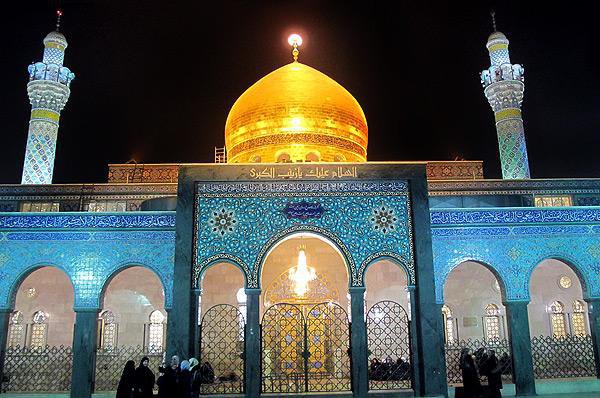
Shrine of Hazrat Bibi Zainab (s.a.) in Dimashq Syria.

Shrine of Hazrat Bibi Zainab (s.a.) in Dimashq Syria.

“That was back in 2008, when I had first visited Syria and fell in love with the country. I loved everything about it; the people, the cultural diversity and above all the sacred shrines that invoked the deepest spiritual awareness of God inside one’s soul. Of course, my view of Syria was limited to the areas I had lived in and visited; those mainly being Damascus and the small city near the outskirts of Damascus where the shrine of Bibi Zainab (AS) is located.

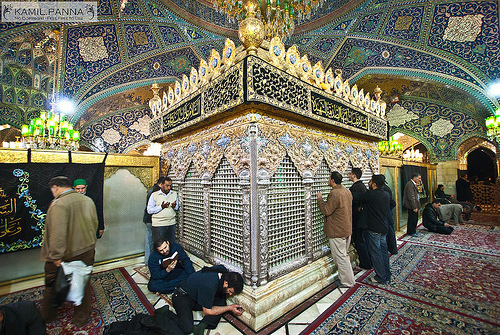
Shrine of Hazrat Bibi Sakeena (s.a.) in Dimashq Syria.

Shrine of Hazrat Bibi Sakeena (s.a.) in Dimashq Syria.

In old Damascus, I visited the historic route leading from old souk, or market, to the Umayyad Mosque, close to which the court of Yazid was originally located. Half a kilometre away was the shrine of Ruqayya Bint al Hussain (AS), commonly known as Bibi Sakina (AS), the four-year-old daughter of Hazrat Imam Hussain, who had died in imprisonment and buried therein.

If anyone had told me back then that in three years time a violent struggle against the regime would start and sacred places would be attacked, I would have laughed at their utter naiveté and told them that it was impossible. But it happened nonetheless and not only was Bibi Zainab’s (AS) shrine attacked, the shrine of one of Hujr Bin Adi(RA), a close companion of the Holy Prophet (pbuh) was also attacked by rebels. They took complete control of Hujr Bin Adi’s (RA) shrine, destroyed the mausoleum including the grave within and allegedly exhumed the body”…..End of quote from the blog of Zain Gardezi.
The hate that began against the Family of Prophet (PBUH) still continues unabated. By the night of Aashoor “Our beloved Imam (AS) put out a singular candle of light but lo, in the aftermath, seventy two lamps got flared up, the ‘blackout’ was caught off its guard – wondering what’s inflamed and what’s silenced.”

“Bujhaya ek ‘diya’ Sheh ne, bahattar ho gaye roshan,
‘Andhera’ khud pareshan hai, jalaa kiya tha, bujha kiya hai !”

That is the story in nutshell of ‘Karb-o-Bala’ that we narrate it to our audiences every year. It is a greatest story of sacrifice in the history of mankind. It is the legacy of forbearance, fortitude and endurance – the height of grit and determination. It is the best example of patience, perseverance, dedication and devotion; it is the worst of story of brutality, savagery, cruelty, ferocity, barbarity, cold-bloodedness and inhumanity. It is the tragedy of Islam; it is the misfortune of Humanity.

The story of the Martyrdom of Imam Hussain (AS), his family and friends could be traced back to the moment when the Prophet Mohammad (PBUH) took his last breath and the issue of succession flared up. But it is not the subject of this tribute.
Islam entered its crucial phase when the Governor of Damascus rebelled against the Khilafat-e- Rasheda and refused to accept Imam Ali (AS) as the Khalifa of all Muslims. The Governor of Damascus declared the areas of his influence as independent and not under the sovereign rule of 4 th Khalif of Islam. Many wars were fought and finally Imam Ali (AS) was martyred in the Kufa mosque. After his martyrdom, the Muslims unanimously elected Imam Hasan (AS) as the 5 th Khalifa (Ruler of Muslims). A conspiracy was hatched and Imam Hasan (AS) was poisoned to death. Yazid-bin-Muaviah – the son of Hakim-e-Sham (Governor of Syria) was nominated as his successor. Yezid was declared the next king and that cataclysmic event brought the paradigm shift in the object and conduct of the Islamic Constitution that was followed during the first three Caliphates. It was this change and the catastrophe to which the Islamic State was reshaped from Caliphate to Mulukiyat – the Monarchy. Unfortunately many of the ‘Companions’ who were still alive and ‘Companions and Companions of the Prophet of Islam (PBUH) witnessed this transformation but kept the stiff upper lip out of fear or conviction. Imam-e-Mazloom foresaw the dangers looming ahead and resolved to stake his life to prevent the imminent doom.

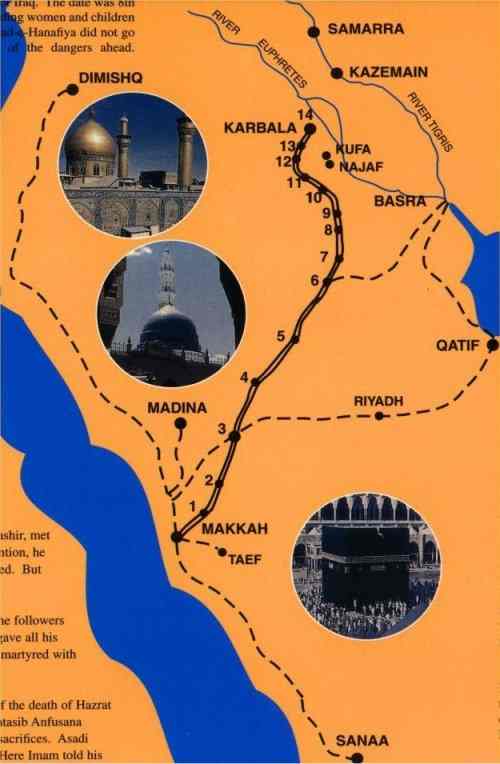
After ascending the throne Yezid demanded allegiance from Imam Hussain (AS), the grandson of the Prophet Muhammad (PBUH) which he flatly refused. The people of Kufa (the capitol of Iraq) invited Imam Hussain to come to Kufa to seek his guidance. Imam set out to Kufa at their invitation. It was a mission of peace. No one maptakes his family, relatives, small children and friends in a pursuit of war. It was much easier for Imam to have rebelled in Medina itself and declare himself as the caliph irrespective of consequences. A war was forced upon him, when the army of Yazid stopped him at Karbala. Imam never asked for trouble. He made an offer of peace to the Commander of Yezid and asked to be allowed to return to Medina or taken to Yezid for a direct one to one talk or be sent to a Muslim land (preferably to India).

The commander of Yezid army, under the instructions of Abdullah bin Ziyad, the Governor of Iraq did not accept any of those proposals but finally his conscience forced him to realize his mistake and Hur, the commander, defected to the side of Imam Hussain (AS) just before the starting of war.

For ten days Imam Hussain and his caravan camped at Karbala. The army of Yezid encircled the camp. The hostile forces of Yezid deprived food and water to them. On the tenth day, Shamir, a trustee of Yezid, ordered to seek the allegiance of Imam Hussain by force. No alternate was given to Imam except to kill him.

A brief battle ensued and all male members of Imam Hussain’s family and close associates were martyred. He was last to be killed and beheaded. Their bodies were run over by horses or desecrated and then left to decompose. Seventy-two heads were taken of Kufa at the tip of spears and presented to the court of Ibn Ziyad, then across the desert to Damascus to face Yazid. The prisoners of war were mostly women and children and one man in his twenties Hazrat Imam Zainul Abedin, the 4 rth Imam who was very sick and couldn’t take part in battle was spared.

Every year, in the month of Muharram, the Muslims all over the world, in their own traditional way observe the mourning of Imam Hussain’s martyrdom. Now, the pertinent question is – what is so unique about the tragedy of Karbala that even though more than1300 years have elapsed the grief is afresh? What value would this mere personal love and devotion hold in the service of Islam? The answer is simple and straight – sacrifices of Karbala bear witness that Imam had held the objective of Islam dearer than his own self.
As one Islamic scholar had pointed out – “The best lesson that we learn from the tragedy of Karbala is that Islam is not a religion of compromises. Living with peace with forces of oppression is wrong. If Imam Hussain had pledged allegiance to a tyrant ruler, he could have saved his neck, and would have most likely given a high post by the Yezid who would have allowed him to do his prayer, fasting, and other ritual acts of worship. But he was the grandson of a Prophet who said, “One of the greatest jihad is to stand up to a tyrant ruler, and say a word of truth. ” Imam Hussain, in one of his speeches on the way to Karbala said,” To live with an oppressor is a crime in itself.”

The second lesson is the concept that our body and life belong to our Creator, and should be spent on His cause. “And if you are slain or die in the cause of Allah, Forgiveness and Mercy from Allah are far better than they could amass, and it you die or are slain, lo it is unto Allah that you are brought together”. (3:157-158). There is a great reward for martyrdom. A martyr is next to Prophets in heaven.

“Those who leave their homes in the cause of Allah and are then slain or die, on them Allah will bestow good provision. Truly Allah is He who bestows the best provision.” (2:58-59)

The Holy Book Quran tells us that Martyrs are not dead.

“And do not call those who die in the way of Allah as “Dead”, no they are living, only you do not see them. (2:154)

The Sacrifices Karbala proved forever the illegitimacy of transformation of benign and just rule of Islam into Kingdom and Monarchy. As Moulana Mohammed Ali Johar has said:

“Qatl-e-Hussain asal men marg-e-Yezid hai; Islam zinda hota hai har Karbala ke baad.”

In the Murder of Hussain, In deed is the death of Yazid.Each Karbala revives Islam. Martyrdom of karbala is the death of Yazid’s and his followers ideology.

What was the objective of Imam Hussain (AS)? Did the Imam stake his life to vindicate his hereditary claim as a ruler? Can anyone who knows the high moral standard of Imam Hussain’s household harbor the vile notion that they would cause bloodshed among the Muslims to gain political power? The fact is that the Imam’s keen eye was discerning the symptoms of decay and corruption in the system of Muslim society and the Islamic state as a materialistic person like Yezid had captured the throne and became in-charge of Islamic affairs. Imam felt impelled to resist these forces – even if it required treading a path of war which he not only considered to be legitimate but obligatory as well.

The character of Yezid presented the worst picture of Islam to the world. The acquiescence of Muslims in general and the acceptance thereof of his authority were going to destroy the mission of the Prophet of Islam (PBUH). Yazid’s nomination as successor marked the second phase of the reign in which the concept of God’s sovereignty was reduced to mere deception. In the new kingdom of Islam, the sovereignty was vested in the monarch and his family, and he was the undisputed master of the life, property, honor and every tangible and intangible entity of his subjects. The Divine Law was not applied to the King, his family, the nobles and the officials. They were all exempted from it. The objective of the state was only indulging in the possession of lands, self-aggrandizement, the collection of tribute and the gratification of sensual desires. The monarch, their nobles and their officials were instrumental in propagating vice than virtue. The policy of the rulers, officers and their subordinates had continuously led the Muslim society to moral degradation. The path of monarchy was embellished with the pomp and pageantry of Caesar. Oppression and injustice overruled justice. Instead of righteousness, profligacy and luxury had come into vogue. The failure to distinguish between the lawfulness and unlawfulness of affairs, rendered in a lack of character and actions of the ruler. Politics was no longer cogent with morality. The rulers kept their subjects under fear instead of instilling the fear of God.

With the beginning of monarchy in Islam, the voice of conscience was stifled and freedom of expression of opinion was denied.
These were the changes that appeared in the wake of converting the Caliphate into a Monarchy. This is the reason why Imam Hussain decided to stem the tide of the evil forces. He took the risk of confrontation by rising in revolt against an established government. The consequences are known to everyone.
The legacy of Karabala is, once again that a believer should not hesitate to sacrifice all that he possesses to safeguard the principles of Islam – laid down by Prophet of Islam (PBUH). Imam Hussain (AS) preferred the crown of martyrdom over the crown of this materialistic world.

Naim Naqvi

Naim Naqvi

Did his graduation in Science discipline from AMU in 1972-73. He was Secretary of University Ali Society in 1970 and M.M. Hall Literary Society in early 70 's and member of Tayyabji Literary Society. Did his Diploma in Bakery Administration from HTT College Oxford Street London in 1987. Worked with National Herald - Delhi, Blitz - Bombay as Trainee Journalist and in Production Department with 'Naya Sansar Pictures' of Khwaja Ahmed Abbas at Bombay in early 70's. Traveled for study and training purposes to Germany, U.K., Switzerland, France, Dubai, Oman, AbuDhabi, Bahrain and Philepines.

More Posts

Are we not wearing thin the most respectable TITLES of clergy ?

Of late years an abundant shower of reputed Islamic titles is falling over the Indian subcontinent where several priests have begun to add them with their names without any solid background to qualify for these honorific designations.

Especially, the two of them that have been offensively consumed by shia clergy are Ayatullah and Hujjatul Islam and the author feels it necessary to share his thoughts about the subtle misuse of these prestigious holy subriquites.

Ayatullah means “Sign of Allah”. It is a high-ranking title given to Ithna Aasharee Twelver Shiah clerics. Those who carry the title are experts in Islamic Studies such as Islamic Jurisprudence, ethics, and philosophy.
The name “ayatollah” originates from a passage in the Quran which the Shia interpret to mean human beings can be regarded as ‘signs’ or ‘evidence’ of God. Passage 51:20–21 of the Quran states: On the earth are signs (Ayat) for those of assured Faith.

The Sunni Muslims do not give credence to this interpretation.

For the readers of this article, it might sound strange that there are a few women who are equal in ranking to the ayatollahs, and are known as Lady Mujtahideh. The most outstanding in recent history was Nosrat Amin, also known as Banu Isfahani. Current examples of the Lady Mujtahidehs are Zohreh Sefati and Lady Ayatollah Aatieh Hassani also known as Imam’ah Al-Hassani daughter of Grand Ayatollah Gholamreza Hassani.

Grand Ayatollah and Marja – Only a few of the most important ayatollahs are accorded the rank of Grand Ayatollah (Ayatollah Uzma, “Great Sign of God”). This usually happens when the followers of one of the ayatollahs refer to him in many situations and ask him to publish his Juristic book in which he answers the vast majority of daily Muslim affairs. The book is called “Resalah” which is usually a reinvention of the book Al-Urwatu l-Wuthqah, according to their knowledge of the most authentic Islamic sources and their application to current life.

It requires decades of serious learning and hardships to reach to the position of Ayatollah. There are seminaries in Iraq, Iran and Syria where the Shia Knowledge Seekers and students are taught, patronised and polished.

RITUALS, RHETORIC and dramatisations are the salient characteristics of the mighty rulers.

The ‘Ayatollahs’ employ none of them. They don’t visit world capitals; they welcome no salutations and no ‘guards of honour’ and sit on the ordinary tattered mat that you can find in the poorest house holds. However, when Ayatollah Khomeni gives a clarion call of rebellion, the crown and scepter of mighty Arya Meher Shanshah Raza Pehelvi go to dust. When Ayatollah Sheestani speaks from his hovel in Iraq, his every word is analysed with utmost care in the most powerful capitals of the world. What makes these Ayatollahs so powerful?

We can’t understand this enigma without an understanding of the theological principles of SHIA religion. According to Ithna Ashri (believers in 12 Imams) Shia belief, whoever dies without following an Imam (Religious Jurist) dies in ignorance. Living Imam is not visible and God has put him beyond the visual reach of ordinary human being. He guides through his ‘spiritual agents’ and ‘Ayatollahs’ are those revered agents or representatives. It requires decades of serious learning and hardships to reach to the position of Ayatollah. There are seminaries in Iraq, Iran and recently in Syria also where the Shia Knowledge Seekers and students are attracted, taught, patronised and polished to begin their upward journey towards religious perfection as guides. These seminaries are known as ‘Hawazat Ilmiyyah’ where Islamic Jurisprudence, Quranic Explications, Philosophy, Sufism, History, Mathematics and Islamic Sciences are taught. These seminaries are headed by Ayatollahs. No formal degrees, certificates or licenses are awarded to students. Emphasis is laid in developing the student’s research skills and mental capacities on increasing the cultural, juridical and philosophical information. An attitude in inculcated for scientific and political approach. These seminaries are located in Najaf, Samaraa, Baghdad and Karbala in Iraq, and in Qum and Mashad in Iran.
After few years of learning if the Ayatollah feels a student fit as beginner he is called the Molvi, Moulana or Mulla.

Maturing after the first rank, he goes the higher stage of learning and it is known as ‘Ijtihad’ and he become as ‘Mujtahid’. Next position is ‘Hujjat Al-Islam’. Then he climbs to the pedestal of ‘Hujjat Al-Islam wa Muslimeen’. As the learning proceeds he becomes an ‘Authoritative Source’ or ‘Ayatollah’. There after he is last authority of Shias – The Grand Ayatollah or ‘Ayatollah al Uzma’.

The financial support for these seminaries comes from every Shia household who can afford and from every country where he resides. It is the most powerful institution of Shia Jurisprudence. The nominated sources or ‘Nayabs’ of these Ayatollahs are present in every country where there is a reasonable population of Shias exists. They collect Zakah, the obligatory charity and ‘Khums’ which is a fifth of total saving of the year. They do distribute that money in their own country also for the welfare of their people. According to Shia doctrine ‘Khums’ is mentioned in Quran and allocated to Prophet during his life time and to his kith and kin after him.
According to Sunni Doctrine, the right of a fifth of saving was only related to spoils of war and lost effect by the Prophet’s death.

The money collected as KHUMS had always been the prominent source of strength of Shia Clergy. It makes Shia priest richer by degrees and independent of any ruler who could interfere in religious affairs. In all matters to religion the decree of Ayatollah al Uzma runs supreme. It is the base of the ‘Theory of Clerical Rule’ or ‘Guardianship of the Jurist’. This Guardianship implies that every public act of Islamic government require a pre-permission or approval of Ayatollah before being done. State derives its legitimacy from being under the ‘Supervision’ of Jurist Guardian – the Ayatollah al Uzma.

Note: It is not a judgmental article and should be considered for its informative value only.

Naim Naqvi

Naim Naqvi

Did his graduation in Science discipline from AMU in 1972-73. He was Secretary of University Ali Society in 1970 and M.M. Hall Literary Society in early 70 's and member of Tayyabji Literary Society. Did his Diploma in Bakery Administration from HTT College Oxford Street London in 1987. Worked with National Herald - Delhi, Blitz - Bombay as Trainee Journalist and in Production Department with 'Naya Sansar Pictures' of Khwaja Ahmed Abbas at Bombay in early 70's. Traveled for study and training purposes to Germany, U.K., Switzerland, France, Dubai, Oman, AbuDhabi, Bahrain and Philepines.

More Posts