What Is Moharram ?

Rāyyan bin Shabeeb, who says that I went to meet Imām Ali ar Rezā (a.s.) on the first day of the month of Moharram. Imām Rezā (a.s.) asked me,

O son of Shabeeb! Are you in the state of fasting today”?
“This is the day when Prophet Zakariyyah (a.s.) prayed to his Lord thus
“Lord grant me from unto Thee a good offspring, Verily Thou art the Hearer of Prayers”

Then Allāh accepted his Prayers and commanded His Angels to go and give him glad tidings regarding the birth of his son Prophet Yahyā (a.s.). The Angels came and called out to him while he was engaged in Prayers in the niche. Hence the one who fasts on this day and asks for his desires from Allāh, his prayer will be answered as was of Zakariyāh.”

Then Imām (a.s.) said,

“O son of Shabeeb! Moharram is such a month that the Arabs of the age of ignorance (pre-Islāmic) too respected it’s sanctity and forbade oppression and blood-shed in it. But these people (the umayyads) did not honour the sanctity of this month nor of their Prophet. In this month they killed the son of the Prophet and imprisoned the women-folk after looting and plundering their belongings, verily Allāh will never ever forgive this crime of theirs.”

“O son of Shabeeb! If you wish to mourn and lament over anyone, do so upon Husain bin Ali bin Abi Tālib (a.s.) for he was beheaded like a lamb. Eighteen persons from among his family, who were unparalleled in the earth, were also killed alongwith him. The heavens and the earth lamented the death of Husain. Four thousand Angels descended from the heavens to aid him, but when they reached there they saw that he had already been mar-tyred. Thus, now they all remain near his blessed grave with disheveled hair covered with dust until the rising of the Qaem (Imām al Mahdi). Then they will all aid him and their slogan will be: Vengeance for the blood of Husain.”

“O son of Shabeeb! My father (Imām Moosā al Kazim) has related from his father (Imām Ja’far as Sādiq), who has related from his grandfather (Imām Ali Zainul Ābedeen), that when my grandfather Imām Husain (a.s.) was mar¬tyred, the sky rained blood and red sand.”

“O son of Shabeeb! If you weep over the afflictions of Husain (a.s.) such that tears flow from your eyes and fall upon your cheeks, Allāh will forgive all your sins whether big or small and less or large in number.”

“O son of Shabeeb! If you desire to meet Allāh the Glorified in a state purified of all sins, then go for the pilgrimage to the grave of Imām Husain (a.s.).”

“O son of Shabeeb! If you desire that you may abide in the palaces of Paradise in the company of the Holy Prophet (s.a.w.s.) and his Progeny, then invoke Allāh’s curse upon the murderers of Imām Husain (a.s.).”

“O son of Shabeeb! If you desire to earn the reward of those who were martyred alongwith Imām Husain (a.s.), then whenever you remember him, say: I wish I had been with them, then I too would have attained the Great Triumph.”

“O son of Shabeeb! If you desire to reside in the exalted status of Para¬dise alongwith us, then bemoan our sorrows and sufferings and rejoice in our happiness and remain attached to our love. For even if a person is attached to a stone in this world, Allāh shall make him arise with it on the day of Qiyāmah.”

Reference: Tradition No. 1 Nafasul Mahmoom
Relating to the heart rending tragedy of Karbalā, Vol. 1 By Hāj Shaikh Abbās Qummi (a.r.)
Translated By Aejaz Ali T Bhujwala (Al Husainee)

Cancers in North East States

Blog by Shariq Haider NaqviThe incidence of cancer is on the rise in the northeast states. Aizwal district has a cancer incidence of 277.2 per 1, 00,000 male population: 231.5 per 1, 00,000 female population whereas Delhi has an incidence of 110.3(male):118.7(female) and Mumbai 983(male): 101.7 (female) per 1, 00,000 population. Mizoram has reported a high number of tobacco consumers among children below 15 yrs-67.1 % (make smokers) 60.3% (male chewers), 22.1 %( girls smokers), 60.7% (girls chewers) whereas the national percentage is 33.1% (male smokers), 28.3% (male chewers), 2.5% (girl smokers) and 12.4 % ( girl chewers). The monthly expenditure on pan, tobacco, etc is Rs 16.08 per person (National) whereas for North East states it is Rs 33.41 per person.

As per records available in the Department of Radiotherapy, Regional Institute of Medical Sciences, Imphal, the Department has diagnosed and treated 1679 cancer cases during Jan 2005 to March 207. There was 236 lung, 167 cervix, 88 breast, 6 stomach and 73 gall bladder cancer cases. Maximum number of cases is encountered in the age group of 31-50 years 51-100years.

In the northeast tobacco is socially acceptable and used as an appetizer, laxative and a substance that improves energy and concentration. Tobacco is offered to guests and friends and allowed in various religious ceremonies and occasions. Tobacco is chewed and held in the check or lower, lip in the form of betel, quid, zarda, khaini etc .Tobacco smoking is commonly used in hukka, bidi and cigarette.

Surveys have revealed that people living in kachha houses (78.6%0 with surface water (46.0%) for drinking and cooking purposes and using pit toilet (67.0%) and wood (68.8%) as fuel face the maximum problem of non-communicable diseases. People having low% of media facilities and low earning capacity, have less awareness of health care facilities. All this is true of the northeast states.

Besides, the northeast is mainly composed of hills with a small area of valleys. The median distance in km is 3.6 (primary Health Care Center) 8.7 hospital, 4.21 (dispensaries).

smoking killsTo control this scourge of cancer in the north states, it is necessary to send out clear cut awareness messages that contain risk factors, preventive measures, ways and means for recognizing cancers. It is also imperative to bring down the cancer by means of changing life style, reduction in consumption of tobacco (smoking and smokeless), alcohol and drugs etc.

People should also be made to recognize and understand the seven warning signals of cancers, a lumps or hard area in breast, some change in a wart or mole, a regular change in digestive and bowel habits; regular cough, excessive loss of blood after the usual dates, blood loss from any wound, swelling or sore that does not get better and unexplained loss of weight.

Ramzan

Ramadan, the greatest religious observance in Islam, is an annual month of fasting. It is the ninth month of the Islamic lunar calendar. Muslims consider this whole month as a blessed month. They fast during the days of this month and make special prayers at night. People also give more charity and do extra righteous deeds. Also, in this Holy Month, The Prophet Muhammad (SAW) received the first revelation of Al-Qur’an (in one of the last ten odd nights of Ramzan). Ramazan/Ramadhan is the month of celebration as well as the month of discipline and self-control.

“Islam is one of those great brotherhoods, which has been given to mankind by prophet Muhammad of hallowed memory.”

Moon

Month of Ramzan

Fasting is means of purification and developing the consciousness of our relationship with Allah. This Taqwa, is a protection against the schemes of Shaitan, and this world. Allah (SWT) has informed us that, “Whoever keeps his duty to Allah (has taqwa), He ordains a way out for him and gives him sustenance from where he imagines not. And whoever trusts in Allah, He is sufficient for him. Surely Allah attains His purpose. Allah has appointed a measure for everything.” (65:2) Ramadhan should be a time of increased activity wherein the believer, now lightened of the burdens of constant eating and drinking, should be more willing to strive and struggle for Allah (SWT).

Such was the month of Ramadhan in the time of the Prophet (pbuh). It was a time of purification, enjoining the good, forbidding evil, and striving hard with one’s life and wealth to make the word of Allah the highest and Islam the dominant Deen.

Significance of Ramzan fasting

  1. The most important consideration in undertaking a fast, as in any act of devotion, is to seek nearness to God, and seek His pleasure and Forgiveness. This itself generates a spirit of piety in man.
  2. Creating the conditions of hunger and thirst for oneself, simply in obedience to the Divine order, measures the faith of man in God and helps strengthen it by putting it to a severe test.
  3. Fasting enhances through creation of artificial non-availability, the value of the bounties of God which man often takes for granted. This inculcates in man a spirit of gratitude and consequent devotion to God. Nothing else can bring home to a man the worth of God’s bounties than a glass of water and a square meal after a day long fast. This also reminds man that the real joy in enjoying God’s bounties lies in moderation and restraint and not in over indulging.
  4. Fasting makes us deeply conscious of the pangs of hunger and discomfort suffered by the less fortunate among our brethren. They have to put up with difficult conditions all through their lives. It thus kindles in man a spirit of sacrifice leading to change towards his suffering brethren.
  5. Fasting gives man an unfailing training in endurance, a spirit of acceptance. This could well prepare him to put up with the unchangeable situations in life in the same spirit of resignation as cultivated during the fasts.
  6. Fasting develops courage, fortitude, and a fighting spirit in man to surmount the heavy odds in life with a cool and tranquil mind. It sharpens his power of concentration to overcome obstacles through a vigorous exercise all throughout the month, leading to a steeling of his will power and resolve, that could help him in challenging situations in life. It is seen than many an undesirable habit which is difficult to give up, is more easily given up during the days of fasting.
  7. Fasting teaches man reliance on God, and confidence in Him. Just as the vigorous state of fasting for a whole month is undertaken with His assistance, bitter situations in life could also be surmounted with His help.
  8. Fasting develops a spirit of patience in man, with the realization that the days of fasting, though seemingly unending, do have a successful and happy end. Thus is life. All bitter situations pass, and come to an end.
  9. Fasting is meant to conquer anger and develop self-control in man. The vigorous effort required to put up with hunger and thirst can well be extended to conquer other infirmities of human character that lead man into error and sin.
  10. 10) Fasting inculcates a spirit of tolerance in man to face unpleasant conditions and situations without making his fellow beings the victim of his wrath. Many people, when facing discomfort and deprivation, become irritable and annoyed. This anger is then vented on those around them. Fasting helps a man become more tolerant despite his own discomfort.
  11. Fasting mellows a man and enhances his character, giving a jolt to the human instincts of pride, haughtiness, jealousy and ambition. Fasting softens his character, and clears his heart and mind of many negative emotions.
  12. Fasting exposes the weakness of man in the event of his being deprived of two basic bounties of God; food and drink. It infuses into him a spirit of weakness and submission, generating humility and prayer in an otherwise arrogant being.
  13. Fasting breathes the spirit of forgiveness in man towards others, as he seeks God’s forgiveness through fasts and prayers.
  14. Fasting gives lessons in punctuality. Man has to adhere to a strict schedule of time in the observance of the fast.
  15. Ramadan dates – Peace And Happiness On Ramadan! Peace And Happiness On Ramadan! Fasting could affect the economy of the individual as he is less wasteful on food and meals.
  16. Fasting demands a rigid sense of discipline, mental, spiritual and physical. This forms characteristics which are an essential ingredient to success in life.
  17. Fasting creates spiritual reformation in man, infusing him with a spirit of enthusiasm and zest to change and become a better human being in the eyes of God. This is an excellent opportunity, given to believers each year, to change themselves and consequently their destinies.

Shine In His Divine Blessings

On the physical side, fasting cleanses the human system of the accumulated impurities of uninterrupted eating throughout the year. It prepares the body to face diseases or conditions of scarcity. The rigid abstinence of a fast regulates man’s health, sharpens his intellect and enhances the qualities of his heart.

The land of Scorpions

Shariq H Naqvi

Student, Jamia Millia Islamia,New Delhi

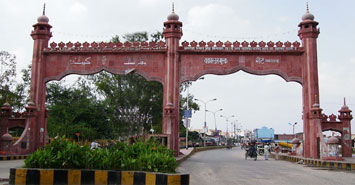
Waqar-ul-Mulk Gate Amroha

Waqar-ul-Mulk Gate Amroha

India has been a land of Rulers and Kings who traveled from far off lands and came here with the desire of wealth that India has beheld since ages.

The motive of these foreign invaders was greed but most of them stayed here mesmerized by this strange exotic land till their last breath. These invaders who ultimately settled here and contributed heavily to the culture, architecture and add to the general blend of Hindu and Muslim cultures.

And such amalgamation of cultures and religion lead to many stories and legends to be born. Adding to the mystic quality of this land, which through centuries had sustained its mythologies and beliefs. Even till today in spite of the modern technology and lifestyle, people still go back to their beliefs and faith.

One such instance is the small town of Amroha situated in Uttar Pradesh, 134 kilometers from Delhi. This town was established by King Amarjodha around 474 BC.

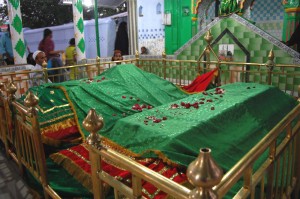
Mazar Hzt. Sharfuddin Shahwilayat

Mazar Hzt. Sharfuddin Shahwilayat

This town has great historical importance not only in respect to its age and ancient heritage, but also to this strange legend of the spiritual belongings. As legend goes, it was on 30 June 1272 AD when a saint came to this small town from a town Wasit in Iran via Multan. He was the Holy Saint–Syed Husain Sharafuddin Shahvilayat–. This town–Amroha–became his place of residence and prayer.

After his death his place of burial in Amroha came to become a famous place for pilgrimage and spiritual importance. It still draws huge believers and the non-believers equally. A strange phenomena occurs here. The grave site has a large numbers of scorpions, –a deadly venomous insect– they surprisingly don’t bite in the vicinity of the grave. This miracle has made many people to travel to this place even from far off lands for the authentication of the word of mouth. It is the inhabitants of this town– the Naqvi clan–who have their family tree traced – to Syed Shahvilayat proudly boast that one can carry the scorpion out of the shrine’s vicinity with the permission of the saint for a promised time, in which the scorpion will obey his master and not harm the carrier. If the time passes by, then there is no guarantee if the same scorpion stings.

Deadly Scorpion don’t bite in the vicinity of the grave

Deadly Scorpion don’t bite in the vicinity of the grave

It is also said that this shrine has medicinal cures for some ailments. Like in the case of corns which till date have no cure in modern medicine. It is said that if anyone suffering from corns brush their feet with broom that is used in the dargah the corns will be healed. Also adding to mystique of this place is in the autumn season that glucose pills fall from the tree which has sprouted from the grave of Bibi Bakhoi (daughter of the syed vilayat). And the same dissolves in the mouth instantly.

This area where the holy saint rests is also shared by his family members. His wife–Hazrat Kaneez Fatima urf Tahira–his son–Syed Amir Ali urf Doodha Dhari–his daughter–Bibi Bakhoi–his Grandson–Dade Raje– are some of the members of the family who rest here. Syed Amir Ali urf Doodha Dhari never ate food or drank water. He existed on milk alone. Therefore, another medicinal ability of the shrine shared by Syed Amir Ali urf Doodha Dhari is to provide milk to animals and women who are unable to lactate.

[ad#468]