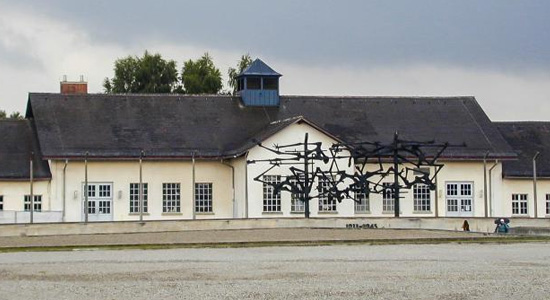
 One of my blogger friend Julia wrote in her ‘Don’t Despair’ column:
The inscription at the base of a statue at Dachau reads:
“To honor the dead, to warn the living.”
Dachau Concentration Camp, near Munich, Germany, August 2005
“We who lived in concentration camps can remember the men who walked through the huts comforting others, giving away their last piece of bread. They may have been few in number, but they offer sufficient proof that everything can be taken from a man but one thing: the last of the human freedoms — to choose one’s attitude in any given set of circumstances…” — Viktor Frankl
Viktor Frankl spent three years of his life in various concentration camps, including Dachau. I can’t begin to imagine what it was like in a Nazi death camp, but it does seem that witnessing what Frankl describes would have been stunning. We all long to believe that we could be heroic if called upon to be so; that we would be one of the few who would have been giving what little comfort we could to our fellow prisoners.
When someone gives you a few minutes of precious time by attending to your story, sending you a note or small gift or any other of a number of personal kindnesses, they are enacting the same spirit Frankl witnessed in the camps. When someone lets you into traffic instead of honking at you, waves you ahead in a line at the grocery, or gives you a smile or a friendly word just when you need it most, they are exercising the freedom to choose a caring attitude….End of the quote.
Let me reproduce few excerpts of the article I’d written and published in 2013.
London is a serene city and it was becoming too mundane and sanctimonious to brighten up my bruised soul. I had had an international heart break. Some of my friends gave heart-breaks in life and some helped to heal. A friend in Germany invited me promising good times and I quickly packed my necessary baggage. Took the earliest flight for Munich and sallied forth into the world of Mercedes, BMWs and Porches. A day in the Munich and walk-through tour of the city did make some subtle difference but the next day’s program was a secret that my friend advised to appreciate the way it comes.
Next morning he announced that we were going to ‘Dachau.’ The very name of this town conjures up some deadliest memories of human history. As early as 1935 there were jingles warning: “Dear God, make me dumb, that I may not to Dachau come.” Dachau concentration camp (German: Konzentrationslager (KZ) Dachau) was the first Nazi concentration camp opened in Germany. It is located on the grounds of an abandoned munitions factory near the medieval town of Dachau, about 16 km northwest of Munich in the state of Bavaria, a state of Kings and aristocrats and it is located in southern Germany.
Dachau served as a prototype and model for the other Nazi concentration camps that followed. Almost every community in Germany had members taken away to these camps. It was opened in March 1933. Heinrich Himmler, the Chief of Police of Munich had officially described this camp as “the first concentration camp for political prisoners.
We took Metro train No. S-2 from Munich Hoptbahnof in the direction Petershasun. Travel time was only 20 Minutes. From Dachau Rly Stn we boarded bus No. 726 to reach camp site, the first destination of our day.
“I’ve brought you a place where once every hope, every dream, every aspiration and every sense that nature has vested in a human beings was paired down to absolute minimum. You can’t fall down further. There existed no abyss after this.” My friend told me as we approached the main Gate.
Dachau is city that runs in circle and as a pantry man of a restaurant informed – even today the spirits of the victims roam in circles here. More than 2 lakhs prisoners from more than 30 countries were housed in Dachau of whom two-thirds were political prisoners and nearly one-third were Jews. 25,613 prisoners are believed to have died in the camp and almost another 10,000 in its sub camps primarily from disease, malnutrition and suicide. In early 1945, there was a typhus epidemic in the camp followed by an evacuation, in which large numbers of the weaker prisoners died.
On 29 April 1945, KZ Dachau was surrendered to the American Army by SS-Sturmscharführer Heinrich Wicker. A vivid description of the surrender appears in Brig. Gen. Henning Linden’s official “Report on Surrender of Dachau Concentration Camp”:
“As we moved down along the west side of the concentration camp and approached the southwest corner, three people approached down the road under a flag of truce. We met these people about 75 yards north of the southwest entrance to the camp. These three people were a Swiss Red Cross representative and two SS troopers who said they were the camp commander and assistant camp commander and that they had come into the camp on the night of the 28th to take over from the regular camp personnel for the purpose of turning the camp over to the advancing Americans.
The Swiss Red Cross representative acted as interpreter and stated that there were about 100 SS guards in the camp who had their arms stacked except for the people in the tower. He said he had given instructions that there would be no shots fired and it would take about 50 men to relieve the guards, as there were 42,000 half-crazed prisoners of war in the camp, many of them typhus infected.”
I was feeling nausea and wanted to leave the sight immediately.
“Do you realize that there are and there had been and there would always be people who are more unfortunate than you ? I have booked a taxi for Lake Steinberg !” I was listening to my friend. In a few minutes a smart lady appeared with her cab and we got into it leaving behind the goriest sight of human depravity.
Within minutes we were in a different world. Along the roads there were shady tree-lined avenues, tranquil orchards, cobbled streets and we passed through the villages whose farmsteads and houses have retained much of their original charm. White stork could be seen as reminder of virgin nature. We saw the glittering waterways and wooded hills. fortified stone churches and beautiful hard working people.
Finally we reached Lake Steinberg. Glaciers and melt water from the last ice age formed a landscape here that has a touch of Switzerland about it. Lush green pine covered hills surround the idyllic lake. You can observe very closely how geology was shaped by the last ice age. A whole host of breathtaking sights did wonders to my spirit. It was evening on the road and we had a nice discussion with our beautiful taxi driver who was not that smart in English :
“My mother taxi; my father taxi; me taxi…”“What about your kids ?” I asked her. “No, they go school !”
