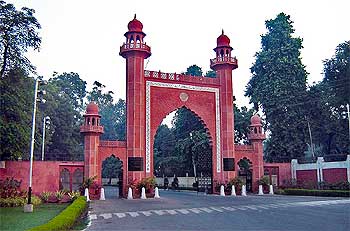
Aligarh Muslim University
On our way, my guide and friend, who had himself been a student of AMU, had narrated umpteen stories about the campus, its romance, its mysteries and its elegance. It was becoming almost impossible for me to sit in patience.
NEITHER am I going to tax the reader with the history of “Aligarh Tehreek” that rejuvenated the Muslims of the sub-continent nor is it my intention to pay my tributes to “Baba-Ey-Qoum” Sir Syed Ahmed Khan, a towering personality whose vision and foresight has changed the destiny of a trampled race. I’m a selfish chronicler and my thoughts would swirl around the sweet and sour memories of my own wonderful and formative period that was spent in this prestigious and renowned institution – Aligarh Muslim University.
More than four decades back, on a sweltering midnight, passing ‘Katpula Bridge’, trundling past the sacred shrine of ‘Baba Barchi Bhahdur’ a train came to a screeching halt at Aligarh Station. There was the usual cacophony of coolies, the commotion of disembarking passengers and the cries of chaye chaye chaye (tea). I was one among the restive people. I can still vividly recollect the new beginning of life that gave me a new direction.
On our way, in the train, my guide and friend, who himself was a student of AMU, had narrated umpteen stories about the campus, its romance, its mysteries and its elegance. It was becoming almost impossible for me to sit in patience. Every minute was hard to pass. I just wanted to see the magnificent buildings, the shimmering pools, the velvety grass and the fronds of palm trees that danced in the air like the ears of elephants.
I wanted to see the ’Union Hall’ where the future leaders of the country would deliver extempore speeches upon any topic under the sun and the showers of enlightenment would continue for hours and hours. I wanted to see the broken ‘Burj’ of the ‘Central Mosque’ which was hit with a pavilion shot of Moustaque Mohammed, a cricket grand-master of yesteryears. I wanted to see the “Riding Club” where there were still the horses from the stable of Nawab Raza Ali Khan of Rampur.
I wanted to see the handwritten Quran, in Kufi Script, by the fourth Caliph and the first Imam of Muslims Hazrat Ali. To attend the University Convocation and the birthday of Imam Ali, the twin functions celebrated with great fanfare at the campus and visit the house of the founder and also pay my tribute to one of the greatest stalwarts of Islamic history – Sir Syed Ahmed Khan.
It was my first exploration with the baggage of history and curiosity. Coming out of the station we took a rickshaw and so began the pilgrimage to my beloved alma mater. We passed the ‘Clock Tower’, ‘Government Press’, ‘Tibbiya College’ – a place to which Hakim Ajmal Khan was emotionally attached, “Naqvi Park’ – still a Naqvi Park for the University though the government changed its names several times, Lal Diggi – a pond drowned in mysteries and stories about bhoots and parees, Phoons Ka Bangla – a natural towering hut covered with straw and straw alone which was cooler inside than present day air-conditioners. And finally we arrived at ‘Faiz Gate”.
It is said that this gate originally belonged to some fort gate of a Nawab and he had donated it to the University. The stones were brought piece-by-piece from the ruins of a far-away fort and assembled here in exactly the pattern as it was in the original scheme. The gate was never used as a gate and today it stands as a sentinel to the tremendous progress the university had made in all these years. The gate is still closed. They have recently built another main gate nearby known as ’Bab-e-Syed’ a real grandiose structure, a new attraction.
More than four decades rolled by. I’m an old man today. My younger daughter was recently admitted to the graduate course. A third generation of Aligarian in my family is registering her name at the university. She is going to walk on the stones and pavement that have forgotten my footsteps. They say – Dharti maa remembers and recognises every stroller’s step. Maybe it is true but there is no one here who recognises me. I leave my daughter in the admission hall and walk down to the hostel which was once ‘Zia Uddin Hostel’ now renamed as ’Shibli Hostel’. I stand before my room. The room is locked.
Present inmates have gone somewhere. For a moment, time has frozen. This visit has stirred up old memories. Nostalgia starts to flow. It was once a place where I had enjoyed the best years of my life. Today no one here knows me. Time and tide waits for noone. I pick up some soil beneath the Amaltas tree that had grown like me. It was a sapling planted by Garib Shah – our gardener when we were freshers. The koel could still be there somewhere but it is silent at the moment. I put the soil in my pocket without any bag or paper.
Only one thing comes to my mind – where are those days which I can’t see but which I clearly feel right here right now.
“Where are the songs of spring? Ay, where are they?
Think not of them, thou hast thy music too
While barred clouds bloom the soft-dying day,
The redbreast whistles from a garden – croft,
And gathering swallows twitter in the skies.”
