Coming out of the woods after the routine completion of my morning walk I overheard the interesting conversation ofa gang of merry intended alfresco defecators and the gist of the talk could be summarised as follows:
“The Holy Scriptures say that one of the symptoms of nearness of Doom’s Day would the period when the people would begin to relieve themselves in their homes.”
It implies that open-air defecation is in accordance with the religious practice and all the body excreta should be discarded in the woods or desert quite far and outside, and not inside the homes of towns or residential complexes.
I didn’t believe that. But it spurred in my mind to put on the thinking cap. I went on to explore the veracity of their statement. And I tumbled upon some pioneer work of Prof. Mike Gruso and Dean Spears whose research focuses on developing country health and the regulations.
In their work on Medicare, they had used publicly available and large-scale administrative datasets to investigate up-coding by physicians. Their onerous observations on sanitation provides the first evidence that that open defecation, practiced by a billion people worldwide, generates large infant mortality externalities.
Their work has been featured in the New York Times, NPR, and the Economist magazine. Dean’s research focuses on children’s health and human capital, which these days often means height, sanitation, and social forces in Indian households and villages.
But the pick of the bunch was the Manusmriti line:
Far from his dwelling let him remove urine and excreta
– The Laws of Manu, Chapter 4 verse 151
According to environmentalists, ecologists and medical experts, the issue of open defecation is a commonsense hygiene and health issue.
If you live in or near an area where a lots of people are defecating in the open, the resultant increase in disease due fecal matter getting into water and food sources will lead to infections, higher disease and sickness.
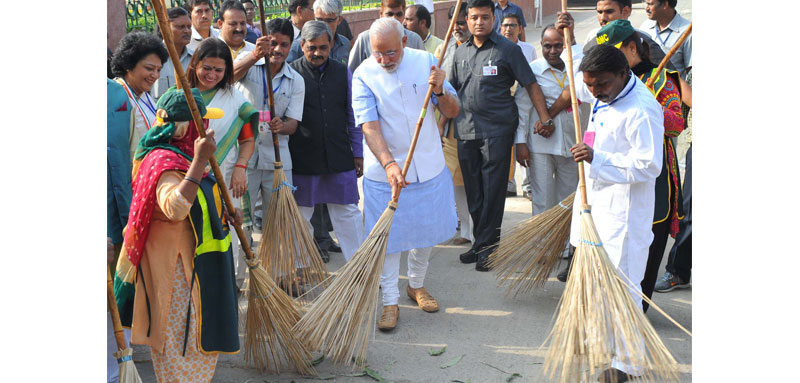
While leaders like Mahatma Gandhi and Vinoba Bhawe might have practiced and preached about hygiene and sanitation that inspired for voluntary cleaning of toilets and bathrooms, it was Prime Minister Narendra Modi who unveiled his Swachh Bharat Abhiyan or Clean India Mission, from the ramparts of the Red Fort on the occasion of India’s Independence Day on 15 August 2014.
I admire NaMo for the new mission. However, nothing much has really changed. When the trains enter the cosmopolitan cities early in the morning, the ugly and unbecoming sight of human beings of all ages and sex relieving unashamedly near the railways tracks welcomes the traveler.
In the small town’s streets and sidewalks choked with rotten belching refuse, the overflowing gutters and sewers, with no signs of being cleared any time soon are all too different from the India that is safely ensconced in fortified luxury esplanades.
Defecation in the open is too common a sight with the poor and the needy of the society’s soft underbelly having no recourse to toilets at home. It is a genuine problem.
Still, I feel, our attitude need gigantic changes. We have to inculcate the sense of cleaning among the less fortunate and we must accept that it is our problem though we might have a toilet attached to every every room of our villa or flat. We must know where the shoe pinches.
