Is the pen mightier than the sword?

Things were normal till his eldest son Sohrab refuses to attend the prestigious Indian Institute of Technology to which he has gained admission and his youngest daughter, Roshan, falls sick. Then the house falls prey to the usual pulls and pushes of life.

“SUCH A Long Journey” has  the city of Bombay in its background and begins in 1971. The novel’s protagonist is a hard-working bank clerk Gustad Noble. He is a member of the Parsi community and a devoted family man. He struggles to shield his wife Dilnavaz and three children from privations and poverty.

Things were normal till his eldest son Sohrab refused to attend the prestigious Indian Institute of Technology to which he had gained admission and his youngest daughter, Roshan, falls ill. And then the house falls victim of pulls and pushes of  life realities. Usual conflicts with his eccentric neighbors and his close friend  co-worker in Dinshawji’s life take the remaining space.

The book is based on an actual event : “the Nagarwala case”. It also gives glimpses of Pakistani torture during the separation with Bangladesh.

“Such a Long Journey” was prescribed for second year B.A. (English) in 2007 – 08. Needless to say that the book was recommended by University Board of Studies. And now we have had another story that is still in the crucible. The University administration had decided to withdraw it by September 15 !

Reason : As if the country was on short supply of Senas, the young scion Aditya Thackrey is coming with “Youa Sena”. It is well known that Thackrey Family is presently suffering from the loss of power and internecine conflicts within the family.

It needed a plank to catapult the boy to limelight as his father lacks carijma and grand father is in his twilight. His uncle is building his own empire away from them.

Naturally, like a barber’s son who is trained initially in his art on some innocent, indefensible customers, they needed some easy prey to make the Tamasha. And they have found it in the book.

President of Bhartiya Vidyarthi Sena, Abhijit Panse, feels the book is offensive to the people in Maharashtra and has abusive references to dabbawalahs, the mentality of the ‘Marathi manoos’ and Pandit Nehru.

Those who, are connected to books and novels know well that in a work of fiction, you have to be true to the characters you portray. It reflects what the characters think and not what the author thinks.

So the obedient V.C. Rajan Velukar used the emergency powers under Section 14 (7) of the Maharashtra University Act, 1994 and decided to withdraw the book form the syllabus.

Senior Journalist Aroon Tikekar is asking how a 20 year-old could go up to the Vice Chancellor and give him 24 hours to withdraw the book? There are protest and petitions from the enlightened citizens.

Let us see if pen is mightier than a sword!

Naim Naqvi

Naim Naqvi

Did his graduation in Science discipline from AMU in 1972-73. He was Secretary of University Ali Society in 1970 and M.M. Hall Literary Society in early 70 's and member of Tayyabji Literary Society. Did his Diploma in Bakery Administration from HTT College Oxford Street London in 1987. Worked with National Herald - Delhi, Blitz - Bombay as Trainee Journalist and in Production Department with 'Naya Sansar Pictures' of Khwaja Ahmed Abbas at Bombay in early 70's. Traveled for study and training purposes to Germany, U.K., Switzerland, France, Dubai, Oman, AbuDhabi, Bahrain and Philepines.

More Posts

Freida Pinto as Miral – a Palestinian Rebel

Miral, as it is claimed by the filmmakers, is a fast sweep across decades of the Mideast conflict. It shows the beautiful Palestinian landscapes and Pinto as a ravishing Arab beauty that is the part of legend.

BORN ON October 18, 1984 in Mumbai in a Mangalorean Catholic family, Freida Pinto, known best for her portrayal of Latika in the 2009 Academy Award winning film Slumdog Millionaire has moved from the Dharawi slums to the refugee camps of West Bank – Palestine.

She is acting in the film “Miral” a defiant Palestinian girl who fights against the tyranny of Israel with her limited resources and courage. For the Western audiences that are more used to movies showing Arabs as jokers, debauches and Islamic militants this film might compel to give a second thought to their biased obsession. It would try to offer a balanced and compassionate view of the Palestinians.

In the world so tightly controlled by Zionist and capitalists the film would come as a whiff of fresh air. “Miral” is directed by award-winning artist Julian Schnabel, a prominent Jew and with cameos by Willem Dafoe and Vanessa Redgrave.

Schnabel was named best director at the Cannes Film Festival in 2007 and awarded him a top prize for his movie “The Diving Bell and the Butterfly.” Yasmine al-Massri, a Paris-based Palestinian actress, who is playing as Pinto’s mother described the message of the film as follows:

“The ordinary American, who knows nothing about Palestine and knows nothing about our cause – it will be the first time he will sit and watch this story. We hope Pinto’s star power would draw audiences into cinemas and that Schnabel’s Jewish faith would deflect claims of bias.”

Miral, as it is claimed by the filmmakers, is a fast sweep across decades of the mid-east conflict. It shows the beautiful Palestinian landscapes and Pinto as a ravishing Arab beauty that is the part of legends. The director has tried to ensemble as much Palestinian history as possible. Miral was premiered at the Toronto Film Festival last month.

In this film the mother of the heroine is an alcoholic and commits suicide. Her conservative Muslim father struggles to raise her according to his rules.

She is admitted to a Palestinian children’s institution in Jerusalem. Miral tumbles headlong into the political storms of 1980’s and rebells against Israel’s military occupation. Miral tries to fight Israel and battle her father simultaneously. She falls for a handsome Palestinian fighter. The film runs for 112-minutes.

Naim Naqvi

Naim Naqvi

Did his graduation in Science discipline from AMU in 1972-73. He was Secretary of University Ali Society in 1970 and M.M. Hall Literary Society in early 70 's and member of Tayyabji Literary Society. Did his Diploma in Bakery Administration from HTT College Oxford Street London in 1987. Worked with National Herald - Delhi, Blitz - Bombay as Trainee Journalist and in Production Department with 'Naya Sansar Pictures' of Khwaja Ahmed Abbas at Bombay in early 70's. Traveled for study and training purposes to Germany, U.K., Switzerland, France, Dubai, Oman, AbuDhabi, Bahrain and Philepines.

More Posts

‘Bichrey sabhi bari bari’: How sad it is for Salman Khan!

'Bichrey sabhi bari bari': How sad it is for Salman Khan!

'Bichrey sabhi bari bari': How sad it is for Salman Khan!

To lose one girl makes you Devdas; to lose four makes you Salman Khan. I know there is one naughty Salman hiding in every boy. We hear love songs, we love ‘love songs.

‘ We all look for unconditional love; we all want to feel love.

I AM tired of politics and politicians; I am tired of their crooked ways and I want to talk abou

t love – no hate. I am looking for solace in life myself! Real life is too cruel for thos
e who got their dreams fulfilled and even for those who failed in life. There is theory of natural balance that works in real life.

From ‘Jab pyar kiya to darna kya’ to ‘Julie – I love you’ and to the present day’s ‘Sunday ko pyar hua; Monday Iqrar Hua; One day na jane ab kya hoga’, I am looking for genuine love and genuine lovers. My exploration and expedition has brought me to Mumbai (It was Bombay when the story started).

It was the deep green blue sea and the waves were lashing the foundations of ‘The Gate Of India’ and they were playing the old melody on boats ‘Teri do takiya kee noukri, mera lakhon ka savan jai…’. Life was going smooth and a lot of friends were telling about their exploits, successes and break ups.

We know that even the most diffident and shy boys want to fall in love at some stage of life. They always try somewhere with someone. Success and failures are secondary as long you don‘t decide to cut your wrist with or jump from the harbour with a determined intention not to come out of the deep end. Personal life of the scribe is not relevant here as the love in the cottage are not worth to discuss. I want to talk about the love stories that involved larger than life personalities.

No I can‘t discuss about Nehru flirtations with Lady Mountbatten or Dilip – Madhubala’s tragedy. They are too reverential to bring in this mundane talk. I would like to talk about the smooth operator Salman Khan – the boy one of us.

To lose one girl makes you Devdas; to lose four makes you Salman Khan. I know there is one naughty Salman hiding in every boy. We hear love songs, we love ‘love songs.’ We all look for unconditional love; we all want to feel love. We think about it, hope for it, fantasise about it, go to great lengths to achieve it, and feel that our lives are incomplete without it. We try to get it and don’t get. This we realise after marriage also and before a break-up also. We all live in make-believe world that is full of compromises. The lack of unconditional love is the cause of most of our anger and confusion and our emotional need for unconditional love is just as great as our physical need for air and food.

I believe Salman Khan looked for unconditional love in Sangeeta, Somi, Aishwarya and now in Katrina. Someone should tell the unlucky boy – he is looking for sprite!

The crux of the problem is – he is unaware of what unconditional love really is. You get it only from your parents and that also up to a certain age. Once you cross the milestone even the parental love becomes conditional. Crossing that threshold, our parents show their love and appreciation only when we do the right things—when we were clean, quiet, obedient and otherwise ‘good’— they love us. They smile at us and speak in gentle tones. But once we jump the lines from naughtiness to nastiness we are ‘bad’, and all those signs of ‘love’ instantly vanish. The first lesson of nature is – love is conditional, that we had to buy ‘love’ from the people around us with our words and behaviour.

So what kind of love Salman is looking for?

Real love! What is real love? Real love is caring about the happiness of another person without any thought for what we might get for ourselves. Real love is when we make foolish mistakes, when we fail to do what other people want, and even when we get in their way, but they don’t feel disappointed or irritated at us.

You are lucky if you get the real love and that love alone has the power to heal all wounds and create relationships quite beyond our present capacity to imagine. Salman Khan lives in a world of glinting crystals and frothing luxuries and here what you get what you got. Give up the dreams for . Settle in life with the new realities before it is too late.

Naim Naqvi

Naim Naqvi

Did his graduation in Science discipline from AMU in 1972-73. He was Secretary of University Ali Society in 1970 and M.M. Hall Literary Society in early 70 's and member of Tayyabji Literary Society. Did his Diploma in Bakery Administration from HTT College Oxford Street London in 1987. Worked with National Herald - Delhi, Blitz - Bombay as Trainee Journalist and in Production Department with 'Naya Sansar Pictures' of Khwaja Ahmed Abbas at Bombay in early 70's. Traveled for study and training purposes to Germany, U.K., Switzerland, France, Dubai, Oman, AbuDhabi, Bahrain and Philepines.

More Posts

Fiddlers on the Knesset

IT COULD have been the case of ‘left hand doesn’t know what the right hand is doing’ if it didn’t involve Benjamin Netanyahu and his most powerful Foreign Minister Avigdor Lieberman. “A final agreement between Israel and the Palestinians has to be based on a programme of exchange of territory and populations,” Lieberman told the United Nations General Assembly in New York.

And a quick repartee from the Prime Minister’s Office “Lieberman’s address was not coordinated with the prime minister,” adding that “Netanyahu is the one handling the negotiations on Israel’s behalf. The various issues surrounding a peace agreement will be discussed and decided only at the negotiating table, and nowhere else.”

The Israeli Foreign Minister Avigdor Lieberman gives the impression that Prime Minister Benjamin Netanyahu is spreading illusions and silly talk about peace. There is no chance for a permanent settlement for a generation. According to FM ‘exchange’ populated areas and adjust the state to its correct size which means that the Arab citizens of Israel must be expelled to the Palestinian side of the border. He suggested ceding parts of Israel with large Arab populations to a future Palestinian state in exchange for Israel keeping large settlement blocs in the West Bank, a proposal which has been part of his party’s platform. He said he expected the process ‘could take a few decades’.

Defenders or protégés of Prime Minister say, “Every time Foreign Minister Lieberman voices his skepticism about achieving peace, he undermines Prime Minister Benjamin Netanyahu’s credibility.”
But the irony is that Netanyahu had never considered the views of Lieberman views as illegitimate and he didn’t chastise his foreign minister for the speech.

Does it not reflect that Israel is a country which doesn’t have a responsible coherent foreign policy?
For few weeks Netanyahu had been investing or pretending to do so with gusto to convince the leaders of the world that he is serious about peace with the Palestinians. He had asked them to ignore the resumption of settlement construction, and tried to convince Palestinian Authority President Mahmoud Abbas not to quit the negotiations.

Settlement have started and dozers and dumpers are trampling the land of helpless Palestenians. Israel is least worried about the legitimacy or world opinion.

Now the most senior diplomat of PM tells the world that it is all crap that Netanyahu is faking. Even worse: the foreign minister is implying that Netanyahu’s demand that the Palestinians recognise Israel as a Jewish state is merely cover for the expulsion of Arab citizens.

The foreign minister made it clear on Tuesday (September 28) that his political partnership with Netanyahu is coming to an end. Lieberman will not back the peace process, which he considers unnecessary and damaging. Those, who know the reality were never in doubt about the expected performance of power game and political circus of Israel. While President Obama is trying to show going for his image, the poor Palestinians continue to suffer under the yoke of cruel and belligerent occupiers. That proves the adage – Might is Right!

Naim Naqvi

Naim Naqvi

Did his graduation in Science discipline from AMU in 1972-73. He was Secretary of University Ali Society in 1970 and M.M. Hall Literary Society in early 70 's and member of Tayyabji Literary Society. Did his Diploma in Bakery Administration from HTT College Oxford Street London in 1987. Worked with National Herald - Delhi, Blitz - Bombay as Trainee Journalist and in Production Department with 'Naya Sansar Pictures' of Khwaja Ahmed Abbas at Bombay in early 70's. Traveled for study and training purposes to Germany, U.K., Switzerland, France, Dubai, Oman, AbuDhabi, Bahrain and Philepines.

More Posts

Lata Mangeshkar, Mehdi Hassan coming together for Tera Milna

Lata Mangeshkar, Mehdi Hassan coming together for Tera Milna

Lata Mangeshkar, Mehdi Hassan coming together for Tera Milna

Few musical creations could be so pregnant with sentiments, history and talent as the forthcoming duet ‘Tera Milna’ between the singing legends Lata Mangeshkar and ‘Shehanshah-e-Ghazal’ Mehdi Hassan.

THERE IS always a silver lining with the darkest of clouds. As the adage goes : “Unka jo kam hai woh ahle siyasat janen, mera paigham mohabbat hai jahan tak pahuche.” Politicians could mind their business. My message is love no matter where it reaches.

So the two greatest muslical talents of India and Pakistan are telling the world.

Few musical creations could be so pregnant with sentiments, history and talent as the forthcoming duet “Tera Milna” between the singing legends Lata Mangeshkar and ‘Shehanshah-e-Ghazal’ Mehdi Hassan. Needless to say that this much awaited magic melody would be the first where the Nightingale of India would be seen with the Pride of Gazal from Pakistan. Mehdi Hassan Saheb is not keeping well for so many years. He always wanted to sing with Lata and finally his cherished dream has been fulfilled.

As the music lovers say – “Once in a lifetime, a man is born who will shake the consciousness and passion of the music industry. Such a man is Mehdi Hassan.”

According to Lata Mangeshkar, “He is the voice of God. Mehdi Saab always wanted to sing with me. In fact he sent me 2-3 recorded songs years back but he had to quit singing due to his prolonged illness. ‘Tera milna’ is one of them. I recorded my version here in Mumbai and Mehdi Saab’s version was recorded in Pakistan a year back. We have made a duet compiling the two versions.” Lata Ji would turns 81 on Tuesday.

Mehdi Hassan was born in Luna, a town near Jaipur, Rajasthan, India. Music runs in his blood for fifteen generations. His education in music began as soon as he could talk. Mehdi Hassan’s father, Ustad Azim Khan, was a notable classical singer in his time and a favorite of Maharaja of Jaipur.

Mehdi Hassan gave his first public performance at Maharaja of Barodi’s place when he was only 8 years old. He is master of vocal music like ‘Dhrupad’, ‘Khayal’, ‘Thumri’ and ‘Dadra’.

His family migrated to Pakistan after partition and young Mehdi adopted the profession of an automobile mechanic. However, lady luck was with him and with the would-be Ghazal lovers and he resumed his music career with in short while. Mehdi Hassan moved to Karachi and created his space in the music world.

In 1952, from Radio Pakistan Lahore, his first perennial ghazal,

‘Gulon may rang bharay, baad-e-nau bahar chalay’ was broadcasted. It was composed by Ghulam Qadir, the elder brother of Mehdi Hassan. It was also his first successful rendition which earned him name, fame and critical acclaim.

Though confined to his bed, he still rules the hearts and minds of Ghazal lovers all over the world.

Naim Naqvi

Naim Naqvi

Did his graduation in Science discipline from AMU in 1972-73. He was Secretary of University Ali Society in 1970 and M.M. Hall Literary Society in early 70 's and member of Tayyabji Literary Society. Did his Diploma in Bakery Administration from HTT College Oxford Street London in 1987. Worked with National Herald - Delhi, Blitz - Bombay as Trainee Journalist and in Production Department with 'Naya Sansar Pictures' of Khwaja Ahmed Abbas at Bombay in early 70's. Traveled for study and training purposes to Germany, U.K., Switzerland, France, Dubai, Oman, AbuDhabi, Bahrain and Philepines.

More Posts

Anarkali Madhubala: She still rules the hearts

Anarkali Madhubala: She still rules the hearts

Anarkali Madhubala: She still rules the hearts

Madhubala was the name given to her by Devika Rani. Her original name was Mumtaz Jehan Begum Dahelvi. She was the daughter of an imperious father Ata Ullah Khan, who had forced her to act in films at the delicate age of eight years.

OUT OF the distance of several decades, I can still vividly recollect my first pilgrimage to the city of my dreams – Bombay (now Mumbai). Before embarking on that journey I had always lived like and anchorite, with two ambitions in heart: first – to make enough money in this Eldorado and come back to my snobbish and aristocratic home town and demand and command respect from those, who had dropped me down as unprosperous connection. Second, to visit the grave of the fairy of my dreams – Madhubala – a human being I loved as a kid, as a child, as a juvenile delinquent and as a mature young man.

Madhubala was the name given to her by Devika Rani – a legend unto herself. Her original name was Mumtaz Jehan Begum Dahelvi. She was the daughter of an imperious father Ata Ullah Khan, who had forced her to act in films at the delicate age of eight years.

She was born on Valentine Day, on February 14, 1937, and she died on February 23, 1968, just nine days after her birthday. Few days before her death she had asked her sister to bring the mirror. She was so shocked to see the face in mirror that she couldn’t speak coherently till she breathed her last. Her dominating and commanding father picked for her so many inconsequential films that it took longer than necessary to establish her as a serious actress again. His father for whatever reasons never liked Dilip Saheb.

“Mahal” was the film directed by legendary Kamal Amrohi that catapulted her to stardom. She had played the enigmatic role of the daughter of a gardener against super star Ashok Kumar. Before the release of the film, Kamal Amrohi’s advisers told him to punch out the song – ‘Ayega anewala’. They said it was meaningless and would confuse the viewers. Kamal refused to accept argument saying that Madhubala’s presence on the screen would clear all confusions. He was right as even today this song of Lata Mangeshkar remains one of the favourite of millions.

Her life was marked with disappointments. In 1951, she had met Dilip Kumar on the set of ‘Tarana’. She was 18 then. She fell in love with Dilip Kumar and sent her hair dresser with a billet doux (love letter) in Urdu along with a Red Rose asking him to accept it if he loved hem. The tragedy-king was amused and intrigued at the gesture and accepted the rose. The flame of this ill-fated romance kindled on for seven years and finally it was extinguished by her father in an ugly melodrama which bruised and wounded her till she entered her last resting place.

She was laid to bed with a heart disease. However, she carried her work in films despite her illness. She had a punctured heart valve and she often used to cough up blood on sets.
Eventually her illness forced her to end her career in ‘Jwala’.

She died but her magic lives on. Even after 40 years of her death she commands immense respect, love and adoration. Her posters are sold at premium price on the urban streets. People still visit the houses where her pictures are hung just to have a look at her oxygenated smile. The deep expression of her eyes and the curl of her lips still transport the viewer into the ethereal dream. I don’t know how much I would write if I have no constraint of space. I have seen all her 70 movies during my stay in Bombay and visited her grave like a Sajjadah Nasheen (one who takes care of the grave).

The only thing I forgot about her was the time I had spent when I had visited the grave of the Venus of Indian screen for the first time.

Naim Naqvi

Naim Naqvi

Did his graduation in Science discipline from AMU in 1972-73. He was Secretary of University Ali Society in 1970 and M.M. Hall Literary Society in early 70 's and member of Tayyabji Literary Society. Did his Diploma in Bakery Administration from HTT College Oxford Street London in 1987. Worked with National Herald - Delhi, Blitz - Bombay as Trainee Journalist and in Production Department with 'Naya Sansar Pictures' of Khwaja Ahmed Abbas at Bombay in early 70's. Traveled for study and training purposes to Germany, U.K., Switzerland, France, Dubai, Oman, AbuDhabi, Bahrain and Philepines.

More Posts

Teenager dies collecting potable water in the heart of Delhi

Teenager dies collecting potable water in the heart of Delhi

Teenager dies collecting potable water in the heart of Delhi

The gleaming new image of India with the Commonwealth Games and a false show of gallop towards an incredible future will be true only when we weed out poverty and disease within our people.

THE SENTINEL of Indian history Qutab Minar was rising majestically from the morning reef of clouds. Sleek and long cars had begun to zip through the Mehrauli-Badarpur (MB) Road. All kinds of traffic were making its presence felt at various speeds.

On the left side there is Saket a posh colony, a residential complex of parvenus and arriving big-shots; on the rights are some clustered hamlets of have-nots of Syed-ul-Ajaib – a township or village which has seen the rise and fall of Chauhans, Ghories, Slave dynasty, Khiljis, Lodhis and Mughals. Every dynasty has left it marks in this area skirting the famed Aravali Ridge.

Here, the M B Road makes a clean divide between the rich and the poor, demarcates between the haves and have-nots and speaks between those, who have taken their morning shower from the scented waters and those who are waiting with empty chattels for the municipal water supply tanker.

The less-miserables don’t know the difference between the water that comes in patented bottles or the clear liquid they get and can call it water. For them the tanker is a blessing of God and gift from Sheila Dikshit and they have always been thankful for that. Hope, fear and gratitude, all reflexes, clearly reflect in their eyes as they wait for the arrival of this bounty of nature and government.

The morning was no different, the denizens of Indira Camp were waiting for the water supply vehicle of Delhi Jal Board. At 6.30am when the tanker reached, the water seekers gathered around it.

Like a pack of wolves the impatient crowd boarded the truck to reach the pipes as quickly as they could. They climbed the tanker from every side. One of those desperate climber was a fourteen years old boy Ali Asghar. On seeing the huge rush and scramble for water, the driver started moving the truck.

At this point Ali Asghar lost the balance and fell from the vehicle. He came under its wheel and died on the spot. Later, the local people blocked the traffic for over two hours to show their indignation. Life of a teenager was lost for few drops of water. That is the story of a poor boy! That is the story of a India that is shining.

The question is whether India’s need of the hour is to impress the foreigners or face the harsh realities of the pangs of the underprivileged, and of the poor whose margins are small; who live on one square meal; whose survival or death is related to the Delhi Jal Board water supply vehicle? It is of no use joining modern industrialised nations with the swanky new airport terminals, when,, here in the national capital, we can’t properly provide the basic needs of life.

The gleaming new image of India with the Commonwealth Games and a false show of an incredible future will be true only when we weed out poverty and disease within our people. Dressing a sick entity in bright new colours is like painting a crumbling edifice to make it look brand new. It is of no use!

Naim Naqvi

Naim Naqvi

Did his graduation in Science discipline from AMU in 1972-73. He was Secretary of University Ali Society in 1970 and M.M. Hall Literary Society in early 70 's and member of Tayyabji Literary Society. Did his Diploma in Bakery Administration from HTT College Oxford Street London in 1987. Worked with National Herald - Delhi, Blitz - Bombay as Trainee Journalist and in Production Department with 'Naya Sansar Pictures' of Khwaja Ahmed Abbas at Bombay in early 70's. Traveled for study and training purposes to Germany, U.K., Switzerland, France, Dubai, Oman, AbuDhabi, Bahrain and Philepines.

More Posts

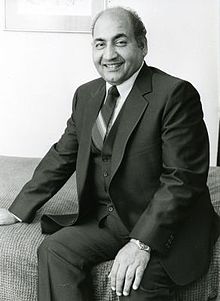
Mohammed Rafi: The evergreen voice remembered

Mohammed_Rafi

Mohammed_Rafi

‘Ek Dil ke Tukde Hazar Hue’ from the Suraiya-Rehman starrer Pyar ki Jeet (1948) is a good example of that indelible mark of GM. ‘Dulari’s’ famous song Suhani Raat Dhal Chuki gave his career a flying start with superb music by Naushad.

IT WOULD be no exaggeration to state that Mohammed Rafi was the most versatile singer in the history of Indian Cinema. He was capable to sing for anyone in any style. Rafi proved his versatility by singing for Dilip Kumar, Dev Anand, Shammi Kapoor, Rajendra Kumar, Johnny Walker, Sunil Dutt, Biswajeet, Joy Mukherjee, Dharmendra, Shashi Kapoor, Raaj Kumar and Amitabh; and many more.

Can any music lover forget the classical “ Madhuban Mein Radhika Nachi Re ?” Some believe that ‘Oh Duniya Ke Rakhwale..Sun Dard Bharey” is the greatest song of Indian films till date.

Rafi was born in Kotla Sultan village, about 30 kms from Amritsar in Punjab on December 24, 1924. He died on July 31, 1980. Rafi was a very simple man, who would talk straight from his heart and used to help everyone in need. Rafi moved to Lahore at the unripe age of 14.

In Lahore, he studied music under Khan Abdul Waheed Khan, Jeevanlal Matto and Ghulam Ali Khan. He was introduced to Radio Lahore by composer Feroz Nizami and made his film debut as playback singer in the Punjabi film Gul Baloch (1944) singing for composer Shyam Sunder.

In 1944, Rafi landed in Mumbai (then Bombay). His first break was with Naushad in Pehle Aap (1944). Naushad gave him more chances in Anmol Ghadi (1946), Tera Khilona Toota Balak and in Shah Jehan (1946) where he sang only few lines in a duet with K L Saigal. Only few remember the maestro GM Durrani, whose singing had influenced Rafi.

“Ek Dil ke Tukde Hazar Hue” from the Suraiya-Rehman starrer Pyar ki Jeet (1948) is a good example of that indelible mark of GM. “Dulari’s” famous song Suhani Raat Dhal Chuki gave his career a flying start with superb music by Naushad. Thereafter, Rafi never looked back.

However, the first challenge to his singing came in 1971, when his popularity plummeted and Kishore Kumar took over.

He was a great human being as he did never lose his composure in prosperity or in adversity. He remained humble and soft-spoken through every up and down.

He made a spectacular comeback with the Nasir Hussain musical Hum Kisi se Kum Nahin (1977) and Amar Akbar Anthony in the same year even winning the National Award for Kya Hua Tera Vada for the former. Unfortunately, he had left little time to enjoy the second phase of success. On 31st July,1980, Rafi died of heart attack.

Rafi has left a vast treasure for every music lover for every occasion. May his soul rest in peace.

Naim Naqvi

Naim Naqvi

Did his graduation in Science discipline from AMU in 1972-73. He was Secretary of University Ali Society in 1970 and M.M. Hall Literary Society in early 70 's and member of Tayyabji Literary Society. Did his Diploma in Bakery Administration from HTT College Oxford Street London in 1987. Worked with National Herald - Delhi, Blitz - Bombay as Trainee Journalist and in Production Department with 'Naya Sansar Pictures' of Khwaja Ahmed Abbas at Bombay in early 70's. Traveled for study and training purposes to Germany, U.K., Switzerland, France, Dubai, Oman, AbuDhabi, Bahrain and Philepines.

More Posts

What’s Kashmir Martyr’s Day

Jammu became part of the Sikh Kingdom of the Punjab, under Maharaja Ranjit Singh. Ranjit Singh bestowed the place as a jagir on Gulab Singh, who belonged to the Jamwal Rajput clan that ruled Jammu. As a jagirdar for the Sikhs, Gulab Singh extended the boundaries of the Sikh kingdom to western Tibet with the help of Zorawar Singh. The Sikh rule was then extended beyond the Jammu Region and the Kashmir Valley to include the Tibetan Buddhist Kingdom of Ladakh and the Emirates of Hunza, Gilgit and Nagar.

After the First Anglo-Sikh War in 1846, Sir Henry Lawrence was appointed British Resident and Lal Singh was asked to surrender Kashmir. Under the terms of the Treaty of Amritsar, the British government then sold Kashmir for a sum of 7.5 million rupees to Maharaja Gulab Singh, who had been their loyal ally against the Sikhs. Jammu again became an independent Rajput Kingdom under Maharaja Gulab Singh, as per the treaties, Treaty of Lahore, signed between the British and the Sikhs.

The origin of Marty’s Day in Kashmir can be traced back to the struggle that was born on July 13, 1931 when Kashmiris raised rebellion against the despotic ruler Hari Singh.
Here is a brief history of Marty’s Day of Kashmir.

On April 19, 1931, the Dogra King applied the ban of Eid Khutba (Sermon). It ignited widespread demonstrations in the Jummu city for a number of days. It was followed by alleged desecration of the Holy Qur’an at the hands of Dogra forces. It resulted into outrage among the Muslims throughout the state. In Srinagar, people gathered in Jamia Masjid to denounce this incidnet. One such get-together was held in Khankah-e-Muella Srinagar, which was addressed by prominent Kashmiris. When the meeting was concluded, a youth, Abdul Qadeer, pointing his finger to the Maharaja’s palace, raised slogans “destroy its every brick”. With the accusation of sedition, he was arrested forthwith. Abdul Qadir was to be tried in the court but due to large public resentment, the court was shifted to Central Jail Srinagar.

On July 12, 1931, in response to the shifting of court, intense public protests were held throughout the city. The next day, on July 13, 1931, thousands of people thronged the Central Jail Srinagar to witness the in-camera trial of Abdul Qadeer. As the time for obligatory prayer approached, a young Kashmiri stood for Azan. The Dogra Governor, Ray Zada Tartilok Chand ordered soldiers to open fire at him. When he got martyred, another young man took his place and started Azan. He was also shot dead. In this way, 22 Kashmiris were killed in their efforts to complete the Azan.

The people carried the dead and paraded through the streets of Srinagar, chanting slogans against Dogra brutalities. Complete strike was observed in the city, which was followed by weeklong mourning. This incident shook the whole state and the traffic from Srinagar to Rawalpindi and Srinagar to Jammu came to halt from July 13 to 26, 1931. The 22 martyrs are buried in Martyrs’ Graveyard at Khawaja Bazar, Srinagar. Kasmiris commemorated this day as marty’s Day.
Omar Abdullah visited the martyrs’ graveyard in the early hours of Monday morning along with senior state government officers and offered tributes to the martyrs under tight security.

Moderate leadership of the pro-freedom camp who had announced a march from the martyrs graveyard to the Red Square of the capital city, were either arrested or detained in their respective houses.

Mirwaiz Umer Farooq, leader of the moderate faction, had asked people to gather at the martyrs’ graveyard situated adjacent to the shrine of Sufi sant Baha-ud-din Naqashbandi in the old part of this city and later march to Red Square. Hurriyat had also announced that during the mammoth rally there. Despite stringent security a slogan shouting small group of people led by second wrung Hurriyat leaders managed to reach near the square but were immediately arrested.

Naim Naqvi

Naim Naqvi

Did his graduation in Science discipline from AMU in 1972-73. He was Secretary of University Ali Society in 1970 and M.M. Hall Literary Society in early 70 's and member of Tayyabji Literary Society. Did his Diploma in Bakery Administration from HTT College Oxford Street London in 1987. Worked with National Herald - Delhi, Blitz - Bombay as Trainee Journalist and in Production Department with 'Naya Sansar Pictures' of Khwaja Ahmed Abbas at Bombay in early 70's. Traveled for study and training purposes to Germany, U.K., Switzerland, France, Dubai, Oman, AbuDhabi, Bahrain and Philepines.

More Posts

Shakira and Waka Waka

shakira

shakira

AFRICA HAS no dearth of singers, especially female to perform for the World Cup. To name a few: Amani from Kenya is one of the biggest female singing sensations of Africa and had been nominated for several awards. Siphokazi is one of the most popular Mzansi singer. Ary from Angola and Zamajobe from the host country South Africa – the soulful jazzy singer, and Lira from the same place who had an awesome 2009, as she picked up four South African Music Awards. The organisers skipped over all these prominent names and picked up Shakira Isabel Mebarak Ripoll for Waka Waka which she will perform at World Cup closing on Sunday (July 11). The singer called herself the ‘Daughter of Africa.’ There had been resentment in the African continent since it was picked by FIFA as the anthem for the tournament over a host of black performers. However, with her million dollar smile and affable manners she won everyone’s heart. The fairy-faced Colombian made a touching statement- “I feel an umbilical cord ties her with Africa.” She struck a sympathetic chord. She made another very diplomatically sentimental statement, “South Africa has enormous power in its people. At this World Cup, the fans of this country have reflected the tolerance shown by Mandela.”

No more hard feelings!
Shakira is a regular fixture at the World Cup. After her ‘Hips Don’t Lie’ performance ahead of the 2006 World Cup in Berlin, this will be her second performance at the football extravaganza. Shakira revealed that she hit upon Waka Waka during her stay at her farm in Uruguay. “I was walking to the house from the barn and it suddenly came to me. I first recorded it with just the guitar and it sounded well,” she said. “The FIFA concert was one of the most emotional experiences of my career. This has been one of the happiest months in my life.”

Just as all children are born with the potential to learn to speak and understand their native language, all children are born with the potential to learn, to perform and to understand their culture’s music.

Shakira means ‘woman of grace’ in Arabic. She gives credits to her father’s Lebanese heritage for her Middle Eastern-influenced dance moves. “I think it is something in my DNA. I have been belly-dancing since I was four.”
The beautiful singer had had her share of tragedies also. Her half brother was killed when a drunk driver hits the motorcycle he was riding. Just two at the time, the singer says that her first memory is learning of his death. “It made me very necrophobic. For a long time I feared death in all its aspects.

Unlike others, she wrote or co-wrote nearly all of her own songs and in the process gained a reputation of a poetic lyricist. When she released her first English lyric in late 2001, she became an instant pop sensation.

She was born on February 2, 1977, in Barranquilla, Colombia, into a poor family. Her mother was a native Colombian and her father was of Lebanese descent. Shakira imbibed up music from both cultures. She also listened and learned studiously English-language rock and roll. She had written her first song at age eight and learned guitar at the age of 11. In 1990, at the age of 13, she moved to Bogotá to pursue the modeling career, but ended at singing with Sony’s Colombian division. Her 1991 debut album, Magia (Magic), was comprised of songs she’d written over the past five or six years, including some of her earliest efforts. The magic of her voice kept the world spell bound.

Naim Naqvi

Naim Naqvi

Did his graduation in Science discipline from AMU in 1972-73. He was Secretary of University Ali Society in 1970 and M.M. Hall Literary Society in early 70 's and member of Tayyabji Literary Society. Did his Diploma in Bakery Administration from HTT College Oxford Street London in 1987. Worked with National Herald - Delhi, Blitz - Bombay as Trainee Journalist and in Production Department with 'Naya Sansar Pictures' of Khwaja Ahmed Abbas at Bombay in early 70's. Traveled for study and training purposes to Germany, U.K., Switzerland, France, Dubai, Oman, AbuDhabi, Bahrain and Philepines.

More Posts