Another winter another Gandhi

He was not even 12 as it appeared from his decrepit bony figure. I’m writing about a bedraggled and unkempt kid who, if alive might still be struggling to find his identity.

HISTORY IS often made to glorify or destroy one individual. Ironically, the individual I am talking about was not even a grown-up man but a child. He was not even 12 as it appeared from his decrepit bony figure. I’m writing about a bedraggled and unkempt kid who, if alive might still be struggling to find his identity.

It is another matter that I am lucky as I am writing his story sitting in a room warmed with an oil heater. Where is he at this moment? I don’t know. It is difficult to survive the Delhi nights with the deadly chill on the road while the mercury is touching 7 degree Celsius.

A few days ago I had to make an urgent trip to Lucknow. I was able to afford Tatkal payment for ‘Garib Rath’ so I entered the train with Rs. 800 and a worn-out traveler’s brief-case. He had boarded the train with shards and flints in his dirty crooked hands with the nails that were never cut. His torn shirt had no pocket.

His trousers had so many colors that you could call it VIBGYOR in action under the domination of soiled hue. Having entered the compartment I checked my berth and planted myself like a Maharajah. He stood in the middle of the berths and began with a dirge of Talat Mehmood’s – “Aey mere dil kaheen aour chal, ghum ki duniya se dil bhar gaya….dhoond le ab koyi ghar naya.”

I remember Talat Mehmood – the golden voice of Indian cinema who became the second victim of creative intrigues of film industry after Master Madan. Talat was my childhood favourite and the child’s rendition of this in this wintry evening put the clock back for me.

Talat was a singer of the century. He was compelled by circumstances to sing at the birthday parties and weddings of the rich in five star hotels. This child was obviously a beggar and his circumstances had put him in Garib Rath. His delivery was clear with a fair grip over pronunciation that reflected his background. He played with those flints in his fingers with a mastery that could put to shame many of our copy-cat music directors. The train was yet to leave Hazrat Nizam Uddin Railway Station and the passengers were still boarding the train. After the performance he held out his palm with an appeal in his bleary eyes. Some one rupee coins were thrown at him and he disappeared.

“Garib Rath” was Laluji’s baby to make the middle classes enjoy the luxury for at least one night at reasonable prices, what the rich take for granted. It doesn’t have the shutters of ordinary trains which you could pull down after smoking the bidi or when the icy wind chills your bones. It has packed glass-windows which run the length of the train. Your chattering teeth stop hitting their sharp edges once you enter the compartment. When I looked out there were hundreds and hundreds of people on the platforms waiting for other destinations. I appreciated the new sense of discipline of Delhi boarders as no one was knocking at the door “let us in, we know you have space in there!” At the assigned time the train pulled out of station.

My co-passenger in the next seat was a Mantriji’s relative and his retinue. As the train crossed Ghaziabad, two suitcases were erected vertically and a long rectangular six-ply plank was perched on it. A servant put up the day’s newspaper on the plank to make a smart table. Some tiffin materialized from somewhere and presto! It was a healthy competition between “Chappan Bhog” and “Kareem Nematkada” right before my eyes.

They asked me to join in. I politely refused as a principle. My heart was willing my mind was discrete. A lot of food was still on the table when Mantriji’s relative and his staff called it a night. The residue was gathered and wrapped in the crumpled newspaper in a slip-shod way and pushed under the seats. After some time the travellers began to feel drowsy and berths were unfolded, the lights of the compartment were switched off and Garib Rath rather the ‘poor’s palace-on-wheels’ continued its journey.

I got up around midnight to go to the toilet. It was an unfriendly hour but you can‘t refuse the call of nature. One needs to be a circus acrobat if you want to land safely on the floor from the 3rd tier height. As I was struggling with my belt, there was a barrage of rarest abuse just outside. Then there was more banging and I felt more secure inside than outside.

As the commotion came down to a low pitch I gathered courage and ventured out. Now I was fully awake. There were people in the corridor and all were embroiled in high pitched dialogue about a train-thief. I was wondering if I was dreaming this but it was for real. The same boy at the door. Now he had a small broom in his hand for cleaning the floor of the compartment. He was almost hanging from the door. I thought they were pushing him out. No, they were not that unkind. They were just abusing him for not getting down at Moradabad. Someone instructed him to get down at the next station.

I said, “Don’t be silly. Where he will go in this chilly night?”
“Saley bhikari char atae hain…………”.
“But where will he go?” I tried to reason with him.

“Aap bahut hamdard ban rahe ho. Jab tumhara kuch qeemti chal jaega to hum hi ko ilzam doge.” You are showing compassion for him but you would be the first to complain when any of your costly belongings are stolen. Poverty has many reasons to turn to crime. The poor are aware of that trait and rich are more afraid of that trait.
Garib Rath slowed down as the next stop was approaching. A new station, a new destination for few arrived but it didn’t matter for the passengers who were bound for longer destinations. This boy was offloaded at a station which was never his destination. I may be wrong. Any station could be a destination of a poor kid.

A few decades back Mahatma Gandhi was thrown out of a train in South Africa. He was strong and he had fought against that treatment. His had succeeded in liberating his own country from the same races. Tonight a new Gandhi failed desperately in his own country. One of Gandhi’s children was again kicked out of the train in winter. This kid is not the first and would not be the last who will be thrown out of a moving train. Another Mohd Toughlaq was defeated tonight; another without-ticket kid might have become the object of Talat’s melody – out of this duniya of ghum – ghum ki duniya se dil bhar gaya. Perhaps this winter is too cold to survive.

Naim Naqvi

Naim Naqvi

Did his graduation in Science discipline from AMU in 1972-73. He was Secretary of University Ali Society in 1970 and M.M. Hall Literary Society in early 70 's and member of Tayyabji Literary Society. Did his Diploma in Bakery Administration from HTT College Oxford Street London in 1987. Worked with National Herald - Delhi, Blitz - Bombay as Trainee Journalist and in Production Department with 'Naya Sansar Pictures' of Khwaja Ahmed Abbas at Bombay in early 70's. Traveled for study and training purposes to Germany, U.K., Switzerland, France, Dubai, Oman, AbuDhabi, Bahrain and Philepines.

More Posts

Moharrum – where Hindus and Muslims Unite

One can observe the richness and beauty of the diversity of Indian Culture at the occasion of Muharram. Since the martyrdom of Imam Hussain, Muharram ceremonies are observed all over the world including India. Hindus take part in them with great reverence and devotion. The tragedy of Karbala has become the harbinger for interfaith understanding in the Indian sub-continent. Participation of Hindus in the mourning rituals of Imam Hussain has been a feature of Hinduism for centuries in large parts of India. Hindus, Sikhs, Jains and even Christians observe Muharram. In the city of Varanasi which is the holiest city for Hindus many Hindu families participate in Muharram processions.

A Hindu poet had once said:
“Baad marne ke bhee matam ki sada aati rahi,
Log harat se meri jalti chita dekha kiye”.
Translation: The sound of lamentation (at the martyrdom of Imam Hussain) continued even after my death. The people watched my burning pyre with adoration and admiration.

One can notice the same spirit of love, respect and sadness for Imam Hussain in Lucknow, Allahabad, Kanpur, Hyderabad, Kolkatta, Mumbai, Chennai, Amroha, Indore, Nagpur, Jaipur, Bhopal and other major cities and towns. In several cities Hindus also take part with enthusiasm in making the taziyas (replicas of the Imam Husain’s mausoleum in Karbala). Varanasi’s Shivala Mohalla boasts of the most artistic taziya, and a replica of Zuljinah, Imam Hussain’s brave horse which is given milk in a traditional ritual in many cities.

Readers of this blog would find it interesting to learn that the Hindu rulers of Vijayanagar in Deccan (southern India) built wonderful Imambaras during the 16th and 17th centuries. They even wore the black garments of mourning during the first 10 days of the month of Muharram. Muharram processions during the 18th and 19th centuries were taken out by the Hindus in Rajasthan, Gujarat and Maharashtra with rath-shaped (Hindu chariots) tazias. The Maratha kingdoms like the Scindias of Gwalior, the Holkars of Indore, the Gaekwads of Baroda and the Bhonsle of Kolhapur and Pune till now observe Muharram rituals with great devotion.

Let us forgive and forget the recent conflagrations caused by those who are not even aware of the meaning and message of Hinduism and Islam and recollect that during the dynastic Hindu rules they strived to create interfaith understanding between Muslims and Hindus by observing Muharram ceremonies. The most famous of them all was the Rajah of Gwalior, a state in central India. The Rajah used to go barefoot with the procession every year on the day of Ashura, holding a replica of Imam Hussain’s mausoleum.. Many Hindus in Lucknow fast with Muslims on this day, while others distribute sherbet (sweet juices) and iced milk to those participating in the Muharram processions. Lucknow also boasts of several Hindu ‘imambaras’ (mausoleums). One such is the ‘Kishnu Khalifa ka Imambara’ in Bashiratganj locality in the old city area. The Imambara, established in 1880, is famous for its Hindu ‘azadars’ (devotees) who observe Muharram with all the religiosity of the Muslims. In Lucknow, seat of the Shia nawabs of Awadh, prominent Hindu noblemen like Raja Tikait Rai and Raja Bilas Rai built Imambaras to house alams, the standards representing the Karbala event.

Muharram is an unique occasion in the socio-cultural fabric of Indian history which presents an unparalleled example of Hindu-Muslim unity. Let us go to South India and you will find the non-Muslim tribal Lambadi community in Andhra Pradesh has their own genre of Muharram lamentation songs in Telugu. Among certain Hindu castes in Rajasthan, the Karbala battle is recounted by staging plays in which the death of Imam Hussain is enacted, after which the women of the village come out in a procession, crying and cursing Yazid for his cruelty.

Let me talk about Madhya Pradesh. The Sharma Hindu families have been taking out the Tazia procession on Muharram for more than 120 years in some districts of Madhya Pradesh. The ritual began in 1882 when the Raikwar family of the Vidisha town began preparing and taking out Tazias on the ninth day of Muharram. Since then, the Raikwar’s Tazia leads the procession of mourners on Muharram, and moves ahead of the long line of replicas of Imam Hussain’s tomb and flags along the streets. Like several Muslim families across the globe, the Raikwar family members, too, set aside their daily chores to grieve for the grandson of Prophet Muhammad. He is one of the greatest personality of Islam and he is loved, respected and admired for his courage and fortitude against the inhuman, corrupt, delinquent and tyrant ruler Yazid, the son of Muawiah. According to historical references Yazid was not properly educated with the teachings of Islam. He used to drink alcohol, gamble, and commit all other cardinal sins. This despot transformed the face of the Islam of Prophet and made it subservient to his whims, fancies and debauchery. He was the real terrorist and he had brought back the old unprincipled life-style that Prophet and his companions had banished and destroyed from ordinary life. Truth, Justice, Equality, Freedom and Liberty were all at stake during his rule. All precious values were disappearing from the life as the ruler was flouting the tenets of Islam. The restoration of those values demanded rebellion against the tyrant ruler and it meant the sacrifice of life of Imam. He chose the path of danger and hardships and never swerved from it, giving up his life. Imam Hussain was martyred in the Karbala along with 72 members of his family and companions. For three days the supply of water and food was completely cut off by the rulers. However, that didn’t weaken the reslove and determination of Imam and he refused to surrender.

Imam Hussain is everybody’s hero. He was the embodiment of virtues of piety, courage and self-sacrifice. He did not seek power. His message was for everyone.

“The Hindu”, one of the largest selling English daily in India reported in its 31 January, 2007 issue that a large number of Hindus participated in the `Tazia’ procession along with Muslims at Pulimankulam in Tamil Nadu state. The procession was led by V. Nayaz Ahmed Bijili and H. Habeebur Rahman Bijili, hereditary trustees of the Athangarai Pallivasal Dargah. Hindus from Sokkalingapuram, Urumankulam, Tiruvamabalapuram and Avudayalpuram, marched towards the `chavadi’, where the `Panjas’ were installed, and offered prayers.

Naim Naqvi

Naim Naqvi

Did his graduation in Science discipline from AMU in 1972-73. He was Secretary of University Ali Society in 1970 and M.M. Hall Literary Society in early 70 's and member of Tayyabji Literary Society. Did his Diploma in Bakery Administration from HTT College Oxford Street London in 1987. Worked with National Herald - Delhi, Blitz - Bombay as Trainee Journalist and in Production Department with 'Naya Sansar Pictures' of Khwaja Ahmed Abbas at Bombay in early 70's. Traveled for study and training purposes to Germany, U.K., Switzerland, France, Dubai, Oman, AbuDhabi, Bahrain and Philepines.

More Posts

Message of Moharrum

The sight of moon and the month of Moharram is a reminder to people that one should fight against oppression and tyranny and help the cause of the oppressed. It rekindles the values that are so dear to all humanity.

SUFI SAINT Khawaja Moinuddin Chishty Ajmeri had said:

“Shah ast Hussain, badshah ast Hussain
Deen ast Hussain, deen panaah ast Hussain
Sar daad, na daad dast dar dast-e-yazeed
Haqu-e-binney la ilaahaa ast Hussain.”

It means:
Hussain is the King, he is King of Kings,
Hussain is Faith , he is the Protector of Faith.
He gave his Head, but not his Hand in the hand of Yazid Verily, truth is nothing but Hussain.
Over one thousand three hundred and fifty years ago, on the 10th of Muharram, just a short time before sundown a man stood on a sand-dune at Karbala. He was bleeding from several wounds on his body. He had lost everything. Since early morning he had carried several dead bodies into his camp. He had even buried his infant child. He looked at the bodies of his loved ones. Tears flowed  down his eyes. He looked at the sky and seemed to draw some strength from an unseen source. Then, like a muezzin (one who calls Azan) from a minaret, he raised a call:
Is there anyone who will come to assist us?
Is there anyone who will respond to our call for aid?
He turned direction and repeated the call.
His call was not meant to ask the help for himself. No, he was calling to save humanity!

Islam is the religion of peace, justice and freedom. It made its appearance in the era of darkness when killings were a way to solve problems. Society was fueled with feuds. If one was born in a low-family, it would mean eternal slavery, oppression, and stripping of any and all rights. The Holy Prophet (PBUH) gave as clarion call against those ways. He strived for justice and equality. He preached the Monotheistic Concept of God and gave us one of the most precious gifts, namely the collective duty to stand for the Haqq (Truth) and denounce Batil (Falsehood). He taught humanity to stand up to oppressors and tyrants no matter what the price was to be paid.  He advocated that it does not require a majority to prevail, but rather a profoundly faithful few, who are keen to uphold the truth and sacrifice for it.


Imam Husain was the grandson of Prophet Mohd (PBUH). He was the son of the 4th Caliph of Islam Hazrat Ali (KAW) and Bibi Fatimah (SAA) – the daughter of Prophet. On the 10th of Muharram, 61 after Hijrah (680 AD) Imam Hussain was martyred by the army of Yazid and this tragedy shook the Muslim world. His martyrdom continues to be remembered by those who love the Prophet (PBUH) and his family.
Everybody knows that Islamic Calendar is Lunar. At the end of month of Dil Hijja (In Urdu it is called Zil Hij) the first visible sight of the slight Crescent moon (Hilal) in the sky announces the arrival of Moharrum – the first month of the New Islamic Year. While every Muslim prays for the beginning of anew year full of happiness and prosperity, the month of Moharrum also reminds of the martyrdom of Imam Hussain.

Imam Hussain is one the greatest personality of Islam as he is loved, respected and admired for his courage and fortitude as he rebelled against the inhuman, corrupt, delinquent and tyrant ruler Yezied, the son of Muawiah. According to historical references Yezied was not properly educated with the teachings of Islam. He used to drink alcohol, gamble, and commit all other sins. This despot transformed the face of the Islam of Prophet and made it a subservient of his whims and fancies. He brought back the old debauch and unprincipled life-style that Prophet and his companions banished and destroyed from ordinary life.  Truth, Justice, Equality, Freedom and Liberty were all at stake during his rule. All precious values were disappearing from the life of Islam and that demanded precious sacrifice. Imam Hussain chose the path of danger and hardships and never swerved from it giving up his life.

The sight of moon and the month of Moharram is a reminder to people that one should fight against oppression and tyranny and help the cause of the oppressed. It rekindles the values that are so dear to all humanity.


Naim Naqvi

Naim Naqvi

Did his graduation in Science discipline from AMU in 1972-73. He was Secretary of University Ali Society in 1970 and M.M. Hall Literary Society in early 70 's and member of Tayyabji Literary Society. Did his Diploma in Bakery Administration from HTT College Oxford Street London in 1987. Worked with National Herald - Delhi, Blitz - Bombay as Trainee Journalist and in Production Department with 'Naya Sansar Pictures' of Khwaja Ahmed Abbas at Bombay in early 70's. Traveled for study and training purposes to Germany, U.K., Switzerland, France, Dubai, Oman, AbuDhabi, Bahrain and Philepines.

More Posts

Mandir Waheen Banega

What is left for this villain of peace to say any more in Parliament? He was the cat’s paw of RSS in the heinous deed and he is proud of that. ‘Mandir waheen banega…” the slogan has lost its luster. RSS, its cohorts and fellow travelers fail to understand that history can never be corrected. All those who have demolished the places of worship irrespective of religion, caste and creed are no more alive. Why can’t we just forget the ugly past and make a new begining? Be rational and ask the government to show courage and let the supreme court give its full and final judgment. This would and should heal either way. You have n the places where Ram was supposed to have born. Just because a place of mosque is incidentally to be one on them so put every emphasis on liberation of that place to keep the wounds festering. It is no logic. Don’t use Astha as instrument of black mail for ever. Nations, religions, states and individual rise and fall with time. There is plenty to learn from past.

Naim Naqvi

Naim Naqvi

Did his graduation in Science discipline from AMU in 1972-73. He was Secretary of University Ali Society in 1970 and M.M. Hall Literary Society in early 70 's and member of Tayyabji Literary Society. Did his Diploma in Bakery Administration from HTT College Oxford Street London in 1987. Worked with National Herald - Delhi, Blitz - Bombay as Trainee Journalist and in Production Department with 'Naya Sansar Pictures' of Khwaja Ahmed Abbas at Bombay in early 70's. Traveled for study and training purposes to Germany, U.K., Switzerland, France, Dubai, Oman, AbuDhabi, Bahrain and Philepines.

More Posts

Some fact about history of Amroha

Rafaqat Ali
MA (English) Aligarh

The right & correct answer for all these questions if at all is not impossible hence, does look a difficult preposition! There is no sign of certified history prior to the Islamic regime. In Hinduism there had been no system prevailing that time to preserve and record to historian events. Apart from the historic books of literature yet there are no ancient signs left within “AMROHA” or in its surroundings concerning the Hindu regime, which could highlight the important historical event. This township however, has something to indicate & refer through its name in the Sanskrit language that this residential part did get rehabilitated during the course of time when the language Sanskrit had been prevailing in conversation or at least it had been so commonly used in keeping to locate the names for the township or the cities. The minimum course of time for the same can be termed and referred 500 years BC. In this very context the existence of “AMROHA” may be counted, understood & known to have got rehabilitated since, the period of 2500 years.

These also get an indication of reasonable confirmation from the referred place. Whereby the population is referred in the name of Raja Amar Jodh from the town “HASTINAPUR” In the west of “AMROHA” within the distance of 5 km, still there exists a town normally “Gajasthal”. Its widely known that Raja of “AMROHA” used to keep this Elephants within this yard(Than).

The name of the specific place has been produced and constituted from the words (GUJJ) meaning Elephant and (ASTHAL) meaning House of Elephants which does solidly indicate that the Town ships in these surroundings ultimately get to be rehabilitated in the course of time when the language Sanskrit had been used mostly during conversation.
In reality name “AMROHA” has been derived from a compact word of Sanskrit language namely “AMROVANAM” Which means “Place of Mangoes”.

During the rising age of Arian Nation Northern Ancient town ship in the northern India had their names kept and known in the prevailing Sanskrit language on the names of the valuable trees of various kinds like Rivers, Wheat, Plants, Valued & working Animals therefore, with in the united provincialism the names of the many more town ships, where the mango trees and the Dry Fruits plantation had been exclusive or such trees had their own self preserved Jungles, such as in the district KANPUR and the township of AMROOD & AMOORAHA etc. During the course of time in the beginning and at the end of these names the changes having been taking place such as from “AMROVANAM” it got converted in to “AMROHA” and eventual it is finally left as “AMROHA” from the name “AMROHA” .The Persian writers during the Islamic regime in the context of “ANBAH” means (Mango) used to write “AMBROHA”.

During the rule of King Jahangir many of the historical & literary books yet continued to have the name “AMROHA” written in the style of “AMBROHA”.

[ad#468]

The land of Scorpions

Shariq H Naqvi

Student, Jamia Millia Islamia,New Delhi

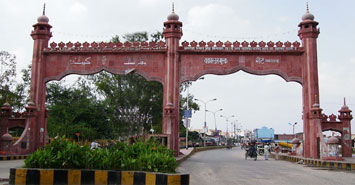
Waqar-ul-Mulk Gate Amroha

Waqar-ul-Mulk Gate Amroha

India has been a land of Rulers and Kings who traveled from far off lands and came here with the desire of wealth that India has beheld since ages.

The motive of these foreign invaders was greed but most of them stayed here mesmerized by this strange exotic land till their last breath. These invaders who ultimately settled here and contributed heavily to the culture, architecture and add to the general blend of Hindu and Muslim cultures.

And such amalgamation of cultures and religion lead to many stories and legends to be born. Adding to the mystic quality of this land, which through centuries had sustained its mythologies and beliefs. Even till today in spite of the modern technology and lifestyle, people still go back to their beliefs and faith.

One such instance is the small town of Amroha situated in Uttar Pradesh, 134 kilometers from Delhi. This town was established by King Amarjodha around 474 BC.

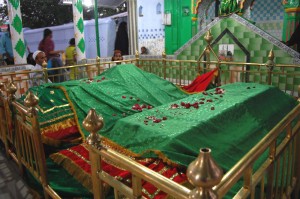
Mazar Hzt. Sharfuddin Shahwilayat

Mazar Hzt. Sharfuddin Shahwilayat

This town has great historical importance not only in respect to its age and ancient heritage, but also to this strange legend of the spiritual belongings. As legend goes, it was on 30 June 1272 AD when a saint came to this small town from a town Wasit in Iran via Multan. He was the Holy Saint–Syed Husain Sharafuddin Shahvilayat–. This town–Amroha–became his place of residence and prayer.

After his death his place of burial in Amroha came to become a famous place for pilgrimage and spiritual importance. It still draws huge believers and the non-believers equally. A strange phenomena occurs here. The grave site has a large numbers of scorpions, –a deadly venomous insect– they surprisingly don’t bite in the vicinity of the grave. This miracle has made many people to travel to this place even from far off lands for the authentication of the word of mouth. It is the inhabitants of this town– the Naqvi clan–who have their family tree traced – to Syed Shahvilayat proudly boast that one can carry the scorpion out of the shrine’s vicinity with the permission of the saint for a promised time, in which the scorpion will obey his master and not harm the carrier. If the time passes by, then there is no guarantee if the same scorpion stings.

Deadly Scorpion don’t bite in the vicinity of the grave

Deadly Scorpion don’t bite in the vicinity of the grave

It is also said that this shrine has medicinal cures for some ailments. Like in the case of corns which till date have no cure in modern medicine. It is said that if anyone suffering from corns brush their feet with broom that is used in the dargah the corns will be healed. Also adding to mystique of this place is in the autumn season that glucose pills fall from the tree which has sprouted from the grave of Bibi Bakhoi (daughter of the syed vilayat). And the same dissolves in the mouth instantly.

This area where the holy saint rests is also shared by his family members. His wife–Hazrat Kaneez Fatima urf Tahira–his son–Syed Amir Ali urf Doodha Dhari–his daughter–Bibi Bakhoi–his Grandson–Dade Raje– are some of the members of the family who rest here. Syed Amir Ali urf Doodha Dhari never ate food or drank water. He existed on milk alone. Therefore, another medicinal ability of the shrine shared by Syed Amir Ali urf Doodha Dhari is to provide milk to animals and women who are unable to lactate.

[ad#468]

Amroha At A Glance

Amroha is a very old township. Local theories of the origin of its name differ. One derives ‘Amroha’ from the Sanskrit word “Amrovanam, the region of mangoes” another is that the name is compound of “Aam” (mango) and “Rohu” (a Kind of fish), whereas yet another traces the word of Raja Amarjoda of Bansi empire, who was in 474 B.C. named the region Amroha.

Historical buildings:

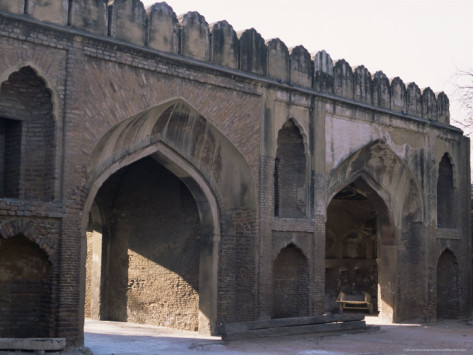
  • Moradabadi Darwaza: The historical buildings of Amroha begin with the fort wall, remnants of which still stand. The wall had several gates. The Moradabadi Darwaza, built by Syed Abdul Majid in 1642 A.D., is the only extant gate. Road passing through this gate connects Amroha with Moradabad. It is built of Lakhori bricks. It is about fifty feet high. Amroha is richly endowed with monuments. Several mosques, dargahs, imambaras, madarsas and mandirs.
  • Ashraful Masajid: “Ashraful Masajid” in Mohalla Shafaat Pota, belongs to Shia Muslims. It was constructed by Shaikh Ashraf Ali Azimabadi in 1817 A.D. which is a beautiful and well planned mosque. It has seven cusped arches, the central one bigger than the others. It is having three decorated domes, two high minarets. It was ones repaired in 1867 A.D and has gone under massive renovation in recent past. Amroha also has one `Eid Gaah’ for holding Id-ul-Fitr and Id-al-Azha prayers. This was constructed by Ghulam Ahmed in 1764 A.D.
  • Vasudev Teerth: There are some old monuments in the complex of “Vasudev Teerth”. There is a tank about 40 meters x 40 meters in area. In the middle of the tank there is one small “Hanuman Mandir” for which there is no direct approach as it is surrounded by water. On all the four sides of the tank there are temples. It is considered as the oldest temple of Amroha.
  • Dargah Shah Vilayat: When Shah Sharfuddin came and settled at Amroha, Shah Naseeruddin Chishti, who had long been settled there and considered Amroha as his vilayat, came to know about that he had a “mug” full of water sent to Sharfuddin meaning by this that Amroha – his Vilayat – was full like “mug”. In reply Shah Shafuddin put a flower in that “mug” filled with water meaning that though Amroha was already full, he would live in that place like that of flower in the “mug”. Undeterred by the opposition of the Chishti Saint Shah Sharfuddin settled down at Amroha and adopted the title of Shah Vilayat. Even today he is called Shah Vilayat by the people of Amroha. Enraged by Sharfuddin’s intention for settlement at Amroha Naseeruddin cursed that after the death of Sharfuddin scorpions would be found around his grave. Sharfuddin restored that those scorpions would not sting and that asses would be roaming about near the grave of Naseeruddin. “But these asses” asserted Naseeruddin, “would not dung.”

The dargah of Shah Sharfuddin Shah Vilayat has an enormous complex of different tombs. Its entrance is a roofed gate. Outside the dargah there are old structures all around — graves, gardens and ruins. An old creeper from the grave of the daughter of Shah Vilayat is called as “Choti” which is climbing on the tree. It is said that her real choti remains outside her grave which was later on converted into a creeper giving the resemblance of a “Choti”.

[ad#468]

Syed Khamis Ali

Syed Khamis Ali

Syed Khamis Ali S/o Late Jb. Mohd Munawwar Naqvi Moh. Darbar-e-Shah wilayat (Lakda) Amroha. Currently residing in Zakir Nagar, New Delhi, founder 'Capra India' and ' ShahWilayat Goat Farms' worked with Larsen and Toubro Ltd. as a chemical engineer (Oil & Gas sector).

More Posts - Website

Attack on IBN office , freedom at a price

There are probably thousands of journalists at work today who are no less courageous than the fallen. Courage is not a quality we can assign only to those who have not survived their pursuit of a story.

TWO PERIODICALS were running my articles about Shiva Sena and its chief with some reference to Emergency when IBN7 office was ransacked. The moment these attacks took place, those articles were removed from the sites. I can understand that. I am glad that IBN’s journalists not only survived the heinous attack but they caught the goondas. As a member of journalistic community I know we have a long way to go. We have to pay the price to protect our freedoms.

There is an unending list of journalists who had sacrificed their lives in normal democracies, banana democracies and the world’s most murderous countries as well. Examples of unstoppable courage are not uncommon. In Latin America, South Asia, Eastern Europe, and the Middle East, many murdered journalists foresaw what awaited them.

There are probably thousands of journalists at work today who are no less courageous than the fallen. Courage is not a quality we can assign only to those who have not survived their pursuit of a story. They are living examples of the values for which their colleagues have died. They awake each morning knowing that at any moment they too could be killed for holding the powerful and corrupt accountable.

They go to work each morning with the conviction that the calling of journalism is to defend the defenseless. The men and women they investigated believed in the opposite principle: that the weak offered opportunities for the enrichment of the powerful. These predators dominate the societies in which the journalists live. I think anyone can identify with the deadly risks the journalists took if one recognizes that they are standing against the might of tyrants.

They did not arrive from somewhere else to seek adventure in their corrupt and violent lands. We should think of those the next time we hear about journalists who have been murdered in faraway places. They have followed in the footsteps of colleagues who pressed on, knowing the fate that awaited them. They refused to bow to threats, wrote their last expose, and would have written their next had not the expected assassin arrived to stop them.

Naim Naqvi

Naim Naqvi

Did his graduation in Science discipline from AMU in 1972-73. He was Secretary of University Ali Society in 1970 and M.M. Hall Literary Society in early 70 's and member of Tayyabji Literary Society. Did his Diploma in Bakery Administration from HTT College Oxford Street London in 1987. Worked with National Herald - Delhi, Blitz - Bombay as Trainee Journalist and in Production Department with 'Naya Sansar Pictures' of Khwaja Ahmed Abbas at Bombay in early 70's. Traveled for study and training purposes to Germany, U.K., Switzerland, France, Dubai, Oman, AbuDhabi, Bahrain and Philepines.

More Posts

Sachin Tendulkar – The giant killer

Sachin-Tendulkar

Sachin-Tendulkar

By criticising Sachin Tendulkar’s patriotic fervour, Balasaheb Thackarey has truly bitten more than he could chew. As the nation leapt into Sachin’s defence, the master blaster inadvertently knocked down a much bigger target this time.

ONCE UPON a time, India was a liberal and tolerant place. Then we started learning how to control free thinking and free writing. Somewhere along the way, creative artists and writers also fumbled and forgot that with freedom comes certain responsibilities.

Then came the Emergency and the state told us, it knew better what was food for us, our family and our nation. The public rejected these concepts outright and the originator of these concepts. Then, Kudip Nayar came with his landmark book,“The Judgement”. It told everything about dictatorship, its evolution and it’s obnoxious outcome. We were back on the track of liberty and civilised life.

That was a time when a cartoonist had already graduated into politics and experimented with success about the applied art of mobbing. He had the patronage of Congress Party as its ebullient Chief Minister VP Naik and was ruling the rich state of Maharashtra. The name of the cartoonist was Balasaheb Keshew Thackeray.

He had started his career in the Free Press Journal in Mumbai in the 1950s. His cartoons were also published in the Sunday edition of The Times of India. In 1960, tasting some name and fame, he decided to launch his own cartoon weekly Marmik with his brother. Initially, it was publishing articles provoking Marathi Monoos against Gujarati businessmen, who wielded immense influence and south Indian labour, who were available at pittance. Thackeray formed the Shiv Sena on June 19, 1966 and its main objective was to ensure job security for Maharashtrians against immigrants from southern India, Gujaratis and Marwaris.

Within a short time, Shiv Sena transformed into an anti-communist organisation, which challenged and wrested control of major trade unions in Mumbai from the CPI. The Shiva Saniks gained strength and some of them even began to demand protection money from Gujarati and Marwari business leaders.

It later allied itself with the Bharatiya Janata Party (BJP). The BJP-Shiv Sena combine won the 1995 Maharashtra state assembly elections and came to power. During the tenure of the government from 1995 to 1999, Thackeray was nicknamed “remote control”, since he played a major role in government policies and decisions from behind-the-scenes.

On November 11, 2009, Thackeray published an editorial in Saamana which criticised a statement made by Sachin Tendulkar in an interview where he said “Mumbai belongs to India… I am a Maharashtrian and am extremely proud of that, but I am an Indian first.”

This time he made a remark that he would regret all his life. He bit more than he could chew. Today, Indians have realised the truth and everyone, including Marathi Manoos, have joined the nation in condemning the politics and ideology of the Thackareys.

Sachin has made a master stroke which is heavier, impressive, convincing and long lasting. The cookie is finally broken. David has subdued the Golaith !

Naim Naqvi

Naim Naqvi

Did his graduation in Science discipline from AMU in 1972-73. He was Secretary of University Ali Society in 1970 and M.M. Hall Literary Society in early 70 's and member of Tayyabji Literary Society. Did his Diploma in Bakery Administration from HTT College Oxford Street London in 1987. Worked with National Herald - Delhi, Blitz - Bombay as Trainee Journalist and in Production Department with 'Naya Sansar Pictures' of Khwaja Ahmed Abbas at Bombay in early 70's. Traveled for study and training purposes to Germany, U.K., Switzerland, France, Dubai, Oman, AbuDhabi, Bahrain and Philepines.

More Posts

A bridge near the Kashmiri Gate

Kashmiri Gate

Kashmiri Gate

It happened at Koria Pul – one of the oldest bridge connecting Kashmiri Gate and Chandni Chowk; the two glittering chapters of Moughal history, the two sides of a railway divide. Night had suddenly grown colder and I was feeling alone in this heartless city. I was an unemployed bachelor, adrift, caught in the currents of mysteries of life. I had to walk down from Panja Shareef to Ballimaran as last pennies of my pockets stopped ringing. Someone had promised me to meet and a job could have been a possible outcome of that pregnant encounter. Nothing materialized and the next reality was the procurement of the evening meals that has to materialize from somewhere if I had to survive.

From that side of Kasmhiri Gate every step at the access of the bridge was heavier than the previous one. In this frightening loneliness I was trying to lose my thoughts in howling whistles of passing trains. I still had my muffler and darned over- all to protecte me from cold winds. As most of the doors which had any possibility of any opening or hope for the job had already been knocked and banged. Nothing succeeds like and success and nothing flops like a failed life. “I was the unluckiest and unwanted creature and there seemed to be no great reason to vouchsafe this world with my existence. This problems-infested world could have done better without me.” Those were the thoughts that haunted me as I minced my steps and looked up at the cloudless sky seeking some answers from one who was letting me cross that foggy night through this Koria Pul, hungry and helpless. Every dark night has a dawn and darker the clouds brighter the silver-lining – Optimism is the last refuge of a hapless soul.

There were scant any passenger across the bridge and I was the Knight of the Bridge at the moment. Then, from nowhere a tattered lady approached in a circuitous move and pulled the corner of my dress.
“Babu Ji, I’m hungry. Give me some money to eat. I shall pray for you and my baby will pray for you.” Irony of fate. A beggar was checking a destitute. I tried to look the other way. I didn’t know who wanted to laugh at my miseries at this juncture. Some times the sense of humor sparks at worst of the moments.
“I have a hundred rupee note. Do you have the change ?” I thought my howler would make her disappear.

“No, I don’t have. Please babu help me.” She replied and persisted.
“Why do you beg and why can’t you find some work for you instead of roaming the streets in this cold winter ?” I tried to reason with her without realizing that there was a mirror put in front of my face by this bedraggled unkempt mother.
“The kid is too small. If I go for work who would take care of her ?”
That was her problem but a logical man can’t accept begging as a worth while occupation to survive upon this planet which was so full of bubbling opportunities.

The child lay quiet, without moan as the mother began to unfold her thin torn shawl by gentle degree, looking down with anxious solitude at that concealed object – a miniature of suffering humanity.
The baby stretched her punny hand and feebly caressed he protectress.
Looking at me with imploring pity she again accosted , this time with more assurance and boldness.
“De na babu Allah tera bhala karega.”(Give babu, God will help you.)
“Sure, but I don’t know when Allah will help me.” I don’t remember if I said or not but she listened.

I saw her walking ahead of me with a kind of poise which if difficult to define in words. After a few steps, she stopped and looked back, waited for me.
“Down the bridge you can get the change. I come with you. Give me something babu I have to feed the baby.” I was annoyed and petrified at the script of the scene written for this strange situation by no one but who knows everything.

Under the light of lamp post I could see the exposed face of the baby. It was infinitely more touching than ever I saw – a beauty in the pathos of sleep.
Now I could see the shivering woman with her exposed body from the chinks of torn dress. We had already reached thedescending side abutting Chandni Chowk. For the whole world it was Chandni Chowk (The Brightened Square) but probably for three human beings, at the moment, it was the darkest side of a brightest square.

I remove my muffler with a flick and throw it at her.
“Bibi, I was lying. I have had nothing – no hundred rupee note, not even one rupee note. Take my muffler and protect yourself from the blistering cold weather and let me go.”

Naim Naqvi

Naim Naqvi

Did his graduation in Science discipline from AMU in 1972-73. He was Secretary of University Ali Society in 1970 and M.M. Hall Literary Society in early 70 's and member of Tayyabji Literary Society. Did his Diploma in Bakery Administration from HTT College Oxford Street London in 1987. Worked with National Herald - Delhi, Blitz - Bombay as Trainee Journalist and in Production Department with 'Naya Sansar Pictures' of Khwaja Ahmed Abbas at Bombay in early 70's. Traveled for study and training purposes to Germany, U.K., Switzerland, France, Dubai, Oman, AbuDhabi, Bahrain and Philepines.

More Posts