Fiza: A strong, wise woman

We all make decisions throughout our life – some are automatic, some are well-thought-out and some are outright blunders. The last ones are based on inchoate thinking and emotions that could be the result of over-stress.

WE ALL make decisions throughout our life – some are automatic, some are well-thought-out and some are outright blunders. The last ones are based on inchoate thinking and emotions that could be the result of over-stress. One wrong decision can change the course of life forever. As one Urdu poet said:

Bus ek qadam utha tha ghalat rah-e-shouq men.
Manzil tamam umr mujhe dhoondti rahee.

Marriage is the biggest turning point in a person’s life. Partners are supposed to treat each other with respect and trust. They must support one another and agree on goals together. They must show equal commitment to the relationship and nurture it to the best of their abilities. Consider the story of Anuradha Bali who fell into the trap set by a wily married politician; the enchantress in her was trapped in an illusion, the lawyer floundered, wisdom failed and common sense became the first casualty. She failed to learn anything from her previous failed marriage. She allowed herself to be exploited and destroyed by the greedy impostor – the product of a clan of political-seasoned opportunists.

Anyone else would have easily turned into a dismal, broken spirit and a pulverised wreck after all she had undergone. She had made a formidable mistake. However in the aftermath of the traumatic relationship she learned to accept the situation and she attempted to correct the course as best as she could. She made every effort to salvage the flotsam of her floundered life and in the process lost almost everything.

What remained with her was her integrity of character and her faith. It is difficult for me to believe that it was her love and respect for Islam that compelled her to become a Muslim. From Sunil Dutt-Nargis to Dharmedra-Hema there is a never ending stream of couples who used the tenets of Islam for their dubious and ulterior motives and of course the case of Chandra Mohan-Anuradha Bali is the most recent.

However, it is to her credit that once she entered to the fold of Islam, she remained loyal and remained faithful to the new faith she had acquired. In an interview with Divya, A she said, “After converting to Islam and assuming my present name, I have adopted its tenets from the core of my heart and would remain Fiza till death.”

Religion is a very personal matter. It is the equation between the individual and God. Whatever faith we follow, most of us are religious people and it is our duty not to make a mockery of our faith. Chandra Mohan brought disgrace to both Hinduism and Islam. Fiza made some interesting comments under duress but it is worth reflecting on her inherited values: “He (the CM) has gone insane. He seems to be changing his religion as often as he changes his wives. All of the members of his family need psychiatric counselling so that they do not play with women’s lives.”

Chandra Mohan had finally gone back to his original Bishnoi fold. We don’t know what he would do if he were to encounter the next beautiful damsel to walk his way. Meanwhile, Fiza, out of the furnace of her life’s tribulations, is trying hard to reassemble the remaining shattered pieces of her life. She appears to be wise, serene, cool and still vibrant. She had not surrendered or accepted defeat.

Life goes on. She ended her interview with the following words:
“It’s not been a normal life and I have now left it to God to take care of things. I don’t even wish to find the logic of things in what He does to me. I trust Him and the logic of things will unfold in future if I can’t understand it now.” We all make mistakes – some repairable, some fatal. Let us not laugh at her folly. She is a wise and strong woman who fell prey to a man’s evil designs. She remains an intelligent and sharp lawyer – a beautiful personality indeed. She has the dignity to accept her mistakes. She can still make amends and go the glorious path of life. We wish you all the best in life Fiza.

Naim Naqvi

Naim Naqvi

Did his graduation in Science discipline from AMU in 1972-73. He was Secretary of University Ali Society in 1970 and M.M. Hall Literary Society in early 70 's and member of Tayyabji Literary Society. Did his Diploma in Bakery Administration from HTT College Oxford Street London in 1987. Worked with National Herald - Delhi, Blitz - Bombay as Trainee Journalist and in Production Department with 'Naya Sansar Pictures' of Khwaja Ahmed Abbas at Bombay in early 70's. Traveled for study and training purposes to Germany, U.K., Switzerland, France, Dubai, Oman, AbuDhabi, Bahrain and Philepines.

More Posts

Forget me not, my alma mater

Aligarh Muslim University

Aligarh Muslim University

On our way, my guide and friend, who had himself been a student of AMU, had narrated umpteen stories about the campus, its romance, its mysteries and its elegance. It was becoming almost impossible for me to sit in patience.

NEITHER am I going to tax the reader with the history of “Aligarh Tehreek” that rejuvenated the Muslims of the sub-continent nor is it my intention to pay my tributes to “Baba-Ey-Qoum” Sir Syed Ahmed Khan, a towering personality whose vision and foresight has changed the destiny of a trampled race. I’m a selfish chronicler and my thoughts would swirl around the sweet and sour memories of my own wonderful and formative period that was spent in this prestigious and renowned institution – Aligarh Muslim University.

More than four decades back, on a sweltering midnight, passing ‘Katpula Bridge’, trundling past the sacred shrine of ‘Baba Barchi Bhahdur’ a train came to a screeching halt at Aligarh Station. There was the usual cacophony of coolies, the commotion of disembarking passengers and the cries of chaye chaye chaye (tea). I was one among the restive people. I can still vividly recollect the new beginning of life that gave me a new direction.

On our way, in the train, my guide and friend, who himself was a student of AMU, had narrated umpteen stories about the campus, its romance, its mysteries and its elegance. It was becoming almost impossible for me to sit in patience. Every minute was hard to pass. I just wanted to see the magnificent buildings, the shimmering pools, the velvety grass and the fronds of palm trees that danced in the air like the ears of elephants.

I wanted to see the ’Union Hall’ where the future leaders of the country would deliver extempore speeches upon any topic under the sun and the showers of enlightenment would continue for hours and hours. I wanted to see the broken ‘Burj’ of the ‘Central Mosque’ which was hit with a pavilion shot of Moustaque Mohammed, a cricket grand-master of yesteryears. I wanted to see the “Riding Club” where there were still the horses from the stable of Nawab Raza Ali Khan of Rampur.

I wanted to see the handwritten Quran, in Kufi Script, by the fourth Caliph and the first Imam of Muslims Hazrat Ali. To attend the University Convocation and the birthday of Imam Ali, the twin functions celebrated with great fanfare at the campus and visit the house of the founder and also pay my tribute to one of the greatest stalwarts of Islamic history – Sir Syed Ahmed Khan.

It was my first exploration with the baggage of history and curiosity. Coming out of the station we took a rickshaw and so began the pilgrimage to my beloved alma mater. We passed the ‘Clock Tower’, ‘Government Press’, ‘Tibbiya College’ – a place to which Hakim Ajmal Khan was emotionally attached, “Naqvi Park’ – still a Naqvi Park for the University though the government changed its names several times, Lal Diggi – a pond drowned in mysteries and stories about bhoots and parees, Phoons Ka Bangla – a natural towering hut covered with straw and straw alone which was cooler inside than present day air-conditioners. And finally we arrived at ‘Faiz Gate”.

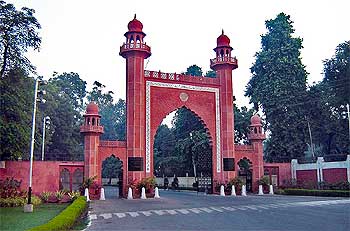
It is said that this gate originally belonged to some fort gate of a Nawab and he had donated it to the University. The stones were brought piece-by-piece from the ruins of a far-away fort and assembled here in exactly the pattern as it was in the original scheme. The gate was never used as a gate and today it stands as a sentinel to the tremendous progress the university had made in all these years. The gate is still closed. They have recently built another main gate nearby known as ’Bab-e-Syed’ a real grandiose structure, a new attraction.

More than four decades rolled by. I’m an old man today. My younger daughter was recently admitted to the graduate course. A third generation of Aligarian in my family is registering her name at the university. She is going to walk on the stones and pavement that have forgotten my footsteps. They say – Dharti maa remembers and recognises every stroller’s step. Maybe it is true but there is no one here who recognises me. I leave my daughter in the admission hall and walk down to the hostel which was once ‘Zia Uddin Hostel’ now renamed as ’Shibli Hostel’. I stand before my room. The room is locked.

Present inmates have gone somewhere. For a moment, time has frozen. This visit has stirred up old memories. Nostalgia starts to flow. It was once a place where I had enjoyed the best years of my life. Today no one here knows me. Time and tide waits for noone. I pick up some soil beneath the Amaltas tree that had grown like me. It was a sapling planted by Garib Shah – our gardener when we were freshers. The koel could still be there somewhere but it is silent at the moment. I put the soil in my pocket without any bag or paper.

Only one thing comes to my mind – where are those days which I can’t see but which I clearly feel right here right now.

“Where are the songs of spring? Ay, where are they?
Think not of them, thou hast thy music too
While barred clouds bloom the soft-dying day,
The redbreast whistles from a garden – croft,
And gathering swallows twitter in the skies.”

Naim Naqvi

Naim Naqvi

Did his graduation in Science discipline from AMU in 1972-73. He was Secretary of University Ali Society in 1970 and M.M. Hall Literary Society in early 70 's and member of Tayyabji Literary Society. Did his Diploma in Bakery Administration from HTT College Oxford Street London in 1987. Worked with National Herald - Delhi, Blitz - Bombay as Trainee Journalist and in Production Department with 'Naya Sansar Pictures' of Khwaja Ahmed Abbas at Bombay in early 70's. Traveled for study and training purposes to Germany, U.K., Switzerland, France, Dubai, Oman, AbuDhabi, Bahrain and Philepines.

More Posts

All about ‘the greats’

We paint their pictures with greatness that is ideal but fake – not real. The irony is that they all want to rectify the world in their own way but fail to clear their own backyards of life. The greatness is not real and hangs heavy round their neck

THE KIND of leaders who dominate the different horizons of civilisation are not the real greats or the embodiment of virtues, as we want to believe. We conceive an ideal image with our own selected and desired attributes and then we impart and cloak our loving subjects with those farce qualities. We lie about our relations, friends, priests, guides and leaders. We boast them to be in possession of those traits, which they don’t carry.

We paint their pictures with greatness that is ideal but fake – not real. Most of these greats are/were mediocre. But they were successful manipulators, attention seekers and imposters. I do never allow myself to be deluded by those so-called leaders or experts of their fields who are showered with the unlimited praise or critics barbs. The irony is that they all want to rectify the world in their own way but fail to clear their own backyards of life. The greatness is not real and hangs heavy round their neck.

We are still passing under the yoke of world-wide economic depression. Who is responsible for this plight of the world? No unknown race had invaded our planet with it’s super techniques. The catastrophe was brought by the very best of the best CEO’s who had the best of the best academic credentials. The super brains pushed the world to the brink of unknown abyss.

We have the best of the religions and their best of the founders who preached nothing but love, compassion, respect, tolerance and understanding. The end product is chaos, hatred and blood shed. No one is immune here. We have the commercial great godmen who promise to walk on water and get killed the kids in their Ashrams. People grace their premises with their smiling portraits.

We had ’The Great Emancipator’ – Abraham Lincoln, who was instrumental in abolishing slavery. He was the ’Champion of Black’. Surprisingly, he never allowed a black to enter in his inner household circle. On August 21, before a crowd of 10,000 people at Ottawa, he declared:

“I have no purpose directly on indirectly to interfere with the institution of slavery in the states where it exists. I have no lawful right to do so, and I have no inclination to do so.’

We have the best of the artists and one of the most saleable and successful painter among them loves to paint goddess in the nude. At his ripe age he could discover spirituality only in nudity. He would slip down by the wayside for any damsel and make the painting / film for her if any of them is willing to accommodate. He would sacrifice his trade-mark beard for the sake of looking young or different to look more appealing. He was the one who had bent backward and forward during emergency and painted the then PM as goddess on horse. He is great and he is afraid to come back because of fear to his life.

We had the finest and greatest showman who loved to show the female natural assets for any inventive excuse. He was proud salesman of “Mera Dil Hai Hindustani.” We had, in our own backyard, many learned and sophisticated Presidents who were, at times, biased and most of the times humblest protégé of PMs. We have the biggest and tallest actor, the thespian who lied about his marriage and caught in camera at their wedding bed.

We have best of the players who doped and used the drugs to boost their performances. We hade Mussolini, the dictator of Italy who wanted to conquer the world found hiding under the heaps of military uniforms when caught. Not to talk of the disgraceful dictator Saddam.

Till yesterday, my favorite and great Statesman President Obama, whom I thought, would change and challenge the world, failed in the first test. He could not withstand the pressures a Black President had to undergo if he had to support a black victim – a scholar of repute against the white racist police of US. He has expressed his regrets today to support a black.

We have the smart PM, who is the pristine innocent, who would sacrifice his post for becoming a member of nuclear club, created the biggest fiasco in the International Politics with including “Baluchistan” into an agenda with the Pak PM. He had given a political victory on platter to a nation till yesterday was pariah in international community.

We also have best of the doctor who has allegedly killed the best of the pop-singer ever born.

Most of them have the feet of clay; they are fakes and moonshine.

Naim Naqvi

Naim Naqvi

Did his graduation in Science discipline from AMU in 1972-73. He was Secretary of University Ali Society in 1970 and M.M. Hall Literary Society in early 70 's and member of Tayyabji Literary Society. Did his Diploma in Bakery Administration from HTT College Oxford Street London in 1987. Worked with National Herald - Delhi, Blitz - Bombay as Trainee Journalist and in Production Department with 'Naya Sansar Pictures' of Khwaja Ahmed Abbas at Bombay in early 70's. Traveled for study and training purposes to Germany, U.K., Switzerland, France, Dubai, Oman, AbuDhabi, Bahrain and Philepines.

More Posts

Palestine – Cry thy motherland

Since the tragic war of 1967, the people of Palestine, have come to terms with the reality of Israel. They have accepted it is as a part of the world community within its 1948 boundaries.

IF YOU thought that South Africa was the last country where apartheid was practiced – you are wrong. If you believe that with the rise of the charismatic statesman, Nelson Mandela, and the consequent collapse of the white regime of the Bothas, the last vestiges of discrimination were relegated to folklore, you are wrong. There is place upon earth – the holy of the holiest of lands for all the major monotheistic religions – where the darkest and harshest of crimes against humanity were committed in the name of belief and with the active support and connivance of the modern State – a darling of the West. It is a place where the self-proclaimed victim of Hitler’s atrocities and suicide bombers, assumes the mantle of a monster of defiance, cruelty, indifference, suppression and hate, all welded together, to deny justice to the hapless people of Palestine. It is the modern state of Israel.

Since the tragic war of 1967, the people of Palestine, have come to terms with the reality of Israel. They have accepted it is as a part of the world community within its 1948 boundaries. That abject surrender by Arabs doesn’t suit the designs and strategies of Israeli governments. They are actively involved in building the so-called ‘security fence’ which divides the Palestinian land like the cracked wind shield of a car. They are regularly building ’outposts’ and ’settlements’ in occupied territories which are in flagrant violation of international law. Jewish settlers believe that they have a God-gifted mandate to settle anywhere in the Holy Land. According to them, it’s a precondition to their Messiah’s arrival. So, the others should bow to their whims and make sacrifices to ensure the fulfilment of the promise made to the Jews.

Israel has a right to exist; it has the right also to protect itself. What is wrong, however, is its occupation of a land that doesn’t belong to it. There is no end to its “perceived need for safety.” It is a case of putting the cart before the horse and not the horse before the cart. The government and Israeli public know that these settlements gravely upset every Palestinian. They are like the red rag before the bull. These outposts and the military boots, feed the undercurrent of resentment that ultimately explodes into hatred and violence; this environment is responsible for moulding the mind of a suicide bomber.

With the erection of safety fences, outposts and settlements, Israel is trying to create new geo-political realities. Israel is colonising the Arab land in order to consolidate the demographic and geographical changes it is engineering. It is a well thought-out strategy to thwart the birth of any viable Palestinian state. It is intended to neutralise the facts of the case – when was the community in question established? Was it a Palestinian habitat or an Israeli outpost? These questions are bound to haunt the Israeli State as and when the world community feels the moral compunction to force the errant State to sign a permanent status agreement with Arabs.

Israel knows very well that to stop this vicious circle of violence, it has to dismantle old settlements and outposts; it has to withdraw its military support to settlers and it has to allow them to return as original inhabitants. The ‘safety fence’ is nothing but a de facto annexation of Palestinian territories. By building the wall and settlements, it has indirectly retained the rights and powers to control all important Palestinian economic areas, agricultural grounds and natural resources, including water.

Do you know that the West Bank settlement domestically consumes 280lt of water per person per day, as compared to 86lt of water pppd by poor Palestinians. According to the WHO, 100lt pppd is the average water requirement of a human being. Israel pulls up that water in the name of domestic requirement and squanders the water resources; a natural property of Palestine is being used for Israel’s farming and industrial development. The so-called ‘Green Revolution’ is a farce to steal, plunder, and confiscate Palestinian assets. Apart from the safety fence that cuts across Palestinian agricultural and industrial land, today there are 122 Israeli settlements and 102 outposts established by the ’Democratic Republic of Israel’. Settlements are built on less than 3 per cent of the area of the West Bank. But due to the presence of an extensive network of roads and restrictions on Palestinians accessing their own land, Israel dominates 40-45 per cent of Palestinian lands in the West Bank.

It seems, with the advent of President Obama’s pricks of conscience, the world is waking up to this travesty of truth and injustice, where Israel, in fact a perpetrator, successfully portrays itself as a victim of atrocities. With the clandestine backing of the West, Israel has so far flouted each and every resolution of the UN Security Council. It needs to keep a certain level of irritation going, so it provokes reactions and outbursts of violence so that it has an excuse for crying – “We are victims ! We are being attacked ! We are innocents ! Please support us !” The truth is otherwise.

Naim Naqvi

Naim Naqvi

Did his graduation in Science discipline from AMU in 1972-73. He was Secretary of University Ali Society in 1970 and M.M. Hall Literary Society in early 70 's and member of Tayyabji Literary Society. Did his Diploma in Bakery Administration from HTT College Oxford Street London in 1987. Worked with National Herald - Delhi, Blitz - Bombay as Trainee Journalist and in Production Department with 'Naya Sansar Pictures' of Khwaja Ahmed Abbas at Bombay in early 70's. Traveled for study and training purposes to Germany, U.K., Switzerland, France, Dubai, Oman, AbuDhabi, Bahrain and Philepines.

More Posts

Rivers – A dirge to the divine

The Hindan river brought back enchanting childhood memories of fresh water, country boats and the burst of flora and fauna. But the sight the river had to offer me on a recent visit, was very different.

THE OTHER day, I was crossing the river Hindan near the capital Delhi. I stopped at the bridge, as its banks have always fascinated me. I love to delve into history and this was the place where, in 1857, the great convulsion of Indian history took place. It had been witness to crucial moments that wrote the future course of the country‘s destiny. It was the place where mutineers had gathered to take up positions against the advancing British regiment. Mirza Abu Bakr, the cowardly son of Emperor Bhahdur Shah Zafar, was in command of the Indian army. He fled the battlefield as soon a few shots were fired from the English side. A battle was lost without a fight.

I remember from my childhood experiences, a stop at the bank of river Hindan where the transport facility had failed at the bridge and all passengers had to disembark till repairs were completed. The Hindan was overflowing with fresh water; there were plenty of fish and fisherman and a burst of flora and fauna at the banks of the river. There were country boats sailing past. All the irritation at the disruption of the journey had disappeared before the enchanting beauty of the river. But the sight the river had to offer me on my recent visit, was very different – it was only a dry river bed, with parched pieces of earth and a few carcasses of pigs and dogs. It was a pathetic sight.

Where had the beauty and the water gone? Maybe a seasonal dry spell could be an excuse now, but was this case with every river? Those were the thoughts crowding my mind when I sat down to write a dirge for the river. Rivers – be it the Amazon or the Mississippi, Danube or Seine, Thames or own Ganges, Jamuna or Jhelum – have supported, nourished, nurtured and shaped the development of our civilisations since time immemorial. Their moving waters create beautiful landscapes, canyons, gorges and fertile deltas and basins. They bringing up new islands and have also forced lands to disappear from the earth’s surface.

They give us a feel of freedom, freshness and a larger life. Their wild flow is immune to petty thoughts. They know no boundaries and they refuse to accept the divisions between man and man. When did you last crossed a river at a leisurely place? Do you remember the full moon at the river bank? If you have been lucky enough to witness such beautiful sights, they would certain be the source of recurring visions. Find time to sit at river banks. Enjoy their ravishing beauty. See the placid and pleasant world of green and blue as the murmuring water flows – sometimes fast sometimes slow. See a kite flying high up in the blue sky suddenly take a dive into the river, catch a fish with its claws and disappear back up majestically. See the twittering birds through the undergrowth and listen to the koyel singing from a distant neem tree on the opposite side of the bank. She would be charging nothing for the most beautiful song on earth. The bounties of nature are free for everyone. Let there be takers.

Rivers are goddesses; they are the symbols of spirituality and they are divine. Their music has given birth to the ‘sargam’ of life. The devotees worship them and immerse themselves in their sacred water. They wash their sins in the holy water – this water that is the fountain of spirituality, is today being polluted with every conceivable impurity. Rivers have been most benevolent and kind to us, yet we have inflicted the unkindest cut to their existence. They impart beauty and we offer them death. What a thankless reward!

Naim Naqvi

Naim Naqvi

Did his graduation in Science discipline from AMU in 1972-73. He was Secretary of University Ali Society in 1970 and M.M. Hall Literary Society in early 70 's and member of Tayyabji Literary Society. Did his Diploma in Bakery Administration from HTT College Oxford Street London in 1987. Worked with National Herald - Delhi, Blitz - Bombay as Trainee Journalist and in Production Department with 'Naya Sansar Pictures' of Khwaja Ahmed Abbas at Bombay in early 70's. Traveled for study and training purposes to Germany, U.K., Switzerland, France, Dubai, Oman, AbuDhabi, Bahrain and Philepines.

More Posts

A view from Eiffel tower

Eiffel tower

Eiffel tower

Eiffel Tower was designed and built in 1889. If you’re in Paris you can’t miss it – even if you want to. The top of the tower is visible from all over the metropolis. The tower symbolises French Revolution and France’s struggle against poverty…

JUST THINK of towers and there are only two names that shot up the memory screen – Qutub Tower (Minar) and Eiffel Tower. The shadow of former encompasses centuries of history of India; the rise and falls of several dynasties, the caravans of Sufis and warriors and the hopes and realities of emerging India. Eiffel Tower is relatively infant – a sentinel of modern France. It is made up of iron and, at one time, was the most despised structure – an anathema for contemporary artists and aesthetics, who felt it odd and not in harmony with the architecture of Paris.

It was designed and built in 1889, by the famous engineer Gustavo Eiffel, who was known for his mastery over ‘bridge building’. It was built to commemorate for World Exhibition to celebrate the French Revolution. It took two years to build this magnificent structure and only one worker died during the entire activity. Think of the safety standards and equipment of 19th century and recall the Metro mishaps that we are getting used to in Delhi.

If you’re in Paris you can’t miss it – even if you want to. The top of the tower is visible from all over the metropolis. It spears up 300 meters in the sky and if you want to climb through stairs, there are only 1665 steps to test your guts. I felt the use of angular elevator would be more helpful to enhance my spirits before I reach the top of the tower than challenging myself and end up as a cropper.

The guide there was telling a little known fact about the tower that, apart from numerous well known suicides, it was used by the scientist Wulf who discovered the Cosmic Rays from this tower.
I used plenty of time to stroll at the bank of river Seine and the flowers and green grass that make the beautiful surrounding of Eiffel unforgettable.

Paris is name that conjures up the images of riches, aristocracy, fashion, beauty, perfumes, cosmetics, art and style. It reminds of poverty also – a very bad name indeed. When I reached the tower the dollops of soft cotton were floating around high up in the light blue sky and a cool wind was blowing. It was so reassuring and pleasing to eyes, which were feasting upon the dancing auburn tresses that crowned the beautiful faces.

The view of Paris from these dazzling heights was really spectacular and the river Seine was flowing like a shimmering silvery serpentine in the body of city. There were guides and there were telescopes and binoculars to unfurl before the eyes the history of city that witnessed the best and the worst of life. One guide was talking about French Revolution, Napoleon, King Louis and his queen. The other guide was telling about the Notre Dam, Arch of Triumph and Champs Elysees.

One guide was enjoying the narration of the day when the poor of Paris stormed the Bastille Prison – when the crowd was gathered outside in the mid morning and by the afternoon the ’drawbridge’ of the inner courtyard was cut. It was the history of poverty and rebellion against poverty. It was the history of fight between haves and have-nots. I was so engrossed in that I forgot I was in Paris. No, I was near the seventh Bus Stop of Malad West – at Malwani. The knots of eunuchs, with their drums and wrenklets were getting down from the bus after their days toil; pick-pockets were comparing their earnings of the day and regular labourers were coming to rest to their huts.

I was not on Eiffel Tower but amongst my own people where poverty and hunger and disease come as natural and they gracefully accept. For them rising index of stock exchange or economic depression are meaningless. They are far above the Eiffel Tower. I don’t remember when I moved into the descending elevator. For the moment I was back in the lap of my placid, staid and colourful Bombay and the show of fountains at Bellagio failed to arrest me. The evening was soured for the moment.

Naim Naqvi

Naim Naqvi

Did his graduation in Science discipline from AMU in 1972-73. He was Secretary of University Ali Society in 1970 and M.M. Hall Literary Society in early 70 's and member of Tayyabji Literary Society. Did his Diploma in Bakery Administration from HTT College Oxford Street London in 1987. Worked with National Herald - Delhi, Blitz - Bombay as Trainee Journalist and in Production Department with 'Naya Sansar Pictures' of Khwaja Ahmed Abbas at Bombay in early 70's. Traveled for study and training purposes to Germany, U.K., Switzerland, France, Dubai, Oman, AbuDhabi, Bahrain and Philepines.

More Posts

“Happiness lies in sharing”: Imam Ali

God being the guarantor means that He has provided ways for everyone to live and earn livelihood; He has allowed everyone equal shares in his bounties – winds, rains, seasons, mountains, forests, rivers, sea, mines in the vast earth.

“HAPPINESS LIES in sharing” – Imam Ali, the fourth caliph of Islam.

‘Wallaho khair-ur-Razeqeen’ is the most common cliché, a message of the holy book, ‘The Koran’, used by Muslims all over the world when they discuss about the ‘sustenance’ and ‘means of sustenance’. It means – God is the best guarantor of sustenance and provider of livelihood. It doesn’t mean that God, through physical means would make the livelihood reach your door.

His providing livelihood doesn’t mean that no effort is needed in searching the livelihood or going out of your house and enjoy the ’flight of pigeons’ or ‘kites’ and ‘smoking hubble bubble’ (huqqa) to kill time. Livelihood would never find its way to the seeker. Those who waste time, do nothing and wait for ‘Manna Salwa’ (food from heaven) and take refuge in this saying of ‘The Koran’ are deceiving themselves and no one else.

His being guarantor means that He has provided ways for everyone to live and earn livelihood; He has allowed everyone equal shares in his bounties – winds, rains, seasons, mountains, forests, rivers, sea, mines in the vast earth. He has given everyone the right to make use of them. His bounties are neither confined to any single person, single race or single continent nor is the door of ’sustenance’ close to anyone.

The order of the universe hinges on the concept of ‘sow and reap’. There could be no germination without sowing; no results without efforts. However, where He has not bestowed the power of seeking the livelihood, there He has taken upon Himself the responsibility to provide that. He has managed the feeding of embryo in the mother’s womb; a fish get oxygen inside the water.

Since, He has created the means of livelihood, and powers of seeking the livelihood have also bestowed by Him, the paucity and plenty of livelihood has been attributed to Him. Imam Ali, the fourth caliph of Islam who was born today, 13th Rajab of Islamic calendar, explained this seeming anomaly in the philosophical way: “Vapour rises from the sea with store of water spread over it in the sky in the shape of dark clouds and they ooze the water by drops till they form them slant in regular lines.

They irrigate plains as well the highlands thoroughly.” He referred the matter to human tendency to hog on and think for the selfish ends. If man’s greed and avarice exceeds its bounds, then just as the excess of rain ruins the crops instead of growing and bringing them up, so the abundance of articles of livelihood and necessaries of life would make man oblivious of God and rouse him to revolt and unruliness.

If the God lessens the rainfall, the land goes arid as the closure of livelihood would destroy the human society.

Consequently God, the wise, the omniscient has put the organisation of livelihood on moderate and proportionate lines.

When we waste water, when we waste food and try to capture more lands than justified and fell the trees; when we are cruel to animals and birds, when waste or squander the resources of cyclic energies we shouldn’t disregard the fact that this planet is inherited by many, who are different, who are weak and we alone do not stand to own it.


Naim Naqvi

Naim Naqvi

Did his graduation in Science discipline from AMU in 1972-73. He was Secretary of University Ali Society in 1970 and M.M. Hall Literary Society in early 70 's and member of Tayyabji Literary Society. Did his Diploma in Bakery Administration from HTT College Oxford Street London in 1987. Worked with National Herald - Delhi, Blitz - Bombay as Trainee Journalist and in Production Department with 'Naya Sansar Pictures' of Khwaja Ahmed Abbas at Bombay in early 70's. Traveled for study and training purposes to Germany, U.K., Switzerland, France, Dubai, Oman, AbuDhabi, Bahrain and Philepines.

More Posts

Romance, idealism and practicality

For many die-hard successful practical people romantics are fools. For those who disagree – anyone practical is no fun to talk about and should be shunned. Practicality, beyond doubt, is an indispensable attribute to succeed in any realm of life

AS A greenhorn, I had always been more of a romantic idealist than a realist bloke. We all grow up on the tales of fantasy and romance. There is a time in everyone’s life when a sense of poetry pervades in our life.

We believe in love, in true love, and we have the assurance that love overcomes every obstacle in life. With a heart of Romeo or Farhad, you could surmount any hillock of difficulties. Unfortunately, the reality tells otherwise. Everyone bears his own cross and disappointments.

Long time of my life, of course the most precious one also, was consumed to clamber up the steep curve of learning through hardships. The process is still continued and I am still learning. Journeying through life I have had my own disappointments and I had also disappointed few; neither is pleasurable when I look back through hindsight.

I do sometimes wonder if realist and romantic are incompatible. Idealist doesn’t necessarily mean one who thinks a lot and does nothing. People at leisure would tell you the stories of how, once upon a time, the native and migratory birds used to be so clean, bright and spry; how the chirping and twittering of birds used to echo at every dawn and every evening and life so beautifully hummed.

Some would recall how brilliant shadows of banyan, peepal and pilkhun trees in the vicinity gave the refuge, cool, protection, peace and happiness to the travelers and to every animate object that moved. They have disappeared or suffering degradation. Alas! these experts of nostalgia and romantics always talked the same subjects and did nothing about the protection of environment – when you ask. They just talk and dream about what could be and would be environmentally beneficial.

However, for many die-hard successful practical people romantics are fools. For those who disagree – anyone practical is no fun to talk about and should be shunned. They are all kill-joys.

Practicality, beyond doubt, is an indispensable attribute to succeed in any realm of life. Pragmatism guarantees the very survival. There are people who have transformed their physical sufferings into a thundering success. However, sole practical approach could provide a person with only an ephemeral success. Our options confine and our thought process narrows down when we try to behave practical in every realm of life. Over-practicality impedes the visions of broader aspects in every field. Similarly, investments based on pure emotions push one to the brink of bankrupt relationships.

For a rational and ordinary human being, practical romance could be identified with realism. We are inspired to achieve the higher goals because we are idealist. However, romance is the prelude to enlightenment. Romance is not only restricted to relationships. It’s an attitude, an approach to life. I do still enjoy the romantic-idealistic stories because they are the integral part of my ethereal self. But I never forget that it is practicality, which carries me to the platform of life where I could appreciate the beauty and feelings.

In real life, practical wisdom enables us to live, and it is the romantic vision of people which gives us something to live for.

There is a third option – dualism. It’s the synthesis of the two extremes.

Naim Naqvi

Naim Naqvi

Did his graduation in Science discipline from AMU in 1972-73. He was Secretary of University Ali Society in 1970 and M.M. Hall Literary Society in early 70 's and member of Tayyabji Literary Society. Did his Diploma in Bakery Administration from HTT College Oxford Street London in 1987. Worked with National Herald - Delhi, Blitz - Bombay as Trainee Journalist and in Production Department with 'Naya Sansar Pictures' of Khwaja Ahmed Abbas at Bombay in early 70's. Traveled for study and training purposes to Germany, U.K., Switzerland, France, Dubai, Oman, AbuDhabi, Bahrain and Philepines.

More Posts

Islam: Challenges and confusions

In these challenging times, where the thin line between sin and righteousness is dissolving fast and people are overwhelmed with all kind of concepts of freedoms, Islam controls life. It guides every aspect of human activity.

FAR BE it for me to proclaim the supremacy of one religion over another. It is neither my profession nor my proclivity; and it might sound strange to many ardent believers when I declare that for me ‘Raksha Bandhan’ is best of all festivals in the world. It has given richness to my life; it had taught me a new chapter in human relationship; it had brought my family closer in deeds and thoughts.

A rakhee from Muslim or Hindu sister has always been the best gift for me and I would wait impatiently for it from the next day till next year.  Similarly, Christmas had always given me the most unforgettable moments of love and happiness – limitless joy, which washed down the feelings of sloth, miseries and worries of the previous years.  We all have one way (Ek hi raasta), the mode of travel may be different.

However, the fundamentals of each religion and faith are quite mysterious. People believe in monotheism; they believe in varieties of deities and there are those who believe fire, humans and animals as gods. Everyone is born in a certain religion and beliefs are passed through generations. People identify with them and are tied to their rituals.

It may be a moot point whether every religion and belief is based on logic and reasoning. Everyone thinks himself to be right, in his faith and belief and it is the most difficult decision to forsake one’s faith and convert into another religion voluntarily. It is greatest intellectual challenge of life.

“Michael Jackson is to be buried according to Islamic rites.” It was the news that provoked me, inspired me and compelled me to write this article. From Cassius Clay, Cate Stevens, Bony M to our own intellectual writer Kamala Das, we have a never-ending list of celebrities who took refuge in Islam. What lead to such a tectonic change in their lives? These people have had everything in life. What did they miss? What did Islam give to them?

If we go by media projections, today, Islam is the other name of terrorism, suppression and chaos. There is distinct schism in Islam. There is violence everywhere. Still what is there in Islam that makes it so attractive? Why is it the fastest growing (not by birth rate) religion in the world?

The answer is very simple. Islam is a peaceful and disciplined religion. Peaceful, not in reference with physical fights but in the context of the ‘peace of mind’. Islam means submission, that is submission to the will of god. Islam doesn’t teach, nor does a true Muslim desire, conversion of any people for fear, greed, marriage or any other form of coercion.

In these challenging times, where the thin line between sin and righteousness is dissolving fast and people are overwhelmed with all kind of concepts of freedoms, Islam controls life. It guides every aspect of human activity: how to deal with your fellow human beings, how to think, what to think, how to enjoy life, how to thank, how to pray, where to pray, when to pray, how to earn and how to spend? It takes away every burden from your intellectual capacities without impairing your capabilities.

It even takes care of your economic well being through its Zakat (2.5 per cent alms from your assets) and Khums (1/5 of your total savings). Quran provides solutions to every challenge of your life with logical, systematic and succinct way. It is unfortunate that Muslims are the first to ignore what is there, in their faith, to uplift them. They, at times, put more emphasis on the cosmetics than the fundamentals. Another important aspect of Islam is despite the peripheral differences between different sects of Islam and there is strong unity in the fundamental beliefs and they all behave on the same wave length when it come to crunch. People outside the peripheries discover it and enjoy the benefits of the universal intellectual stream and this is the beauty of Islam.

Naim Naqvi

Naim Naqvi

Did his graduation in Science discipline from AMU in 1972-73. He was Secretary of University Ali Society in 1970 and M.M. Hall Literary Society in early 70 's and member of Tayyabji Literary Society. Did his Diploma in Bakery Administration from HTT College Oxford Street London in 1987. Worked with National Herald - Delhi, Blitz - Bombay as Trainee Journalist and in Production Department with 'Naya Sansar Pictures' of Khwaja Ahmed Abbas at Bombay in early 70's. Traveled for study and training purposes to Germany, U.K., Switzerland, France, Dubai, Oman, AbuDhabi, Bahrain and Philepines.

More Posts

Inquiry Commissions: A ruse to fool the public

Inquiry commission is a tool to fool people and foil the judicial process of a controversy. India has witnessed hundreds of inquiry commissions, their reports and no results. It is the worst kind of political game played in India.

THE ORIGIN of the phenomenon of ‘inquiry commission’ has its roots deep buried in the legal system of British Raj. If we look into retrospect, we find that except some minor incidents of local confusions and misunderstanding there were no communal riots during the Moghul period. The riots, as we witness today, are the product of ‘divide and rule’ policy of Britishers.

They re-wrote and fabricated the Indian history to distort the facts and sow the dragon’s teeth and create enmity between Hindus and Muslims. Even at the height of Mutiny in 1857, the last Moghul Emperor Bhahdur Shah Zafar had risked his life and went himself to Delhi Hindus to assuage their wounded feelings when the Wahabbi Commander Bakht Khan, who had come from Barely, slaughtered the prohibited animal.

Cow slaughter was banned in Moghul Empire. Having failed to create the wider rift between Hindus and Muslims, the British rulers designed an Act known as ‘Public Service inquiry Act 1850’. The Congress government followed that act and sometimes used ad-hoc and temporary legislations till 1952 as and when situation arose.

To meet the public demand for impartial and judicial inquiries ‘Commission of Inquiry Act’ came into being in 1952. Since its inception, the act has become a tool for consecutive governments to defer any precipitated action and subside the public anger. More than one hundred inquiry commissions have been set up since then and literally no purpose did they serve. This Act has sprung up a toothless tiger, which is less effective than a jackal in the turbulent scenario of Indian Democracy.

The provisions enshrined in this Act are not deterrent in nature and have no power whatsoever even to compel a person to ‘adduce’ before it and give evidence. It can’t pass verdicts or judgments, which could be enforceable. It is pathetic to learn that even if an offence is committed in the presence of commission, it can’t take any direct action. The commission needs to forward the case to the Magistrate for trial as provided by Criminal Procedure Court. Most of the commissions are set up under retired judges. The appointment of retired judges, as head of the commission suits to every government. It is not also oblivious to the fact that public understands these appointments as ‘post retirement placement schemes’ for the favourite retired judges.

Have you ever seen any follow up action? The astronomical amounts squandered on these commissions to sponsor these futile exercises are unjustified and undue strain on public exchequer. Let the readers recall that more than ten commissions and committees were set up with regard to the anti-Sikh riots in Delhi after the assassination of Indra Gandhi. Has any prominent leaders been punished.

Justice BN Kirpal Commission of Inquiry was set up on July 13, 1985 to probe Air India Flight -182 disaster in which the plane crashed into the Atlantic Ocean with 329 passengers and none was left alive. The members of the commission enjoyed the hospitalities of Canada and US governments in the process of probe and could perceive nothing in the end. Needless to say the entire exercise went in vane.

An inquiry commission was set up under Justice Phukan to investigate the ‘fictitious defense deals’, which were exposed by ‘Tehelka’. Everyone saw the tapes on TV and the then government deflected the legal course by constituting the inquiry commission. The members of the commission enjoyed the hospitality of IAF as its plane took them to visit Shridhi, Pune and Bombay. The next government later claimed that plane was made available in order to influence the Judge. These commission are the smoke screen to hide the inefficiency and ineptness of government.

Had Agatha Christi  been alive she would have written a novel on every inquiry.

I am deliberately not including Hindu Muslim riots in this article as it would open more wounds and that is not the purpose of this scribe. The cacophony about the report of the destruction of Babri Masjid would die down its own death, as it’s a ploy of Congress to beat the already wounded BJP. May I ask Sonia Ji and our able PM Dr Manmohan Singh, why nothing has been done about ‘Sri Krishna Inquiry Commission Report’? It is worst kind of hypocrisy played in the name of Secular India.

Naim Naqvi

Naim Naqvi

Did his graduation in Science discipline from AMU in 1972-73. He was Secretary of University Ali Society in 1970 and M.M. Hall Literary Society in early 70 's and member of Tayyabji Literary Society. Did his Diploma in Bakery Administration from HTT College Oxford Street London in 1987. Worked with National Herald - Delhi, Blitz - Bombay as Trainee Journalist and in Production Department with 'Naya Sansar Pictures' of Khwaja Ahmed Abbas at Bombay in early 70's. Traveled for study and training purposes to Germany, U.K., Switzerland, France, Dubai, Oman, AbuDhabi, Bahrain and Philepines.

More Posts