Amroha and The Patriotic Uprising 1857

It was a bolt from the blue. Order to use Enfield rifle with the greased Cartridge did hurt deeply the feelings of both Muslims and Hindu soldiers. They refused to fire the bullet. The spark of the unfired bullet caused an explosion that ballooned up in the form of Mutiny 1857. Invariably it failed to change the course of history but added a glorious chapter of sacrifice, valor and love for the motherland.

On the 11 th day of May 1857, sixteenth of Ramadan, rebel soldiers from Meerut landed in Delhi and were joined by Delhi regiments. Soon the walled city of Delhi was on fire. The jubilant deserters  were furiously looking for their white masters and putting them to sword. This evening Delhi was in control of Indians. True, there was loot and plunder all over the Moughal capital. By midnight a 21- gun salute from Royal Moughal Cannon announced the restoration of Moughal Empire. Bhahdur Shah Zafar was declared as the Commander-in Chief of Rebel forces. It was a new dream – a beginning of a new end.

The ripples of rebellion reached the shores of Amroha by 12 th May. There were three British officers posted in Moradabad region namely C.B. Saunders – the magistrate, J.J. Compbell – Joint magistrate and J Cracroft Wilson – the judge. Gursahay Jat was the Nazir in Collector’s office. Mr. Wilson was there in Amroha for 17 years. He was well posted in local affairs.

Please note that this scribe, by no means, is trying to produce a scholarly document that would satisfy the masters of historiography. This narration may or may not conform to the merits of experts. It is a simple narration as I read and heard in my journey to explore my roots. It is a short story of valiant attempts of ordinary Amrohvis who fought against the most powerful state  upon earth of their time.

The ancient Moughal capital was under intense turmoil now. News of rebellion at capital had warmed the blood of simple denizens of Amroha. On 17 th May 1857, the descendants of Dewan Syed Mehmood and Durwesh Ali Khan Saheb called a meeting of important dignitaries of the town inside the Dargah of Syed Sharfuddin Shah Wilayat. Public  gathered patiently outside the wall of dargah to learn the decision made by 30 city fathers. Majority of leaders wanted to stand up against the Raj and capture the reins of local administration. Some participants advised to use discretion, wait and watch. The decision to rebel against the usurpers was taken by majority vote and the meeting called off. On 19 th May mutineers broke the central jail of Moradabad and freed all the prisoners. Syed Gulzar Ali was the proud leader and commander of Amroha-Uprising. He arrived at Amroha with a group of freed prisoners. People gathered at short notice in the courtyard of Syed Ramzan Ali (Mohalla Katra) to chalk out the future strategy. Another meeting followed at the residence of another Ramazan – Sheikh Ramazan Ali (Moh Darbar Kalan). The clarion call was made there. The die was cast. Amroha was now a city of rebellion. Meer Madad Ali  and Shahmat Khan were Thanedar and  Jamadar of police department respectively at that time.

The appeal of Syed Gulzar Ali inspired thousands of young men and an ill equipped army of amateur soldiers attacked the police station and Tehsil of the town. Seventeen thousand rupees were confiscated from the government treasury. Thana and Tehsil were razed and put on fire. Many police officers were gunned down. Their graves are still lying undisturbed opposite the building of Old Thana near Mohalla Kali Pagri. Amroha was now in the hands of mutineers. The town munsif Saad Ullah Khan was rescued by Ali Muzaffar Khan who brought him home with his office.

This uprising is also the story of our weakness, disunity and conflicting motivations. It is also  the story of ordinary mortals caught in an extraordinary situation. It is story of human greed. It is a story of Jaichands and Meer Jafers.

On 25 th May 1857, Wilson arrived with a strong force that ruthlessly crushed the nascent revolt. The leaders of local revolution had to beat the retreat. They went underground.  The houses of Syed Gulzar Ali and other freedom fighters were razed to ground. The dream of freedom ended in smoke.

Government promoted Gursahay Jat as Chief Administrator and Amroha was given in care of a  Rampur Royal Nawab Abdul Ali Khan to soften the bruised contours of proud Amrohvis. Gursahay was rewarded a big Jageer (11 villages) by British masters. He was given the title Raja and there after referred officially as Raja Gursahay.

What followed later was a bloody, vicious and awful suppression. Heaps of dead bodies scattered around the police stations and streets. Homes were broken down and sacked. The ordinary town folk were falling victims of British ire. It took another 90 tediously long years to write the new chapter.

Naim Naqvi

Naim Naqvi

Did his graduation in Science discipline from AMU in 1972-73. He was Secretary of University Ali Society in 1970 and M.M. Hall Literary Society in early 70 's and member of Tayyabji Literary Society. Did his Diploma in Bakery Administration from HTT College Oxford Street London in 1987. Worked with National Herald - Delhi, Blitz - Bombay as Trainee Journalist and in Production Department with 'Naya Sansar Pictures' of Khwaja Ahmed Abbas at Bombay in early 70's. Traveled for study and training purposes to Germany, U.K., Switzerland, France, Dubai, Oman, AbuDhabi, Bahrain and Philepines.

More Posts

The Bridge Over the River Sot

Once upon a time, many years ago, in fact around fifty years ago, Amroha was a beautiful town of  mango and guava orchards, lush green fields, holy dargahs, ancient temples, caravan sarias, takias, khanqahs, wonderful lakes and enchanting pools. People used to enjoy their morning and evening walks at Lipton Road known as Thandi Sarak (Winter Street). The life was simple – no big frills attached. You would see a lot of  amateur fishermen sitting patiently by the lake side with their fishing rods dangled in silent water, waiting for the catch. Now, all those pastimes are gone forever. As the generations pass their stories and memoirs can no longer be heard. Only a few stories of human interest, bits of wisdom, family histories and humorous happenings are left for future generations to enjoy. However, two lines are common in all of them: Amroha is situated at the banks of River Sot. Amroha is located near the River Sot. Unfortunately that river does no longer exist. There is no water; the river bed is a parched dry land. There stands a lonely bridge that reminds a gruesome old story.
Hundred years  back a train fell into the river as the bridge caved in. All the travelers were killed.

Several images conjure up when someone asks you to remember the childhood. Every one of us has too many wonderful stories and memoirs to narrate if someone touches the emotional cord. According to individual psychology people don’t recall the events that happened to them correctly but they recall them in a way that best describes their subconscious state of mind. As a child we wanted to grow up but now we realize that broken toys and lost pencils were much better than broken heart and lost friends.

This one is a blast from past.

I can still vividly recollect the distant sound of train gracefully passing over the solitary bridge of River Sot in the dark nights. The trundling sound was gentle and often furious. I would get up in my bed and ask my father, “Why the whistle of the engine is so strident? Why the train makes so much sound when it passes over the bridge?” My father was a systematic man who would never get irritated with my most idiotic questions. He would promise me to give the answer in the morning and instruct me to sleep.”

“The train moves against the wind. First, it’s the wind that generates the sound. Second, the sound is due to stress which is created between the wheels of train and iron track. Third, the vibrations of the compartments also create noise. The combined effect is that intensity increases aided with the water below the bridge. Vibrations are absorbed by the earth when the train moves on track on the land. I don’t have to explain the noise of the whistle.” Since my childhood the technical explanation often helped me in winning appreciation of my peers and the admiration of elders – a reason to remember my father in difficult times.

Drina River, Serbia

Drina River in Serbia.

Tower Bridge spans over River Thames in London. It is the only bridge in the world which could be raised from its middle section to permit the large vehicles to pass through it. There is another bridge which always brings back the memories of distant past – “The Bridge On the River Drina.” It was built  by Mehmed Pasa Sokolovic. Construction of this bridge began in 1566 A.D. and it took five years to finish it. It connected Sarajevo pashaluk (the territory of present day Bosnia and Herzegovina) to rest of the Turkish Empire. He was a Serbian child and was taken away from his mother as a part of levy by the Turkish rulers. His mother followed him wailing until they reached the river where they parted and the boy boarded the ferry. This boy, in the years that  followed, showed extraordinary talents. In due course of time he became the Grand Muslim Vazir. He assumed the name – Mohammed Pasha Sokolovik. Yet, his childhood memories had always haunted him and he ordered to build a bridge at the specific spot where he was snatched away from his mother.

Sot River has no such rich past to boast. The bridge over the River Sot was built by Britishers.

Come Shab-e-barat and groups of believers would walk down the river front, early in the morning, to plop into the water an AREEZA from the bridge – a kind of written supplication to Living Imam. There would be lots of fireworks by the river side and prizes were often awarded for the best firework. All is gone now into folk- lore. Now, no one visits Sot for spiritual reasons. The story of ‘tragedy- of-Sot’ had been kept alive by stray Dastango – the traditional itinerant story tellers.

Long before the advent of theaters and films, the minstrels used to practice this medieval art of story- telling. They would engage the public at street corners with stories of adventures, romances, tragedies, djins, fairies and prophesies. A baton in the right hand and a wrist full of iron bangles was the instrument to provide the background music. “Dastan Ameer Hamza” was one the favorite topic.

The narration of the tragedy of River Sot was so impinged upon my memory screen that I have carried it all thorough my life. According to Dastango, the river looked best at dawn. It was the time the train met its preordained  fate. Sit down under the bridge even today and you couldl hear the cries of unfortunate travelers. Listen to the faint whistle of train and you won’t miss the last shriek of Hameeda – the unfortunate groom who had rebelled against society to marry a craft- man who was lower in ranks. The first time she was going her Susral. The couple had put on their wedding dress. As the train slipped down every traveler including the newly wedded couple  disappeared into ocean and with them died the dreams and ambitions of that great caravan.

The story had some unbelievable segments but it was always listened in pin drop silence with awe and agony. Absolute concentration was the name of the game.

I can recollect just one couplet of dastango:

“Sot naddi pa mehshar bapa ho gya,
Bhai se bhai juda ho gya.”

Naim Naqvi

Naim Naqvi

Did his graduation in Science discipline from AMU in 1972-73. He was Secretary of University Ali Society in 1970 and M.M. Hall Literary Society in early 70 's and member of Tayyabji Literary Society. Did his Diploma in Bakery Administration from HTT College Oxford Street London in 1987. Worked with National Herald - Delhi, Blitz - Bombay as Trainee Journalist and in Production Department with 'Naya Sansar Pictures' of Khwaja Ahmed Abbas at Bombay in early 70's. Traveled for study and training purposes to Germany, U.K., Switzerland, France, Dubai, Oman, AbuDhabi, Bahrain and Philepines.

More Posts

Modi’s Victory – A Pyrrhic Scenario

Narendra Modi

Narendra Modi

A few stray thoughts, some point of views………and a pessimistic observation.

The victory of Modi is a  foregone conclusion. The issue of debate is only the margin of victory, its implications for the nation in general and Gujarat in particular. I present here the future in simple terms without loading my arguments with statistical data.


A possible scenario:

If Modi wins big the Muslim minority in Gujarat (save the already rich trading Muslim communities which are exceptions) would be further pushed into oblivion. It would find life difficult and often miserable for itself. Helplessness and frustration would force it to resign to fate. Time to time Modi would throw some odds and bits before them for RSS propaganda and public consumption. But, from now onwards, they have to struggle much harder for their survival. In past Congress has done nothing for Indian Muslims  except lip service. A fleeting remark about their pathetic plight in P.M. Manmohan Singh’s address was all that it could do for them. Congress failed to take up a principled stand in Gujarat. This party wants people like Modi to remain vibrant. It makes easier for Congress to project itself as the protector of minorities. Ironically, Congress would remain a mute spectator while  RSS would force apartheid in the states where it rules. Indian National Congress has destroyed our economy, our language, our culture and our identity. New circumstances  would put the minorities between the devil and deep sea. The Urdu poet has said:

“Na tarapne ki ijazat hai na faryad ki hai,
ghut ke mar jayen yeh marzi mere sayyad ki hai.”

December 20 is also going to change the internal equations of BJP and the Saffron House for ever. A big electoral victory would catapult Modi into the central stage of Bharat. Modi would become the supreme leader. BJP and its leaders would be compelled to act as subservient to Modi’s dictates. The present cadre of leadership would have no control over the developing situations.

Undoubtedly, his towering personality has made him the pivot of every activity in Gujarat. He is able to attract the powerful rich investors, considerable middle class, media and film stars to bolster his aspirations and establish him as an undisputed leader. He is unstoppable. Consequently, RSS would no longer be in the driving seat. He would play politics on his own terms which is something unusual and contrary to RSS history and discipline. His march towards Delhi would begin on Dec 20, 2012.

Now, here is the rest of the story.

Mulayam, Mamta and Maya would find it difficult to opt for Modi as they also need the Muslim votes for their survival. With Modi at the helm of affairs, BJP would find it difficult to forge new alliances.

With the departure of Mr. Yedurappa from Karnataka BJP, Saffron Brigade has lost a powerful leader who had opened accounts of BJP in South India. Karnataka is about to slip from its stronghold. The results of Hills  do not augur well for BJP.  Defeat in Hills is almost certain as its victory in Gujarat. Mr. Gadkari, the present president of BJP has effectively become a liability for the party. The longer he sits at the top the more BJP is going to lose face.

The convincing victory of Modi would leave BJP with  no choice but to present him as the BJP’s Prime Ministrial  candidate. And lo ! here comes the Guardian’s knot. Nitish Kumar will never accept Modi. He finds himself a suitable candidate for the prime minister chair. Mr. Nitish is obviously more acceptable to  coalition partners even now. Mulayam, Mamta and Maya would find it difficult to opt for Modi as they also need the Muslim votes for their survival. With Modi at the helm of affairs, BJP would find it difficult to forge new alliances. The cultivation of new relationships would be an uphill task as the choice is limited. The time is running out.

Ultimately, the victory of Narendra Modi in Gujarat would be a Waterloo for BJP ambitions in Delhi.

Naim Naqvi

Naim Naqvi

Did his graduation in Science discipline from AMU in 1972-73. He was Secretary of University Ali Society in 1970 and M.M. Hall Literary Society in early 70 's and member of Tayyabji Literary Society. Did his Diploma in Bakery Administration from HTT College Oxford Street London in 1987. Worked with National Herald - Delhi, Blitz - Bombay as Trainee Journalist and in Production Department with 'Naya Sansar Pictures' of Khwaja Ahmed Abbas at Bombay in early 70's. Traveled for study and training purposes to Germany, U.K., Switzerland, France, Dubai, Oman, AbuDhabi, Bahrain and Philepines.

More Posts

THE SALVATION ISLE-AMROHA, AMRO-TALE NO.-3

Syed Kaleem Sibtain Naqvi

“Not gold, but only men can make
A people great and strong-
Men who, for truth and honour’sake
Stand fast and suffer long.
Brave men who work while other sleep,
Who dare while others fly,
They build a natiion’s pillars deep,
And them to the sky”……………………….(R. W. Emerson)

‘’THE WINDS AND THE WAVES ARE ALWAYS ON THE SIDE OF THE ABLEST NAVIGATOR’

Undivided India or BHARAT has the honor to welcome and follow the precious teachings of World’s pioneers of non-violence, like GAUTAM BUDDHA, MAHAVEER, ASHOKA ETC. but also that of HZ. MOHAMMAD MOSTAFA ( S.W.) and Hz. IMAM HUSAIN (A.S.) then-after the other godly-men.

MAHATMA GANDHI, the Father of The Nation, was highly inspired by non-violence and sacrifice of HZ. IMAM HUSAIN to establish the HUMANITY in the world. He got the greatest power of non-violence and sacrifice from the un-comparable source of such energy- HZ.IMAM HUSAIN , and acquiring it ,he could get success to gather the peoples of the same ideology together becoming a strong NON-VIOLENT POWER to set free the country from the torment of shackles of British-slavery. So, the followers of the ultimate – ideals of our ideal godly-men get the divine powers to bring about prosperity and honor to the nation and such followers provided reinforcement to the humanity.

SYED SHARAFUDDIN SHAHVILAYAT SAHIB was also one of such pillars of AMROHA who never danced to the tunes that were played by his contemporary tyrannical rulers. He was such an amazing source of non-violence that even the poisonous scorpions do not sting the peoples within the area of his DARGAH and if the snake bites some-one in this area, it’s sacs of venom do not send poisonous matter through its fangs, means,-

EVEN THE CREATURES HAVING THE VENOMOUS NATURE BECOME NON-VIOLENT IN THIS GOD BLESSED AREA OF AMROHA.

A LITTLE HISTORICAL BACKGROUND OF CONTEMPORARY PERIOD OF SHARAFUDDIN SHAHVILAYAT SAHIB-

Syed Sharafuddin Shahvilayat sahib was born in SAHODARA near Lahore in 1252 A.D. and reached AMROHA on 2nd ZILHIJ, 1269 A.D. in the age of 17 years and left this world for everlasting life of heavens on 21st RAJAB, 1382 A.D., so if we deeply go through the metamorphosis of the period, we will find that the entire life of Shahvilayat Sahib acknowledged three dynasties of SALTANATES out of five Sultanate Dynasties ruled in UNDIVIDED INDIA STARTING FROM 12O6 TO 1526 before the battle of PANIPAT in which BABER defeated and killed the LAST SULTAN IBRAHIM LODI on April 20th 1526. That was the time when a number of drastic changes occurred in the entire network of our political, economical and social affairs and values. SYED MOHAMMAD ASHRAF TAQVI was given the title of DANISHMAND by the MOGHAL EMPEROR BABER. Most probably the mosque of Mohalla Shaikh Saddo which is now almost a deserted structure was also built by the instructions of BABER near the raised centre of town Amroha.

ARRIEVAL OF SYED MOHAMMAD ASHRAF DANISHMAND TO AMROHA-

How can the contribution of such a great scholar descendant of Hz. Imam Mohammad Taqi be neglected who came to INDIA during the Emperor Baber’s rule from SUBZWAR and first settled in ZAIDPUR near Amroha but the strong spiritual force of attraction of AMROHA brought him to Amroha where the area of present DANISHMANDAN is there. He was the man of powerful intellect to put the knowledge and intelligence quickly to practical use in life. He promoted the awareness in the society that intellectuality must be the part and parcel of our practical life and mare intelligence is ineffective to achieve the aim of life. It looks that the world today has come in the state of chaos due to perversion in human development where all intelligence is there but no intellect which is obviously visible everywhere. Now we can see that even highly educated persons are not in perfect equilibrium, either they are short tempered, succumb to worry and anxiety or are involved in other extravagances. SYED MOHAMMAD ASHRAF TAQVI SAHIB was so much intellectually intelligent that the MOGHAL EMPEROR BABER honored him the title “DANISHMAND’’ and so the area where he settled in Amroha was called as DANISDMANDAN. Now his descendants have been proving the meaning of the title by getting the world-wide fame by their intellectual contribution not only in literary field but also in all the other sphere of life in INDIA and abroad.

“INTELLECTUAL BEAUTY IS, INDEED, THE HIGHEST KIND OF BEAUTY” ……(C.V.RAMAN)

Now again I am coming to the historical background , I would like here to produce a clear picture of Sultanates ruling in India, around the period of Syed Sharafuddin Shahvilayat Sahib and other contemporary learned saints who adored AMROHA, which affected the culture and traditions at a large scale witnessed by our ancestors and now as a matter of fact we have a vast treasure of our healthy heritage and no doubt, we, all INDIANS have the honor of possessing our most worthy ancient values that have been inspiring the developed and advanced countries for a long time.

MOHAMMAD OF GHOR invaded the INDO-GANGETIC PLAIN during the last quarter of 12th century and conquered – GHAZNI, SINDH, MULTAN, LAHORE and DELHI and the GHORI KUAN at Amroha is one of the witnesses of his regime.

QUTBUDDIN AYBAK a slave of Mohd. Of Ghor proclaimed himself SULTAN OF DELHI in 1206 A.D., which was the beginning of SULTANATE DYNASTIES in INDIA. >>>,then in the beginning of 13th century, a former slave warrior SHAMSUDDIN ILTUMISH became SULTAN OF DELHI from 1211 to 1236 A.D. and after ILTUMISH, his daughter RAZIYA ruled as SULTAN .

Anyway, after RAZIYA SULTAN, GHIYASUDDIN BALBAN, the slave servant of QUTBUDDIN AYBAK became officially SULTAN OF DELHI for the period 1266 to 1290 A.D.

THE DYNASTIES OF SULTANATES:-

Before the first battle of Panipat in which BABER invaded INDIA defeating and killing ABRAHIM LODI on April 20th 1526,there were FIVE DYNASTUES OF SULTANATES and their rulers were called as SULTANS. Syed Sharafuddin Shahvilayat Sahib reached Amroha nearly 270 years earlier than the invasion of Emperor Baber ( 1ST MOGHAL MONARCH).

FIRST DYNASTY (SLAVES) [1206-1290];-

The first dynasty was SLAVE DYNASTY that was in power in INDIA from 1206 to1290 A.D. When Syed Sharafuddin Shahvilayat Sahib reached AMROHA in 1269 A.D., the Sultan from Slave Dynasty ruling in INDIA was GHIYASUDDIN BALBAN whose grave is in Mahroli near Qutab Minar ,was in power from 1266 to1290 A.D.

During 1290 A.D. the slave dynasty came to its’ end with the end of SULTAN KAY QUBADH. SYED SHARAFUDDIN SHAHVILAYAT SAHIB reached AMROHA on second Zilhij 1269 A.D. when the LAST FEEBLE SLAVE KING, SULTAN KAY QUBADH was in power for a very short duration and soon disappeared in the fiasco of melting situations to snatch the treasures of Greater India .

SECOND DYNASTY (KHILJIS) [1290-1320];-

The second Dynasty of KHILJIES captured the ruling power from SULTAN BALBAN in 1290 A.D. and the rule of Khilji Dynasty was finished in 1320 A.D. with the beginning of the third Muslim Dynasty 0f TUGHLAQS. SYED SHARAFUDDIN SHAHVILAYAT SAHIB was a divine saint so had no links with Sultans of any dynasty while he reached Amroha in 1269 A.D. during the regime of 1st DYNASTY OF slaves.

JALALUDDIN FIROZ KHILJI came in power as SULTAN OF DELHI with the downfall of SLAVE DYNASTY, so, started the KHILJI DYNASTY in the same year 1290 A.D. but all these were immaterial for SHARAFUDDIN SHAHVILAYAT SAHIB. FIROZ KHILJI was already an elderly and unpopular Sultan due to closeness of his tribe to the nomadic Afghans. He was unable even to dare to enter his capital because BALBAN’S officers were against him so they revolted.ALI GURSHAP, his nephew and son in law murdered him by the order of his father when he returned in 1296 A.D. successfully repelling two invasions from the MONGOLS.

Ali Gurshap reined for 20 years with the title ALAUDDIN KHILJI ALI GURSHAP (1296 TO 1316 A.D.). He died in early 1316 A.D. The LAST KHILJI SULTAN, Qutbuddin Mubarak Shah Khilji came in power and murdered in 1320 A.D. by his own Chief Minister KHUSRAW KHAN. GHIYASUDDIN TUGHLAQ SHAH -I (1321-1325) The first Sultan of Turkic Tughlaq Dynasty replased KHUSRAW KHAN in the beginning of 1321 A.D. while in Malwas , the ruling house of Khiljis ruled for some time as a remnant token of sultanate. He ruled from 1321 to 1325 A.D. and then MOHAMMAD SHAH –II (1325 to 1351 A.D.) and then MAHMOD IBN-MOHAMMAD (for a month of Mach 1351 A.D.).

THIRD DYNASTY (1320-1413)[TUGHLAQS] ;-

TUGHLAQ DYNASTY remained in power for the longest period in all the five dynasties from 1320 to 1413 A.D., so SYED SHARAFUDDIN SHAHVILAYAT SAHIB was also beholding the regimes of GHIYASUDDIN TUGHLAQ –I, from 1321 to 1325 A.D.,MOHAMMAD SHAH TUGHLAQ-II from 1325 to1351, MAHMOD IBN-MOHAMMAD-for March 1351 only and then SULTAN FIROZ SHAH TOGHLAQ got the power to rule INDIA from 1351 to 1388 A.D.

The most talented Tughlaq SULTAN, FIROZ SHAH TUGHLAQ became the ruler in 1351A.D.and successfully ruled for about 38 years till 1388 A.D. ,GHIYASUDDIN TUGHLAQ II(1388-1389) and SULTAN NUSRAT SHAH ,grandson of Firoz shah Tughlaq, ruled the West from Firozabad till 1413 A.D. SYED SHARAFUDDIN SHAHVILAYAT SAHIB PEER PAHARI left this perishable world on 21st Rajab 1382 A.D.(783 Hijri) at Amroha leaving behind his descendants with his divine mission of humanity who carried it on unaffected of the political transition .After 32 years of his death SAYYIDS’DYNASTY came in power in1414 A.D. and the founder SULTAN of this Dynasty was KHIZAR KHAN who claimed to be a descendent of Prophet Mohammad(S.A.W. ).

FOURTH DYNASTY (1414-1451)[SAYYIDS]:-

It was the period after the death of Syed Sharafuddin Shahvilayat when Sayyid Sultans ruled for more than 37 years. As described above KHIZAR KHAN was the first SYED ruler in India who collaborated with TIMUR during his invasion on INDIA. After the successful invasion of TIMUR on INDIA, TIMUR rewarded Khizr Khan the GOVERNORSHIP of Lahore, Multan and Dipalpur because DAULAT KHAN LODI and KHIZAR KHAN both were attempting to occupy the throne of DELHI after the death of the last TUGHLAQ RULER MOHAMMAD SHAH in 1412 A.D. and KHIZAR KHAN won the battle with the help of TIMUR, so he preferred to rule in the name of TIMUR and his successor SHAH RUKH. He did not pronounce him as Sultan Khizar Khan even after the departure of Timur. As a result of Timur’s invasion and continuous wars for succession among the successors of FIROZ SHAH TUGHLAQ, a number of states and provinces of the Sultanate of DELHI declared their independence and KHIZAR KHAN’S Sultanate was reduced to SINDH, WESTERN PUNJAB and WESTERN UTTAR PRADESH. He died a natural death on 20th May1421 A.D.

SULTAN MUBARIK SHAH was the son of Khizar Khan so after the death of his father he became the ruler of DELHI SULTANATE and he declared him as SULTAN MUBARIK SHAH. It was the time when the entire Sultanate was boiling by political and social turmoil due to revolts all around him that could not be controlled and two accomplices of his Wazir, SARWAUL MULK ,killed him on 19th Feb.1434 A. D.

SULTAN MUHAMMAD SHAH-IV who was the nephew of Mubarik Shah ruled the Sultanate of Delhi from 1435 to 1445 but still the situation of the SULTANATE was not favourable , so the political instability was overcastting the SULTANATE.

SULTAN ALAUDDIN ALAM SHAH who was the son of SULTAN MUHAMMAD SHAH ruled from 1445 to 1451 A.D.but he was also marked by political instability. Internal and external revolts were increasing, the ruling power was decreasing due to disintegration of different states and provinces as a result of failures of SULTANS which reduced the ruling territories within the distance of mere ten miles from DELHI to PALAM and the SULTANATE OF DELHI was occupied by LODHI DYNASTY established by Bahlul lodhi in 1451 A.D.

The description of SULTANATES and MONARCHIES is necessary here to be given because AMROHA was always active to serve in all of the fields of literature ,culture and life skills to create healthy bonding between all the peoples to strengthen the humanity in the world .

FIFTH DYNASTY (1451-1526)[LODIS]:-

BAHLUL LODHI(1451-1489 A.D.),SIKANDER LODHI(1489-1517A.D.) and IBRAHIM LODHI(1517-1526 A.D.) SULTANS ruled the DELHI SULTANATE.IBRAHIM LODHI died on 21st April, 1526 who presided over much of INDIA but his own AFGHAN nobility invited BABUR OF KABUL to invade INDIA.

IBRAHIM LODHI died in the BATTLE OF PANIPAT on 20th April1526 A.D., so the rule of MUGHALS RULE started in 1526 to 1540 and then after it from 1540 to 1555 A.D.SURI ruled (SHER SHAH SURI, ISLAM SHAH SURI,MUHAMMAD SURI,FIROZ SURI IBRAHIM SURI and SIKANDERSHAH SURI).Until all these transitional political and social scenarios AMROHA had established its’ intellectual and spiritual rank at the high standard of values by the grace of the GOD through proper channels of divine power. Moghal Monarchy started on April 21st,1526 and ended on June 1858 A.D. NEARLY FOR THREE CENTURIES started with BABUR of FERGANA or present Uzbekistan and ended with the last Moghal Emperor BAHADUR SHAH (ZAFAR)-II. Though, the changing scenario was effective in the entire world, yet AMROHA had been simultaneously enriching the real values of HUMANITY producing the prominent figures who became the lighthouses for creating the literary and social merits in the world.

We are proud of literary, social and intellectual heritage of AMROHA for which innumerable witnesses are still present in the history of Amroha. The past living witnesses have also been expressed in the previous two chapters but as such inspiring personalities were uncountable so the justification requires to get the honour to pay our earnest homage to such charismatic figures. Not only the AMROHI people are highly obliged but the entire literary world is thankful to MEER SYED ISMAIL AMROHI (1105 A.D.), SYED SAADAT ALI SAADAT,SHAH AALAM MAHZON,NIJABAT ALI NIJABAT,GHULAM ALI HUSAINI, NAJEEB UDDIN SAFDAR AND GHULAM HAMADANI MOS HAFI AMROHI during the 12th century.

If we see the pedigree analysis of literary contribution of AMROHA onwards 13th century ,we find JANAB SIRAJUDDIN SIRAJ AMROHI,TAPISH, MOJIZ, RIYAZUL HASAN NIKHAT, ABULHASAN FORQATI , VALI and HAIDER HUSAIN YAKTA AMROHI who promoted the literary culture for making the strong bonding among all the peoples of the world.

During 14th century, Amroha provided its’ revolutionary reinforcement to the culture and literature .The great scholar ALLAMA SHAFIQ HASAN AILIA,MOLVI NASEEM HASAN HILAL and NASEEM AMROHI were the witnesses of the promotion of the literature.With the high and low tides ,mechanization and renascence of the world ,Amroha was also marching shoulder to shoulder in all the fields but the moral values were the dominating factor to shape the society. The centuries were becoming the witness of AMROHA’S CONTRIBUTION to develop the nation of qualities and slowly we entered in 20th century in which AMROHA HAS ITS’ PROMINENT POSITION in all of the fields .

19th century was marvelous for literary awareness of AMROHIS’. JANAB SHAMIM AMROHI, HAFIZ AMROHI,BIRJIS AMROHI ,ZIYA AMROHI, TAMKEEN AMROHI ,SAFI AMROHI,YATEEM ,TOOBA AMROHI,MOZTAR AMROHI ,RAZA HASAN RAZA AMROHI,ZAKI AMROHI,KALEEM AMROHI ,MADINA AMROHI, ANEES HASAN HILAL AMROHI etc. were providing the literature to the society. SYED AAL-E-AHMAD NAIM AMROHI composed not only the rich poetry in Urdu but also in Persion and it looks that his style was highly influenced by MIRZA DABEER .

Chehakta hon sada golzar-e-zahra-o-Mohammad main,
Misal-e-bolbol-e-sodah gulafshan hai zaban mairi,
Ali Allah ka banda hai monkir iska kafir hai,
Main banda hoon Ali ka bund hai aagay zoban mairi
Naim-e-zar ko maula Najuf main yad kart-e hain,
Vaheen darbar main ja kar thamain gi hichkiyan mairi.

Ali ka nam bhi nam-e- khoda kiya rahat-e-jan hai,
Asa-e-peer hai taigh-e-jawan hai hirz-e-tiflan hai.
(Syed Aal-e- Ahmad Naim Amrohi)

JANAB KAMIL AMROHI ,MANZAR AMROHI,SIKANDER HUSAIN FAHEEM AMROHI,SADEQAIN AMROHI , MOLVI SAFI MORTAZA SAHIB,MOLVI IBADAT SAHIB KALEEM AMROHI and their contemporary scholars provided the reinforcement to the progressive attitude of the society. They ALL ARE THE BRIGHT SHINING STARS OF AMROHA who made Amroha the land of excellent status in the world of literature.We are also proud of MASTER RAUF AMROHI,RAIS AMROHI,HIYAT AMROHI,MAHSHAR AMROHI,RAGHUBEER SARAN DIVAKAR RAHI,PURWAZ AMROHI AND PRESENTLY the same responsibility has been carried forward with healthy texture by a number of well versed, witty literary personalities having treasure of abilities. No doubt DR.MANZAR ABBAS NAQVI ,,JANAB AZEEM AMROHI,JANAB SAIFI AMROHI,JANAB NASHIR AMROHI and many more are the pride of AMROHA who have not only been serving for the best possible beautification of literature but also for the uplift of the society and now nobody can hesitate to say that AMROHA IS STILL THE ISLE OF ALL THE BEAUTIES.

Lives of great men all remind us
We can make our lives sublime,
And departing leaves behind us
Footprint on the sand of time-
Footprints that perhaps another,
Sailing o’er life’s solemn main,
Aforlorn and shipwrecked brother,
Seeing shall take heart again…….(H.W.LONGFELLOW)

Ramzan

Ramadan, the greatest religious observance in Islam, is an annual month of fasting. It is the ninth month of the Islamic lunar calendar. Muslims consider this whole month as a blessed month. They fast during the days of this month and make special prayers at night. People also give more charity and do extra righteous deeds. Also, in this Holy Month, The Prophet Muhammad (SAW) received the first revelation of Al-Qur’an (in one of the last ten odd nights of Ramzan). Ramazan/Ramadhan is the month of celebration as well as the month of discipline and self-control.

“Islam is one of those great brotherhoods, which has been given to mankind by prophet Muhammad of hallowed memory.”

Moon

Month of Ramzan

Fasting is means of purification and developing the consciousness of our relationship with Allah. This Taqwa, is a protection against the schemes of Shaitan, and this world. Allah (SWT) has informed us that, “Whoever keeps his duty to Allah (has taqwa), He ordains a way out for him and gives him sustenance from where he imagines not. And whoever trusts in Allah, He is sufficient for him. Surely Allah attains His purpose. Allah has appointed a measure for everything.” (65:2) Ramadhan should be a time of increased activity wherein the believer, now lightened of the burdens of constant eating and drinking, should be more willing to strive and struggle for Allah (SWT).

Such was the month of Ramadhan in the time of the Prophet (pbuh). It was a time of purification, enjoining the good, forbidding evil, and striving hard with one’s life and wealth to make the word of Allah the highest and Islam the dominant Deen.

Significance of Ramzan fasting

  1. The most important consideration in undertaking a fast, as in any act of devotion, is to seek nearness to God, and seek His pleasure and Forgiveness. This itself generates a spirit of piety in man.
  2. Creating the conditions of hunger and thirst for oneself, simply in obedience to the Divine order, measures the faith of man in God and helps strengthen it by putting it to a severe test.
  3. Fasting enhances through creation of artificial non-availability, the value of the bounties of God which man often takes for granted. This inculcates in man a spirit of gratitude and consequent devotion to God. Nothing else can bring home to a man the worth of God’s bounties than a glass of water and a square meal after a day long fast. This also reminds man that the real joy in enjoying God’s bounties lies in moderation and restraint and not in over indulging.
  4. Fasting makes us deeply conscious of the pangs of hunger and discomfort suffered by the less fortunate among our brethren. They have to put up with difficult conditions all through their lives. It thus kindles in man a spirit of sacrifice leading to change towards his suffering brethren.
  5. Fasting gives man an unfailing training in endurance, a spirit of acceptance. This could well prepare him to put up with the unchangeable situations in life in the same spirit of resignation as cultivated during the fasts.
  6. Fasting develops courage, fortitude, and a fighting spirit in man to surmount the heavy odds in life with a cool and tranquil mind. It sharpens his power of concentration to overcome obstacles through a vigorous exercise all throughout the month, leading to a steeling of his will power and resolve, that could help him in challenging situations in life. It is seen than many an undesirable habit which is difficult to give up, is more easily given up during the days of fasting.
  7. Fasting teaches man reliance on God, and confidence in Him. Just as the vigorous state of fasting for a whole month is undertaken with His assistance, bitter situations in life could also be surmounted with His help.
  8. Fasting develops a spirit of patience in man, with the realization that the days of fasting, though seemingly unending, do have a successful and happy end. Thus is life. All bitter situations pass, and come to an end.
  9. Fasting is meant to conquer anger and develop self-control in man. The vigorous effort required to put up with hunger and thirst can well be extended to conquer other infirmities of human character that lead man into error and sin.
  10. 10) Fasting inculcates a spirit of tolerance in man to face unpleasant conditions and situations without making his fellow beings the victim of his wrath. Many people, when facing discomfort and deprivation, become irritable and annoyed. This anger is then vented on those around them. Fasting helps a man become more tolerant despite his own discomfort.
  11. Fasting mellows a man and enhances his character, giving a jolt to the human instincts of pride, haughtiness, jealousy and ambition. Fasting softens his character, and clears his heart and mind of many negative emotions.
  12. Fasting exposes the weakness of man in the event of his being deprived of two basic bounties of God; food and drink. It infuses into him a spirit of weakness and submission, generating humility and prayer in an otherwise arrogant being.
  13. Fasting breathes the spirit of forgiveness in man towards others, as he seeks God’s forgiveness through fasts and prayers.
  14. Fasting gives lessons in punctuality. Man has to adhere to a strict schedule of time in the observance of the fast.
  15. Ramadan dates – Peace And Happiness On Ramadan! Peace And Happiness On Ramadan! Fasting could affect the economy of the individual as he is less wasteful on food and meals.
  16. Fasting demands a rigid sense of discipline, mental, spiritual and physical. This forms characteristics which are an essential ingredient to success in life.
  17. Fasting creates spiritual reformation in man, infusing him with a spirit of enthusiasm and zest to change and become a better human being in the eyes of God. This is an excellent opportunity, given to believers each year, to change themselves and consequently their destinies.

Shine In His Divine Blessings

On the physical side, fasting cleanses the human system of the accumulated impurities of uninterrupted eating throughout the year. It prepares the body to face diseases or conditions of scarcity. The rigid abstinence of a fast regulates man’s health, sharpens his intellect and enhances the qualities of his heart.

THE RELIGION

(S.Kaleem Sibtain Naqvi)

The religion is that divine lights which engulfs all the darkness of minds and hearts if is adopted not superficially but followed by our inner souls with full of its gravity.

English poet Drydon says-

Errors, like straw, upon the surface flow

He that would search for pearls must dive below

Everything and everyone deserves respect because they are the product of Almighty God’s creation that is so infinitely complex that our minds can comprehend and not duplicate, and the religion is the divine code of mission of the creator for the people to decode by accepting and following the commanding authority of the creator which is merely not the methodological performance of the of the formalities to achieve the materialistic merits but in the divine grace of the Creator.

The religion is the state of equilibrium between our mental, physical and social interactions in the form of humanity. it is the connection between us, our inner souls and our creator. wen have no merits but it is his grace that we are in our existence.

There is a lone religion for the entire creation of the universe commanded by he creator whom we call by different synonyms as God, Parmatma, Khuda, Om or Allah. The creator constituted a mission or religion that can create the balance of emotions to search the foremost and ultimate truth, and the truth of life and death which is phenomenologically called as religion. The phenotype of the traits of religion is humanity.

So if our aim of life is one, our religion is also one. No matter if the ways of approaching the same target are different. Different routes for single destination keep away the problems of space to move for huge crowd of people. No matter if some roots are rough and tough and some are smooth, no mater if phonetics of expressing the feelings is different in different groups of people but the matter is the heartiest acception gravity of the connection between the creator and created which is universal religion of all the human beings and is called humanity. A hindi poet Vayom says-

“dharm toh aachran hai, nahin aavrun

Aachran ki kami reh gai hai aamrun

Aachran ki kami dur jo kar sake

is zamane ko woh aadmi chahiye

Hai andhera bahut roshini chahiye”

So infect the humanity is the universal religion given us as the mission of God which connects us with the God, Parmatma or Allah and all the superficial terms as Hinduism, Christianity’s, Mohammad’s, jews or Sikh are the only exponent of the single religion of humanity which has its spiritual ideology to fulfill the aim of life.

WHY DID HZ. MOHAMMAD LIKE THE CAVE OF MOUNT HIRA?

(S.Kaleem Sibtain Naqvi)

Jashn e Eid Miladun Nabi

Jashn e Eid Miladun Nabi

Hazrat. Mohammad Ibn-e-abdullah was born in an absolutely illiterate, turbulent, ineivilized and most hostile Arabian tribe, the ill assort bunch of all the satanic deeds that always shocked the divine sentiments of Hazrat Mohammad(SAW) from his early childhood.

He had been always in search of the ways to bring about the drastic cultural, social and moral change. His living style was quite different from all the other children of Quraish Tribe. All his fellow quraish children insulted him for his dissimilarities of his behaviour.

As long as he had been growing up his worries about his tribal reformation were increased, so he searched a peaceful secret place to concentrate and to focus on his mission of moral and social improvement of the people. This place was a cave three miles away from Mecca in the bed of mount Hira. It was quit peaceful to meditate, worship and pray the Almighty God to reveal the best possible way for salvation of turbulent quarish people sinking in the sea of sins. He liked this cave of Mount. Hira which he always used for his peaceful worship and progress to Almighty God. This was a place where angel Gabriel came to him and told the Mohammad about the declaration of his Prophet hood by Almighty God. There after the series of final divine commandments instructions, agreements and informations discreetly revealed by Almighty God to Hz. Mohammad were communicated through angel Gabriel for ultimate reformation of uncivilized people of dreadfully horrid desert tribes of largest peninsula of the world.

WHO AM I

(S.Kaleem Sibtain Naqvi)
A-126C Paryavaran Complex
New Delhi-30

It is the question of each individual of anima rationalis(ashraful makhloqat) that all the organs of my body belong to me and are said as my heart, my hands, my nose and my eyes etc. but this ‘my’ pronoun is governed by ‘I’ which is the replacement of any proper noun. So superficially the reality of ‘I’ was very difficult to understand since the origin of man.
The question of ‘I’ can be easily solved if we go through the Holy Book of Entire Knowledge, the collection of entire Revelation of mysteries of the universe told by Allah to Hz. Mohammad Mustafa (S.W.), Qur’an, which is the solution of all the problems and Islam is the simplest and the easiest religion consisting of the extract of all the religions of humanity.

Mirza Ghalib says:
Na tha kochh to khuda tha,
Kochh na hota to khuda hota,
Duboya mujh ko hone ne,
Na hota main toh kya hota.

“Main (I)” is not a substance made of matter but is only the power of life created by Almighty God with some specific divine purpose.

Tennyson says in his “The Two Voices”-
” That God, which ever lives lones,
One God, one law, one element,
And one for all divine events,
To which the whole creation moves.”

The Almighty God created me and ‘I’ is that abstract element which is divine and the Almighty Allah has given it the power of rationalization to discriminate good & evil & the power to follow either the path of righteousness or of evils as commanded in Qur’an. So ‘I’ is free to do good or evil through the body made of material but there are rewards for goodness & punishment for the evils in the real another world of life.
So ‘I’ is the divine abstract, hidden spirit or soul or power of life in the body. When this hidden abstract or soul leaves the body, the death approaches & no dead says -‘I’, where this ‘I’ has gone. This ‘I’ get transferred from this body to another world for the real life depending upon the fate of the deeds performed in this world.

[ad#468]

Life, Death & Resurrection

S. Kaleem S.Naqvi
A-128c, Paryavaran complex

IGNOU Road ND 110030
9871359053

There is the existence of an extraordinary methodical organization presiding over the arrangement of phenomena of life and then of death. There are the earths somewhere in the universe similar to our own earth and the nature of the origin of life is aquatic which all are explained in Qur’an as

“Allazi Khalaqos samavat –e vul arz –e – va ma bainahoma”
(Al-furqan)

[Allah is the one who created the heavens and the earth and all that between them].

“Vo hoval lazi kahalaqal laila vuu nahara vas shamsa vul kamara kollo fi falakain yasbahoon”
(Al Ambiya)

[Allah is the one who created the night, the day, the sun & the moon. Each one is traveling in an orbit with its own motion.]

And in the same Soora-e-Al Ambiya He says
“ Va ja ulna minil ma e kola sha in haiyin afala yomenoon.”

[The Almighty God says- We got every thing out of the water, will they then not believe.]

Then he says in Soora –e – Alaq
[Allah fashioned man from something which changes
“Khalaqal insane min alaq”]

Soor –e – Almominun He says “ Summa Khalaqanunnotfata alaqa tan fa khalaqnul alaqata mozahatan fa khalaqnul mozahata izaman fakasonal izama lahmn soma unsha nahoo khalaqan akhera.Fatabarakal la ho ahsanal khabqeen”

[We arranged the things which chings into a chewed lump of flesh and we disciplined the cheved flesh into bones & we covered the bones with active flash.Then we created out of it another creature.So Blessed be allah who is the perfect creator.]
In this way we find the mechanism of the origin of life and also that of man whose all the stages of embryologic development to the young ones are explained in Qur’an which could science discover after a prolonged biochemical & technical struggle.

In Qur’an, para number 28 He says

“ Allazi khalaqa maota vul hayata leyublomakum aiyokon ahsano amalan (b) vo hovul azeezol ghafoor”

[We created life & death so that can test & judge the deeds.]

Qur’an is a collection of commands and devine teaching revealed by allah to his Mohammad .He says “It is allah that takes the souls (of men) at death…” (39:42) and it is also mentioned again & again “When death approaches one of you, our angles take his soul & they never fail in their duty” (6:61) and it all is scientifically proved that death is the state when some invisible power leaves the body.
Then there is the resurrection of the creatures which is the life after death for the judgement of good & evil deeds of anima rationalis (Ashraful Makhloogat ) Which is clear in all the commands of Allah “Kollo nafson zaiqatul mot” and he says it is allah who give you life ,death & who will gather you together for the day of judgment .. “ and the death is not the end of life but only the transfer from this world to another & this would decides the fate of life after death in the other would .
In this way everything about life ,death and resurrection is clearly sxplained in Qur’an , the book of entire Knowledge & allah’s mission which revealed all the facts that science & technology discover later but if we would have the ability to understand Qur’an , all the scientific discoveries & mysteries might be within our reach through our book of knowledge the Holy Qur’an –e -Hakeem

[ad#468]

The land of Scorpions

Shariq H Naqvi

Student, Jamia Millia Islamia,New Delhi

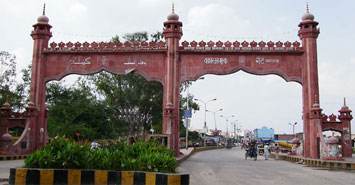
Waqar-ul-Mulk Gate Amroha

Waqar-ul-Mulk Gate Amroha

India has been a land of Rulers and Kings who traveled from far off lands and came here with the desire of wealth that India has beheld since ages.

The motive of these foreign invaders was greed but most of them stayed here mesmerized by this strange exotic land till their last breath. These invaders who ultimately settled here and contributed heavily to the culture, architecture and add to the general blend of Hindu and Muslim cultures.

And such amalgamation of cultures and religion lead to many stories and legends to be born. Adding to the mystic quality of this land, which through centuries had sustained its mythologies and beliefs. Even till today in spite of the modern technology and lifestyle, people still go back to their beliefs and faith.

One such instance is the small town of Amroha situated in Uttar Pradesh, 134 kilometers from Delhi. This town was established by King Amarjodha around 474 BC.

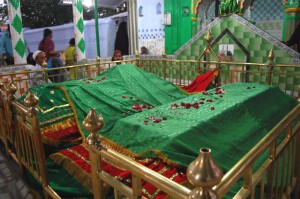
Mazar Hzt. Sharfuddin Shahwilayat

Mazar Hzt. Sharfuddin Shahwilayat

This town has great historical importance not only in respect to its age and ancient heritage, but also to this strange legend of the spiritual belongings. As legend goes, it was on 30 June 1272 AD when a saint came to this small town from a town Wasit in Iran via Multan. He was the Holy Saint–Syed Husain Sharafuddin Shahvilayat–. This town–Amroha–became his place of residence and prayer.

After his death his place of burial in Amroha came to become a famous place for pilgrimage and spiritual importance. It still draws huge believers and the non-believers equally. A strange phenomena occurs here. The grave site has a large numbers of scorpions, –a deadly venomous insect– they surprisingly don’t bite in the vicinity of the grave. This miracle has made many people to travel to this place even from far off lands for the authentication of the word of mouth. It is the inhabitants of this town– the Naqvi clan–who have their family tree traced – to Syed Shahvilayat proudly boast that one can carry the scorpion out of the shrine’s vicinity with the permission of the saint for a promised time, in which the scorpion will obey his master and not harm the carrier. If the time passes by, then there is no guarantee if the same scorpion stings.

Deadly Scorpion don’t bite in the vicinity of the grave

Deadly Scorpion don’t bite in the vicinity of the grave

It is also said that this shrine has medicinal cures for some ailments. Like in the case of corns which till date have no cure in modern medicine. It is said that if anyone suffering from corns brush their feet with broom that is used in the dargah the corns will be healed. Also adding to mystique of this place is in the autumn season that glucose pills fall from the tree which has sprouted from the grave of Bibi Bakhoi (daughter of the syed vilayat). And the same dissolves in the mouth instantly.

This area where the holy saint rests is also shared by his family members. His wife–Hazrat Kaneez Fatima urf Tahira–his son–Syed Amir Ali urf Doodha Dhari–his daughter–Bibi Bakhoi–his Grandson–Dade Raje– are some of the members of the family who rest here. Syed Amir Ali urf Doodha Dhari never ate food or drank water. He existed on milk alone. Therefore, another medicinal ability of the shrine shared by Syed Amir Ali urf Doodha Dhari is to provide milk to animals and women who are unable to lactate.

[ad#468]